
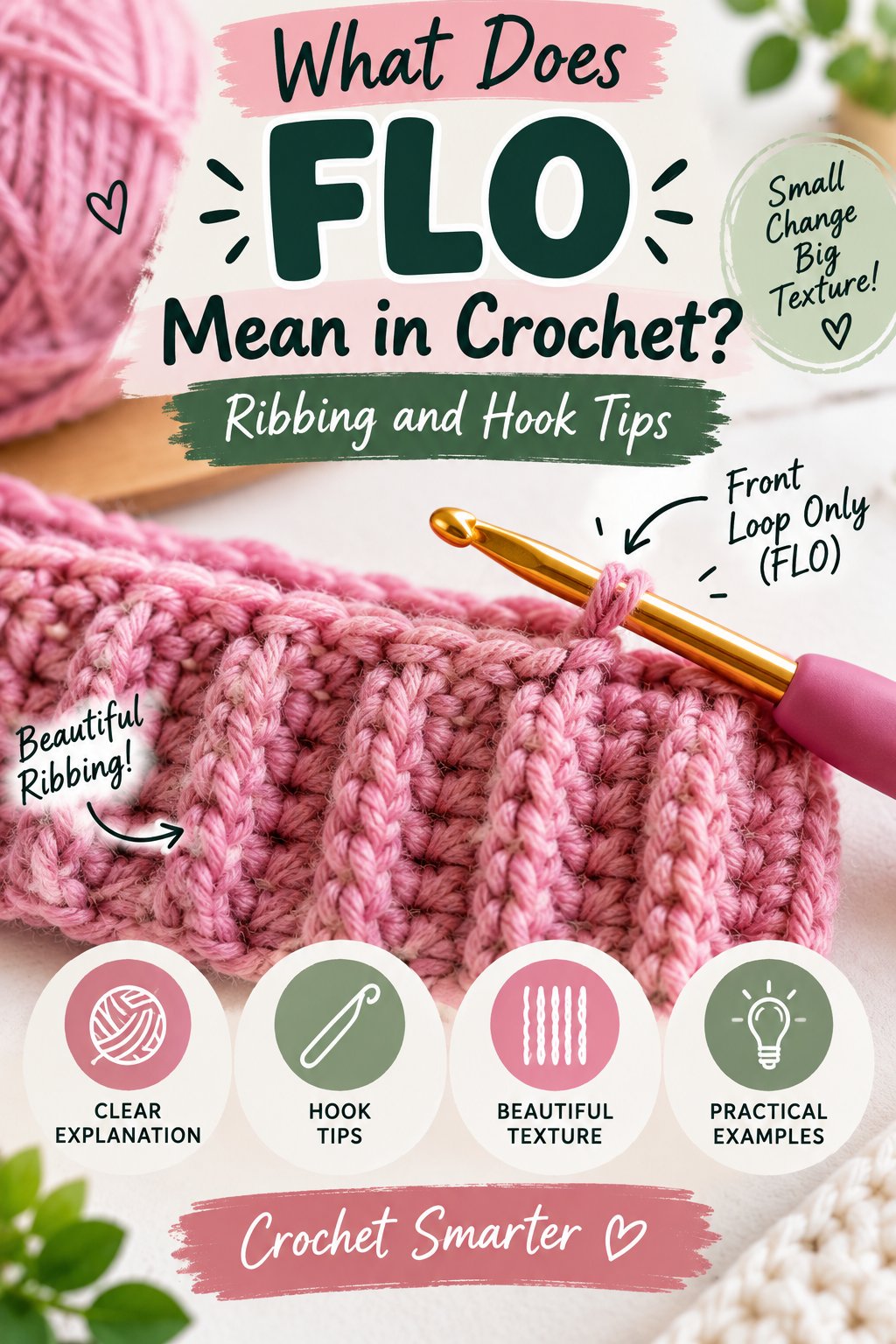
FLO in crochet means Front Loop Only, a stitch-placement instruction that tells you to insert the hook under the loop nearest you instead of under both strands of the stitch top. The unworked back loop forms a horizontal ridge, changing the fabric’s texture, flexibility, height, drape, and sometimes its stretch direction.
Key Facts
FLO means Front Loop Only, not a separate crochet stitch.
The front loop is the strand closest to the crocheter on the current working side.
You can work FLO with single crochet, half double crochet, double crochet, and other stitches.
FLO usually creates horizontal ridges and a more flexible fabric than working through both loops.
FLO adds no tool cost, but it can change row gauge and finished dimensions.
A gauge swatch is more reliable than a fixed percentage for predicting stretch or yarn use.
What Does FLO Mean in Crochet?
FLO is a loop placement modifier. A pattern such as “sc FLO” means to make a single crochet through the front loop only, while “hdc FLO” means to make a half double crochet through the front loop only. The stitch type remains the same; only the hook insertion point changes.
At the top of a completed crochet stitch, two strands usually form a V. The strand closer to your body is the front loop, and the strand farther away is the back loop. Working through both loops is the standard method unless the pattern gives a different instruction.
The abbreviation may appear in several forms:
| Pattern wording | Meaning | Hook placement | Common result |
|---|---|---|---|
| sc FLO | Single crochet, front loop only | Front loop of each target stitch | Firm ridges and moderate flexibility |
| hdc FLO | Half double crochet, front loop only | Front loop of each target stitch | Taller ridges and softer drape |
| dc FLO | Double crochet, front loop only | Front loop of each target stitch | Taller, more open ridges |
| BLO | Back loop only | Back loop of each target stitch | Ridge on the opposite fabric side |
| Both loops | Standard stitch placement | Front and back loops together | More stable, conventional fabric |
FLO is not the same as crocheting into the space between stitches. The hook goes under one strand of the stitch’s top V, not into the gap beside the stitch.
How Does Front-Loop-Only Crochet Work?
Front-loop-only crochet leaves one strand unused on every stitch, and those unused strands accumulate into visible ridges across the fabric. The working yarn still travels through the complete stitch, so FLO changes the attachment point rather than creating a partial stitch.
To identify the correct loop, hold the work so the active row faces you and inspect the top of the next stitch. The loop closest to you is the front loop for that insertion. The front loop is defined by position, not by a permanent side of the project.
How to Make a FLO Stitch
Use the following process for a single crochet. The same insertion principle applies to taller stitches.
- Insert the hook under the front strand of the next stitch.
- Keep the back loop behind the hook and visibly unworked.
- Yarn over and pull up a loop through the front loop.
- Yarn over again and pull through both loops on the hook.
- Check the completed stitch and confirm that the back loop remains as a ridge.
- Repeat across the row without inserting under the back loop.
- Count the finished stitches before turning.
A normal turning chain does not automatically count as a stitch. Follow the pattern’s stated stitch-count rule. If the first stitch is difficult to find, place a marker in the first and last real stitch before beginning the row.
The most common beginner error occurs on the return row. After turning, the fabric’s visible face changes, but the working side also changes relative to the new row. Do not assume that the loop on the same physical side is still the front loop. Find the strand closest to you at the current insertion point.
Does FLO Change After Turning?
Yes. The front loop is identified from the side where the hook is currently working. On a turned piece, the strand that was previously farther away can become the strand nearest you. This is why a pattern worked in rows can produce a ridge on alternating sides even when every row says FLO.
When a pattern requires ridges to appear consistently on one public side, it may specify front-loop-only rows, back-loop-only rows, or a particular row orientation. Follow those instructions rather than substituting FLO on every row.
How Do FLO Stitch Types Differ?
FLO single crochet produces the firmest common ribbed fabric, while FLO half double crochet and FLO double crochet create progressively taller and usually more open structures. Stitch height, yarn thickness, hook size, and tension determine the final fabric more than the abbreviation alone.
| FLO stitch | Typical fabric density | Typical row height | Best-known use | Main limitation |
|---|---|---|---|---|
| Single crochet | High | 0.35-0.55 inch per row in medium yarn | Cuffs, dense bands, structured panels | Can feel stiff |
| Half double crochet | Medium-high | 0.45-0.70 inch per row in medium yarn | Soft ribbing, hats, garments | Third-loop placement varies |
| Double crochet | Medium-low | 0.60-0.90 inch per row in medium yarn | Lightweight panels and drape | Can create larger gaps |
| Slip stitch | Very high | 0.15-0.30 inch per row in medium yarn | Narrow ribbing and edging | Slow and easy to tighten |
The measurements above are typical working ranges for medium-weight yarn and common hook sizes, not universal gauge standards. A crocheter using tight tension or bulky yarn can produce substantially different dimensions.
What Is the Third Loop in FLO Half Double Crochet?
A half double crochet has an additional strand often called the third loop. Its visible location depends on whether the stitch is viewed from the front or back and whether the row has been turned. The third loop is not automatically the same as the front loop.
For a standard hdc FLO instruction, insert under the front loop of the top V. If a pattern says “third loop” or “camel stitch,” locate that separate horizontal strand and use it instead. Treating those terms as interchangeable can move the ridge to the wrong side.
What Texture Does FLO Create?
FLO creates ridges from the unused loops, often making the fabric resemble knitted ribbing without reproducing knitted construction. The ridges usually run across the rows, while the fabric’s flexibility depends on the stitch height and the direction in which the piece is constructed.
A band crocheted in rows from side to side can stretch across its width because the rows form accordion-like ribs. A flat panel crocheted from bottom to top may show the same ridges but have less useful stretch across the body. Construction direction matters.
What Happens When FLO and BLO Alternate?
Alternating FLO and BLO means placing some stitches through the front loop and others through the back loop according to a specified sequence. The method creates alternating ridges, but the finished texture is not automatically a seed stitch.
| Loop sequence | Visual pattern | Relative stability | Suitable example |
|---|---|---|---|
| FLO across every row | Parallel horizontal ridges | Medium | Hat brim or cuff |
| BLO across every row | Parallel ridges on the opposite face | Medium | Ribbed garment panel |
| FLO, then BLO by row | Reversible ridge contrast | Medium-high | Textured scarf |
| FLO and BLO within each row | Alternating raised lines | Medium | Decorative panel |
| FLO, BLO, FLO, BLO in staggered rows | Small textured blocks | High | Dense blanket motif |
“Seed stitch” usually describes a named pattern with a defined alternation of stitch types or loop placements. Read the pattern’s terminology exactly. A designer may use “alternating loop stitch,” “ribbing,” or “texture stitch” instead.
FLO/BLO alternation can also affect the fabric’s face. If the unused loops are pushed toward the viewer on one row and away on the next, the result may look like small ridges rather than a smooth seed-like surface.
What Are the Advantages and Limitations of FLO?
FLO is useful when a project needs surface ridges, controlled flexibility, or a visual break from standard crochet fabric. FLO is less suitable when a project needs maximum dimensional stability, a completely smooth face, or an exact gauge that has only been tested with both-loop stitches.
Advantages of Front-Loop-Only Crochet
- Creates texture without a special hook or yarn.
- Produces a flexible band for hats, cuffs, and waist sections.
- Uses the remaining loop as a visual design line.
- Allows texture changes within an otherwise simple stitch pattern.
- Can reduce the dense feel of some single-crochet fabrics.
- Works with many stitch heights and yarn categories.
Limitations to Expect
FLO does not guarantee a fixed amount of stretch. A loose FLO single crochet may stretch more than a tight FLO double crochet, while a wool blend may recover better than cotton after use. The fabric can also curl if the pattern alternates heights or if tension changes between loop placements.
FLO is not the best default for structural bases, load-bearing handles, or pieces that must keep a precise rectangular shape. Working through both loops generally anchors each stitch more securely and creates a more stable edge.
An experienced crocheter checks recovery, not only extension. Pull a swatch to its intended width, release it, and measure it again after five minutes. A fabric that stretches 20 percent but returns only halfway may not perform well as a cuff.
FLO Versus BLO and Both Loops
FLO, BLO, and both-loop crochet differ mainly in hook placement and in which unused strand becomes visible. Claims that one method always provides vertical stretch or another always provides horizontal stretch are too broad because stitch direction, yarn fiber, hook size, and construction method also control the result.
| Method | Hook enters | Common visible feature | Typical fabric behavior | Edge stability |
|---|---|---|---|---|
| FLO | Loop nearest the crocheter | Ridge from unused back loops | Flexible, ridged, often less dense | Medium |
| BLO | Loop farthest from the crocheter | Ridge from unused front loops | Flexible, ridged, often similar to FLO | Medium |
| Both loops | Both top strands | Smooth V-shaped stitch tops | Stable and uniform | High |
| Third loop | Separate hdc strand | Knit-like horizontal bar | Directional texture | Medium |
| Alternating FLO/BLO | Specified loop sequence | Repeating ridges or blocks | Textured and moderately stable | Medium-high |
Neither FLO nor BLO has a universally superior stretch direction. For example, a brim made in short rows can stretch around a head, while a brim made in long rows may stretch along its length, regardless of whether the hook uses the front or back loop.
Is FLO the Same as BLO?
No. FLO uses the loop nearest the crocheter, and BLO uses the loop farthest from the crocheter. The two methods can look similar from the opposite side, which causes confusion when a pattern is photographed from the reverse.
Turn a swatch over before comparing methods. The ridge created by an unworked loop is often more prominent on the side opposite the hook insertion. Pattern designers may call the visible face the “right side,” so the written instructions take priority over a photograph.
How Much Does FLO Cost and How Long Does It Take?
FLO has no added tool cost because the technique uses the same hook, yarn, and notions as the base stitch. A beginner commonly needs 5-10 minutes to understand the movement, while consistent tension across a full row may require 20-40 minutes of practice.
| Item | Typical amount | What changes the amount | Practical guidance |
|---|---|---|---|
| Additional equipment | $0 | No special equipment is required | Use the project’s existing hook |
| First practice swatch | 10-20 minutes | Stitch height and yarn thickness | Make at least 20 stitches |
| Hook adjustment | 0-0.5 mm smaller | Loose loops or visible gaps | Test before changing the pattern |
| Yarn change | 0-15% typical variation | Gauge, tension, stitch height | Compare equal-size swatches |
| Stitch-count check | 30-60 seconds per row | Edge visibility and texture | Count before turning |
The 10-15 percent speed advantage sometimes claimed for FLO is not a dependable general rule. Some crocheters insert the hook faster through one loop, but others slow down to avoid splitting yarn or stretching the unworked strand. Record your own time on a 20-stitch sample if production speed matters.
Likewise, FLO does not reliably use 10 percent less yarn. Leaving a loop unworked can alter the path and height of the stitch, but yarn consumption changes with tension, stitch type, row count, and finished dimensions. Measure two swatches of equal size for a useful comparison.
Where Should You Use FLO?
FLO works well in components that benefit from ridges or controlled flexibility, including hat brims, sweater cuffs, waistbands, textured panels, and some decorative edges. FLO is a poor choice when the fabric must remain smooth, highly rigid, or evenly dense on both faces.
| Project component | Recommended method | Why it works | Test before making |
|---|---|---|---|
| Hat brim | FLO single crochet in rows | Creates flexible horizontal ribs | Head circumference and recovery |
| Sweater cuff | FLO or BLO ribbing | Adds stretch at the wrist | Sleeve-to-cuff transition |
| Waistband | Sideways FLO rows | Places stretch around the body | Row count and seam strength |
| Blanket panel | FLO hdc or dc | Adds texture with moderate drape | Curling and wash response |
| Amigurumi base | Usually both loops | Keeps stuffing contained | Shape stability |
| Plush detail | FLO for a local ridge | Changes direction or surface relief | Loop orientation after turns |
For amigurumi, FLO can help create a line, flap, sole, or directional change, but it is usually not ideal for the entire stuffed object. The unworked loops can open small gaps when the form is stuffed firmly. Use a smaller hook only after checking that the resulting fabric is not too rigid.
For cuffs and waistbands, crochet the ribbed strip in the direction that matches the desired stretch. Join the ends securely, then work the garment body into the long edge. This construction usually provides more useful circumference stretch than crocheting the cuff as a flat circle.
How Can You Fix Common FLO Problems?
Most FLO problems come from loop identification, tension, or edge counting rather than from the technique itself. The fastest repair is usually to unravel to the first incorrect loop and rebuild the row, because correcting a misplaced insertion later can distort several ridges.
| Problem | Likely cause | Visible symptom | Fix |
|---|---|---|---|
| Large holes | Loose tension or missed back-loop control | Open spaces between ridges | Reduce hook size by 0.5 mm and reswatch |
| Slanted edge | First or last stitch omitted | Row count decreases | Mark both edge stitches |
| Ridge on wrong side | FLO confused with BLO after turning | Texture faces backward | Identify the nearest loop each row |
| Tight, hard fabric | Hook too small or tension too firm | Swatch will not expand | Increase hook by 0.5 mm |
| Uneven ridges | Mixed loop insertion | Lines vary in thickness | Pause after five stitches and inspect |
| Wavy edge | Turning chain or height mismatch | Border does not lie flat | Follow the pattern’s turning-chain rule |
How Do You Keep FLO Edges Straight?
Mark the first and last stitch of each row, especially when the turning chain does not count as a stitch. Count the row immediately after completing it, because a missing edge stitch becomes harder to locate once several ridges have been added.
Keep the working loop at a consistent height. Pulling the loop taller because the hook enters easily can create a ladder-like gap, while tightening it to control the unused strand can make the edge narrower than the center.
Expert insight: the unworked loop is part of the visual structure, but it is not a substitute for a turning chain. Many uneven FLO swatches contain the correct stitch count and still slope because the turning height does not match the stitch height.
What Should You Do If the Fabric Looks Gappy?
First, check whether the hook is passing under only the front loop. A hook that accidentally catches the back loop on occasional stitches creates irregular density, while a consistently loose tension creates evenly spaced gaps.
Make a 20-stitch by 10-row swatch using the recommended hook. If the gaps remain, try a hook 0.5 mm smaller and compare the fabric after gently stretching it. Do not change hook size solely to match a published gauge number if the fabric loses the flexibility the project requires.
How Should You Read FLO in a Crochet Pattern?
A FLO instruction modifies the stitch immediately after it unless the pattern defines a wider repeat. “Sc in FLO across” means work single crochet through the front loop of every applicable stitch, whereas “sc 2, FLO sc 2” generally means the modifier applies to the following two single crochet stitches.
Look for these pattern details:
- Whether the turning chain counts as a stitch.
- Whether the first stitch is worked into the front loop.
- Whether the designer wants the front loop from the current working side.
- Whether “FLO” applies to one stitch, a repeat, or the entire row.
- Whether the pattern uses “front loop” to mean the visible front-facing strand.
- Whether a chart uses a special symbol for loop-only insertion.
Pattern abbreviations are not perfectly universal. Designers can define FLO differently in a glossary, especially in tapestry crochet, Tunisian crochet, or unusual construction methods. The project’s abbreviation key overrides a general convention.
Frequently Asked Questions About What Does FLO Mean in Crochet
Is FLO crochet reversible?
FLO crochet can be reversible in the sense that both sides remain usable, but the two faces usually look different. One side often shows the ridge more clearly, while the opposite side displays the remaining loop as a subtler horizontal line. A reversible project should be swatched from both sides before construction.
Does FLO make crochet stretchy?
FLO can make crochet more flexible because each stitch is attached through one top strand instead of both. The amount and direction of stretch depend on stitch height, row orientation, yarn fiber, hook size, and tension. Wool and acrylic blends commonly recover better than cotton, which may stay elongated after repeated stretching.
Should I use a smaller hook for front-loop-only stitches?
Use a hook 0.5 mm smaller only when a swatch shows loose loops, holes, or weak recovery. A smaller hook tightens the remaining unworked strand, but it can also make the fabric stiff and reduce the stretch that FLO was intended to provide. Swatch the original and smaller sizes before deciding.
Does FLO use less yarn than regular crochet?
FLO does not have a guaranteed yarn saving. A typical project may show a small difference in consumption because the stitch path and fabric dimensions change, but tension and gauge usually have a larger effect. Weigh equal-size swatches with a digital scale for a meaningful comparison rather than relying on a fixed 10 percent estimate.
Can I use FLO in a crochet circle?
Yes, but FLO in a circle creates a ridge around each round and can emphasize the spiral join. Work the front loop of each target stitch, maintain the prescribed increases, and mark the round beginning. FLO is useful for textured soles, baskets, and decorative discs, but both loops usually create a more stable structural base.
Why does my FLO row look like BLO?
FLO and BLO can look nearly identical when viewed from opposite sides. Turn the work and inspect the insertion side: FLO uses the loop closest to the hook and crocheter at that moment, while BLO uses the farther loop. Photographing the swatch with both sides labeled prevents errors when following a video.
Conclusion
FLO in crochet means Front Loop Only, a way to work a standard stitch through only the loop nearest the crocheter. The technique creates ridges, changes flexibility and gauge, and works especially well for cuffs, brims, waistbands, and controlled surface texture.
Use the current working side to identify the front loop, count the edge stitches, and test the fabric before committing to a full project. FLO costs $0 in extra tools, but its stretch, yarn use, and appearance depend on stitch type, yarn, hook size, tension, and construction direction.