
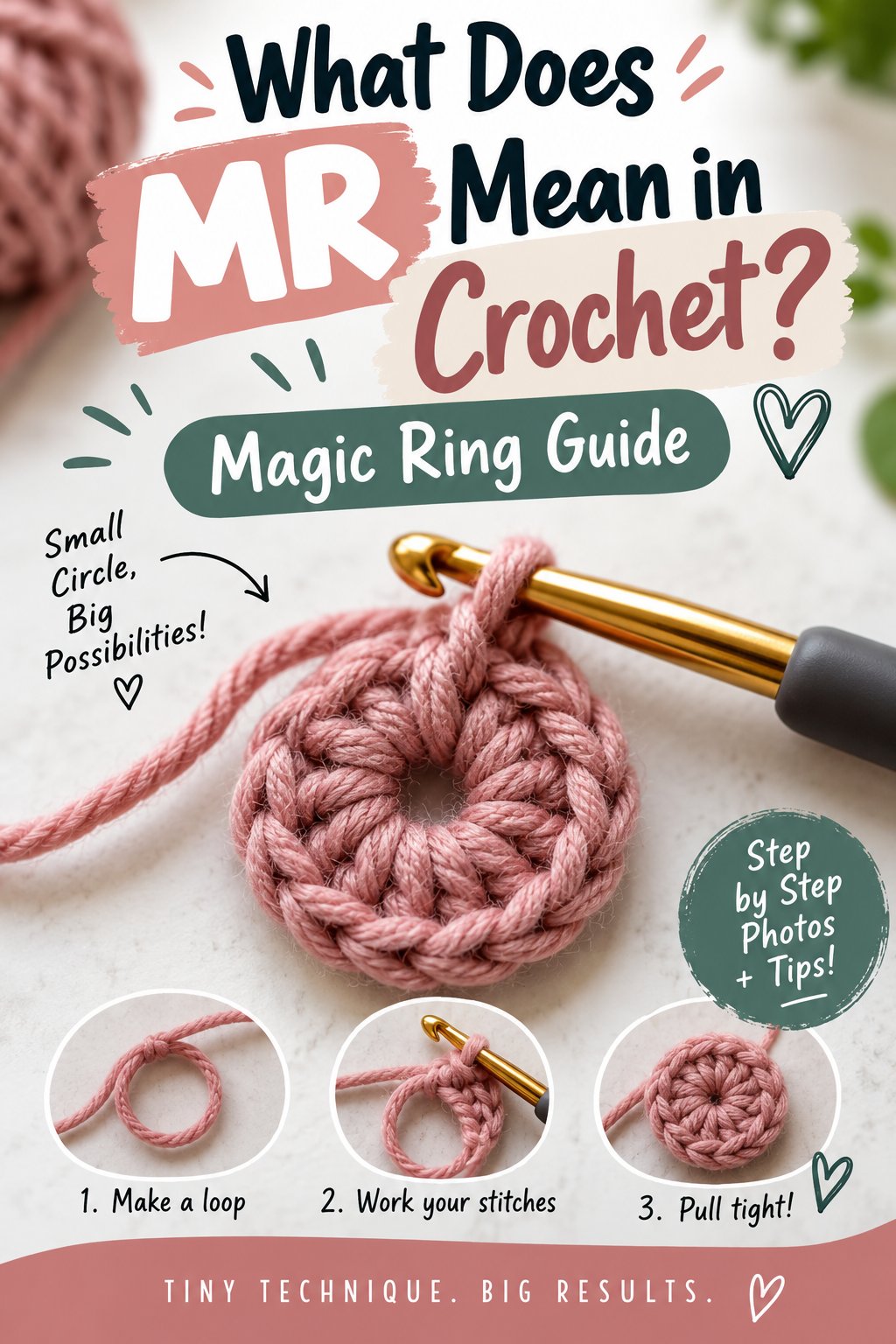
What does MR mean in crochet? MR means Magic Ring, also called a Magic Circle or Adjustable Ring. It is a temporary yarn loop used to begin crochet worked in the round, allowing the first stitches to slide together so the center can close instead of leaving the fixed hole created by a chain.
Key Facts
MR means Magic Ring, Magic Circle, or Adjustable Ring.
The technique begins circular crochet with a movable loop rather than a fixed chain.
Pulling the working tail closes the center, often to nearly zero millimeters.
A typical first round uses 6 single crochets, 8 half-double crochets, or 12 double crochets, depending on the pattern.
The starting tail usually needs 10-15 cm, or 4-6 inches, for secure finishing.
The technique costs $0 when you already have a crochet hook, yarn, and tapestry needle.
What Does MR Mean in Crochet?
In crochet patterns, MR is an instruction to make a Magic Ring before working the first round. The ring is especially common in amigurumi, crochet balls, flowers, hats, mandalas, and other designs that expand outward from a central point.
The starting loop is adjustable because the stitches are worked around a strand that can slide. A chain-based start has a predetermined opening, while an MR can usually be tightened after the first round is complete. That difference controls both appearance and function.
| Term in a pattern | Full name | Main property | Common projects |
|---|---|---|---|
| MR | Magic Ring | Adjustable center | Amigurumi, hats, motifs |
| MC | Magic Circle | Adjustable center | Amigurumi, flowers |
| AR | Adjustable Ring | Adjustable center | Written tutorials, lace |
| Ch-2 start | Chain-two method | Fixed small opening | Thick or fuzzy yarn |
| Ch-4, sl st | Chain-four ring | Fixed larger opening | Doilies, lace motifs |
A Magic Ring is not a stitch count. It is a starting construction. The pattern still tells you how many stitches to place into it and whether those stitches are single crochet, half-double crochet, double crochet, or another stitch.
How Does a Magic Ring Work?
A Magic Ring works because the first-round stitches encase a movable loop and the yarn tail controls its circumference. After the stitches are made, pulling the correct tail slides the base loop beneath the stitches and closes the center.
The ring has three functional parts: the working yarn connected to the ball, the short starting tail, and the loop that receives the first-round stitches. Confusing the working strand with the tail is the most common reason a new ring will not tighten.
The usual sequence is:
- Form one loop around two fingers, leaving a 10-15 cm tail.
- Hold the crossing point so the loop cannot collapse.
- Insert the hook through the ring and pull up the working yarn.
- Make a securing chain, usually chain 1 for single crochet or chain 2 for taller stitches.
- Work the instructed first-round stitches over the ring and the tail.
- Pull the starting tail gradually until the center closes.
- Join the round if the pattern requires a slip stitch, or continue in a spiral.
The securing chain normally does not count as a stitch unless the pattern explicitly says so. In amigurumi, rounds are commonly worked continuously, so a stitch marker identifies the beginning instead of a joining slip stitch.
Which Strand Should You Pull?
Pull the short starting tail, not the strand leading to the yarn ball. The tail is the strand that travels around the fingers and forms the adjustable loop; the working yarn must remain connected to the ball so the stitches retain their tension.
If the tail moves but the hole does not shrink, gently slide the first stitches toward the tail while pulling. If the yarn ball strand moves instead, the ring was oriented incorrectly or the tail was not held against the loop during stitching.
An expert diagnostic rule is simple: before tightening, tug each loose strand separately. The strand that makes the loop contract is the closing tail. Finding it early prevents forceful pulling that can split cotton or break a weak novelty yarn.
What Are the Main Types of Magic Ring?
The two practical forms are a single-wrap Magic Ring and a double-wrap Magic Ring. Both create an adjustable center, but the double version places two strands under the stitches and usually resists loosening more effectively.
| Ring type | Finger wraps | Typical setup time | Security level | Best yarn situation |
|---|---|---|---|---|
| Single Magic Ring | 1 wrap | 5-10 seconds after practice | Medium | Smooth cotton or acrylic |
| Double Magic Ring | 2 wraps | 8-15 seconds after practice | High | Slippery, smooth, washable yarn |
| Chain-two start | 0 wraps | 3-5 seconds | High | Chenille, faux fur, bouclé |
| Chain-four ring | 0 wraps | 5-8 seconds | High | Lace, doilies, open motifs |
A double ring is useful when the project will be handled, stuffed, or washed repeatedly. It is not automatically better: two strands create more friction, can be harder to tighten, and may produce a bulky center with fine thread.
Use a single ring when the yarn grips itself and the center will be covered by later rounds. Use a double ring when reopening would damage the object or when the fiber slides easily under tension.
How Many Stitches Go Into an MR?
The first-round stitch count depends on stitch height, yarn thickness, gauge, and the shape the designer wants. Typical starting counts are 6 single crochets, 8 half-double crochets, and 12 double crochets, but a pattern’s stated count always takes priority.
| First-round stitch | Typical starting count | Approximate circle expansion | Common application |
|---|---|---|---|
| Single crochet | 5-8 stitches | Compact, dense | Amigurumi, small balls |
| Half-double crochet | 7-10 stitches | Medium height | Coasters, textured motifs |
| Double crochet | 10-14 stitches | Wider, more open | Hats, mandalas, blankets |
| Treble crochet | 12-16 stitches | Very open | Lace, decorative motifs |
These figures are practitioner ranges, not universal laws. A designer may use 5 single crochets for a tight spiral, 7 for a particular yarn, or a larger count to prevent cupping.
A flat circle grows correctly only when later rounds add stitches at an appropriate rate. With single crochet, many patterns increase by about six stitches per round; with double crochet, twelve increases per round is a common baseline. Fiber, hook size, and tension can shift that requirement.
Why Does the Center Sometimes Cup or Ripple?
A center cups when too few increases are made for the stitch height, yarn, or tension. A circle ripples when too many increases are packed into the round or when the hook is too large for the chosen stitch pattern.
The starting ring itself is rarely the entire cause. Check the finished first round on a flat surface, then inspect the next round’s increase spacing. A tight center with a cupped edge usually needs more circumference in later rounds, not a looser tail.
How Do You Make a Magic Ring?
A right-handed crocheter can make a basic single-wrap ring in under one minute after learning the hand position. Left-handed crocheters use the same sequence with the loop mirrored, so the important relationships are the tail, working yarn, hook, and first-round stitches rather than a particular finger direction.
- Leave a 4-6 inch tail and place it across your palm.
- Wrap the working yarn around your index and middle fingers once.
- Cross the working yarn over the tail to create an X.
- Hold the crossing point with your thumb and middle finger.
- Insert the hook under the first strand and catch the working yarn.
- Pull up a loop without releasing the crossing point.
- Chain once to stabilize a single-crochet start.
- Insert the hook through the center of the ring.
- Yarn over, pull up a loop, yarn over, and pull through both loops.
- Repeat the required number of stitches over both ring strands and the tail.
- Pull the tail slowly until the opening closes.
- Continue in rounds, then secure the tail after finishing.
The first stitch can feel loose because the ring has not yet been anchored by several stitches. Keep the crossing point pinched until at least two stitches are complete.
What Tools, Cost, and Practice Time Are Typical?
A Magic Ring requires no special equipment beyond the hook and yarn used for the project. The direct additional cost is therefore $0, although a tapestry needle helps secure the tail and a stitch marker helps track spiral rounds.
| Item | Typical price in USD | Required? | Useful specification |
|---|---|---|---|
| Crochet hook | $3-$12 | Yes | Size matched to yarn label or pattern |
| Yarn | $3-$15 per skein | Yes | Smooth yarn is easiest for practice |
| Tapestry needle | $1-$5 | No for forming | Blunt tip, eye wide enough for yarn |
| Stitch marker | $0.10-$2 each | No for forming | Locking marker for spiral rounds |
| Practice sample | $0.25-$2 of yarn | Recommended | Light-colored worsted yarn |
Most beginners need 10-30 minutes of focused practice to coordinate the loop, tail, and hook. Once the movement is familiar, forming the loop and anchoring it commonly takes 5-15 seconds, excluding the first-round stitches.
Light-colored worsted-weight acrylic or cotton is easier to inspect than black, fuzzy, or chenille yarn. A hook around 4.0-5.0 mm is a practical practice range, but the yarn label and pattern gauge should determine the final hook.
Which Starting Method Should You Use?
The best starting method depends on the center opening, fiber behavior, and durability requirement. A Magic Ring gives the smallest adjustable opening, but a chain-based start is often more reliable with yarn that grips, sheds, or hides individual strands.
| Starting method | Center after tightening | Learning difficulty | Typical time | Best use |
|---|---|---|---|---|
| Single Magic Ring | 0-2 mm | Moderate | 10-30 minutes to learn | Smooth amigurumi yarn |
| Double Magic Ring | 0-2 mm | Moderate-high | 15-35 minutes to learn | Washable toys and garments |
| Chain 2, stitches in first chain | 2-5 mm | Easy | 2-5 minutes to learn | Chenille and blanket yarn |
| Chain 4, slip stitch | 4-8 mm | Very easy | 2-5 minutes to learn | Lace and open motifs |
Choose a fixed chain instead of an adjustable ring when:
- Faux fur or chenille makes the tail difficult to identify.
- A small permanent opening is part of the design.
- The yarn breaks when pulled through several dense stitches.
- The pattern explicitly requires a chain ring.
- The center will be hidden by a later applique or joining seam.
A closed center is not always the goal. Doilies, lace flowers, and some granny-square motifs need a visible opening for proportion and drape.
Which Yarn Works Best With an Adjustable Ring?
Smooth, moderately twisted yarn is the easiest material for a Magic Ring because its strands slide without excessive snagging. Cotton provides clear stitch definition, while acrylic often offers lower friction and easier tightening during practice.
| Yarn type | Ring behavior | Recommended method | Main adjustment |
|---|---|---|---|
| Mercerized cotton | Smooth, can slip | Double ring for security | Weave tail in twice |
| Wool or wool blend | Grippy, easy to hold | Single ring | Tighten gradually |
| Acrylic | Predictable, moderate friction | Single or double ring | Avoid excessive tension |
| Chenille or blanket yarn | Fibers hide the loop | Chain 2 | Keep center slightly open |
| Faux fur or bouclé | Tail catches and obscures stitches | Chain 2 or chain 4 | Use stitch markers |
| Fine crochet thread | Small, high-friction center | Single ring | Use a long tail and small hook |
The most counterintuitive yarn rule is that a softer yarn does not always make a softer ring. Chenille can resist sliding because its pile catches neighboring fibers, while mercerized cotton can loosen because its smooth surface provides little friction.
Why Will a Magic Ring Not Close?
A Magic Ring usually fails to close because the stitches are not worked over the adjustable strand, the wrong tail is being pulled, or the yarn has snagged between split plies. The repair depends on whether the tail moves freely, moves only a few millimeters, or does not move at all.
| Symptom | Likely cause | Immediate test | Repair |
|---|---|---|---|
| Tail moves, hole stays open | Stitches are not over the ring | Inspect first-round bases | Slide stitches toward tail |
| Tail will not move | Hook pierced a strand | Loosen nearby stitch | Gently reverse the stitch |
| Ring tightens, then reopens | Tail was cut without locking | Pull center after testing | Reweave tail in reverse |
| Yarn snaps | Excessive force or weak fiber | Check fuzzy or single-ply yarn | Use double ring or chain 2 |
| Center twists | Tail and working yarn crossed | Flatten first round | Rebuild with marked strands |
| First round has loose loops | Pinch released too early | Check first two stitches | Restart while holding crossing |
The most common beginner mistake is stitching into only one strand of the ring. Each first-round stitch should normally pass around the ring and the starting tail, which anchors the tail beneath the stitch bases.
Do not yank a jammed ring. A short back-and-forth motion often releases fibers more safely than a single hard pull. If the yarn has split, undo the last one or two stitches and rebuild the damaged section before tightening.
How Do You Secure the Center So It Stays Closed?
Tightening the loop is only half of finishing a Magic Ring. The tail must be woven through the back of the first-round stitches and redirected so friction, stuffing, handling, and laundering cannot pull the center open.
Use this finishing sequence:
- Leave at least 10 cm, or 4 inches, of tail after tightening.
- Thread the tail onto a blunt tapestry needle.
- Weave through the back loops or stitch bases for 2-3 cm.
- Reverse direction through neighboring stitch bases.
- Repeat the direction change at least twice.
- Trim close to the fabric without cutting the stitches.
For stuffed amigurumi, a duplicate-stitch path around several stitch bases provides stronger resistance than a straight pass through the center. The tail should travel through fabric, not merely sit behind one stitch.
A practitioner rule of thumb is to test the closure before trimming: pull the center in the direction stuffing will press, then release it. If the opening returns visibly, add another reverse pass or use a longer woven path.
Can You Use MR for Hats, Coasters, and Flat Circles?
A Magic Ring works for hats, coasters, blankets, and flat motifs when the pattern begins from the center and the selected stitch count supports the intended circumference. The ring controls the starting opening, while increases control whether the fabric remains flat.
| Project | Common first-round stitch | Typical starting count | Main concern |
|---|---|---|---|
| Small amigurumi ball | Single crochet | 6 | Dense, secure center |
| Adult crochet hat | Double crochet | 10-12 | Avoid a tight crown |
| Cotton coaster | Single or half-double crochet | 8-10 | Prevent cupping |
| Mandala motif | Double crochet | 12-16 | Maintain increase rhythm |
| Flat blanket motif | Double crochet clusters | Pattern-specific | Preserve geometric spacing |
MR is less suitable when the pattern begins with a long foundation chain, requires a rectangular base, or intentionally uses an open center. It also adds little value when a later seam completely covers the starting hole.
Pattern notation varies. “MR 6 sc” generally means make a Magic Ring and work six single crochets into it. “6 sc in MR” conveys the same construction, while “sc 6 into adjustable ring” uses a longer form for beginners.
Frequently Asked Questions About What Does MR Mean in Crochet
Is MR the Same as a Slip Knot?
No. A slip knot is a starting knot placed on the hook, while MR is an adjustable ring that receives the first round of stitches. A slip knot may be used while forming some versions of a ring, but the two terms describe different constructions and should not be substituted automatically in a pattern.
Why Does My Magic Ring Open After I Finish?
A Magic Ring can reopen when the tail is only pulled tight and then cut, when stitches were worked around one strand, or when smooth yarn slips under handling. Secure the tail with a tapestry needle, weave through several stitch bases, reverse direction twice, and test the closure before trimming.
Can a Magic Ring Be Used With Chunky Yarn?
Yes, but chunky, chenille, and blanket yarn can make the adjustable loop difficult to identify and tighten. Try a double ring for smooth chunky yarn. Use chain 2 when pile or friction prevents the tail from sliding without damaging the fibers.
Should the Chain at the Start Count as a Stitch?
Usually, the securing chain does not count as a stitch in amigurumi and continuous single-crochet rounds. Taller-stitch patterns may count a chain 2 or chain 3 as the first stitch. Follow the pattern’s abbreviation key because counting conventions change the total and joining position.
How Large Should the Center Opening Be?
A properly tightened ring can have an opening from nearly zero to about 2 mm, depending on yarn, stitch tension, and tail construction. A larger opening is acceptable when the design needs ventilation or when thick fibers cannot close cleanly, but it should match the pattern’s intended appearance.
Is a Double Magic Ring Always Stronger?
A double ring usually has greater resistance to reopening because two strands support the first round, but it is not always the best option. Fine thread, brittle yarn, and open lace can become distorted by extra friction. Secure weaving and appropriate tension matter as much as the number of wraps.
Conclusion
What does MR mean in crochet? MR means Magic Ring, the adjustable starting loop used to build crochet in the round with a nearly closed center. Choose a single ring for smooth everyday yarn, a double ring for extra security, or a chain-based alternative when fuzzy fibers, fragile yarn, or the design itself makes adjustability unsuitable.