

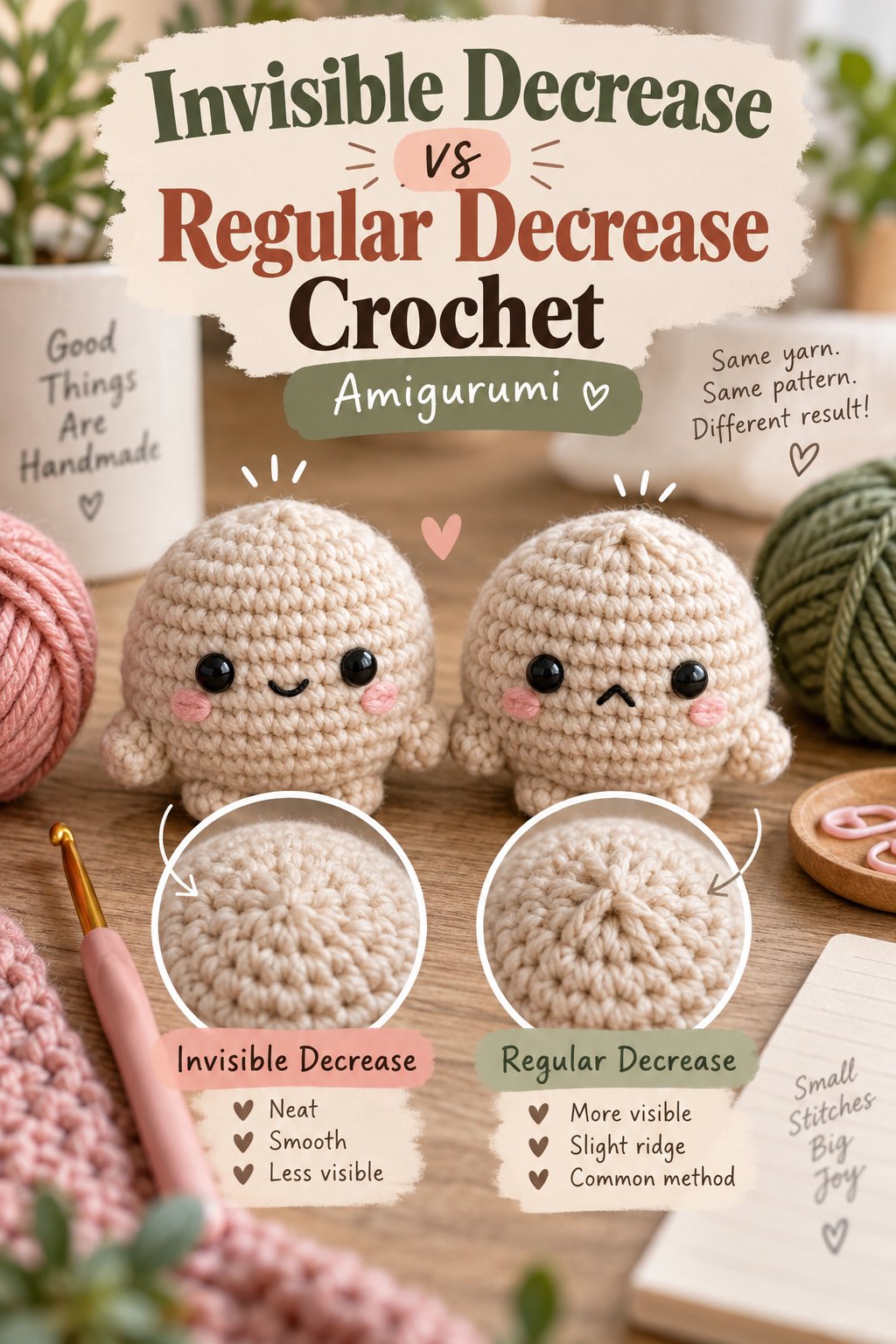
Invisible Decrease vs Regular Decrease Crochet compares two single-crochet reduction methods: regular sc2tog works through both loops of two stitches, while invisible decrease uses their front loops only. Regular decreases are versatile and reversible; invisible decreases create a flatter, tighter right side that usually suits amigurumi and other dense, right-side-out crochet.
Key Facts / Quick Answer
A regular decrease, usually written sc2tog, combines two stitches through both loops and creates a visible diagonal or raised point.
An invisible decrease, usually written inv dec, combines two front loops and leaves the back loops behind as a small internal ridge.
Use inv dec for smooth, closed amigurumi when the front side is always visible.
Use sc2tog for garments, blankets, turning rows, reversible fabric, and projects where both sides need similar structure.
A typical invisible decrease takes 10-20% longer while learning, but the difference becomes small with practice.
Yarn texture, stuffing pressure, hook size, and tension can matter more than the decrease label.
What Are the Two Crochet Decreases?
A regular decrease and an invisible decrease both reduce the stitch count by one. The difference is which loops carry the load: sc2tog uses both loops from two neighboring stitches, while inv dec uses only the front loops and leaves the back loops to form a smoother barrier on the visible side.
A standard single-crochet decrease changes two stitches into one. For example, a round containing 24 stitches with four decreases finishes with 20 stitches. The mathematics is identical for both methods, but the stitch anatomy and surface result are different.
The term “invisible” describes the right-side appearance, not literal invisibility. Close inspection can reveal a small diagonal line, altered stitch angle, or tension change, especially in pale yarn under strong light.
Regular Decrease: sc2tog
A regular decrease engages the complete structure of both stitches. The hook passes through the front and back loops of the first stitch, then through both loops of the next stitch, and the final yarn-over closes four stitch loops into one top.
The method is dependable because it resembles an ordinary single crochet with a second insertion. It also works from either side of a fabric, which matters in turning rows and reversible designs.
Invisible Decrease: inv dec
An invisible decrease uses the front loop only from the first stitch and the front loop only from the second stitch. The hook draws yarn through those two front loops, then through the remaining loops, producing one stitch with less bulk on the right side.
The unused back loops are not wasted. They remain inside the fabric and help cover the opening between the two stitch bases. That benefit is most visible when the crochet is worked in continuous rounds and viewed from the outside.
How Do sc2tog and inv dec Work?
The mechanical distinction is simple: sc2tog pulls through both loops of two stitches, whereas inv dec joins two front loops. The first method emphasizes structural consistency on both sides; the second shifts visual smoothness toward the right side.
Regular sc2tog Steps
- Insert the hook under both loops of the first stitch.
- Yarn over and pull up a loop. Three loops now occupy the hook after the next insertion.
- Insert the hook under both loops of the second stitch.
- Yarn over and pull up a loop.
- Yarn over and pull through all three loops.
The finished top counts as one single crochet. Do not add a separate chain unless the pattern specifically instructs one.
Invisible inv dec Steps
- Insert the hook from front to back under the front loop of the first stitch.
- Without yarning over, insert the hook under the front loop of the next stitch.
- Yarn over and pull through both front loops.
- Yarn over and pull through the two loops remaining on the hook.
The hook angle often determines success. A shallow upward sweep catches the front loops cleanly; forcing the hook downward can split yarn, grab a back loop, or twist the decrease.
| Feature | Regular sc2tog | Invisible inv dec | Practical result |
|---|---|---|---|
| Loops used | Both loops of 2 stitches | Front loop of 2 stitches | Different surface tension |
| Stitch count change | 2 to 1 | 2 to 1 | Same shaping rate |
| Right-side bulk | Moderate | Low | Smoother inv dec surface |
| Wrong-side structure | Balanced | Back-loop ridge | Better for one-sided fabric |
| Typical placement | Rows and rounds | Right-side rounds | Project choice changes |
What Does the Finished Fabric Look Like?
The regular method usually produces a small raised bar, diagonal indentation, or thicker junction. The invisible method tends to produce a flatter V-shaped area because the unworked back loops bridge the bases of the two reduced stitches.
Neither method automatically prevents every gap. A loose gauge, an oversized hook, sparse stuffing, or an uneven final yarn pull can open the fabric even when the maker uses inv dec.
Right-Side and Wrong-Side Differences
On the right side of amigurumi, inv dec generally hides the reduction better. On the reverse side, the two unworked back loops can form a horizontal ridge, so the technique is not visually neutral when both sides are displayed.
Regular decreases have more similar front and back behavior because each stitch contributes both loops to the reduction. That balance makes sc2tog more suitable for a scarf, blanket, or garment panel that can fold, turn, or expose either surface.
Stitch Count and Shape
Four decreases remove four stitches regardless of method. If a round begins with 30 stitches and contains five decreases, the next round contains 25 stitches.
The silhouette can still differ slightly. Invisible decreases often tighten the outer surface less abruptly, while regular decreases can create a more pronounced line that makes shaping easier to see and count.
| Starting stitches | Decreases in round | Ending stitches | Common use |
|---|---|---|---|
| 24 | 4 | 20 | Small amigurumi head |
| 30 | 5 | 25 | Medium toy body |
| 36 | 6 | 30 | Hat crown shaping |
| 48 | 8 | 40 | Large stuffed form |
When Should You Use Each Method?
Use an invisible decrease when the project is a dense, right-side-out tube or sphere and surface smoothness matters. Use a regular decrease when the fabric is reversible, worked in turning rows, or designed to distribute tension evenly through both loops.
Best Uses for Invisible Decreases
- Amigurumi heads, limbs, tails, and small animals
- Crochet balls, dolls, fruit, and ornaments
- Dense baskets or containers viewed from the outside
- Hat crowns worked continuously in the round
- Any stuffed shape where small openings could expose filling
Inv dec is not a requirement for every toy. A regular decrease can work well in dark yarn, textured yarn, or a design with embroidered details that conceal the shaping.
Best Uses for Regular Decreases
- Sweaters, cardigans, and fitted garment panels
- Shawls, blankets, scarves, and flat motifs
- Turning rows where the work flips after each row
- Reversible baskets or fabric with a deliberately visible ridge
- Patterns that specify a standard sc2tog for consistent grading
A regular decrease also provides a firmer, more familiar structure at a shaping edge. That can help a neckline, armhole, or flat seam retain its intended line.
| Project situation | Preferred method | Reason | Typical exception |
|---|---|---|---|
| Cotton amigurumi, right side visible | inv dec | Low surface bulk | Decorative ridge desired |
| Acrylic blanket, turning rows | sc2tog | Similar behavior on both sides | One-sided appliqué |
| Chenille stuffed toy | Either method | Fuzz hides small junctions | Loose stuffing needs closure |
| Continuous-round beanie | inv dec | Cleaner crown spirals | Pattern requires sc2tog |
| Sweater armhole | sc2tog | Stable edge structure | Designer specifies front-loop shaping |
How Do Yarn and Tension Change the Result?
Yarn fiber and tension determine whether the visual advantage of an invisible decrease is worth the extra manipulation. Smooth cotton exposes every loop, while chenille, blanket yarn, and faux fur conceal small irregularities but can make front-loop insertion harder.
A typical beginner working in worsted cotton may spend 2-4 seconds on a regular decrease and 3-5 seconds on an invisible decrease. Across 40 reductions, that difference is usually 1-2 minutes after the technique is familiar, not a major project delay.
Yarn Behavior by Fiber
Smooth mercerized cotton gives the clearest comparison because its tight plies preserve stitch definition. Acrylic is more forgiving, while plush yarn obscures the junction and can collapse the practical difference between methods.
| Yarn type | Stitch visibility | Front-loop difficulty | Typical best choice | Typical hook range |
|---|---|---|---|---|
| Mercerized cotton | High | Low to moderate | inv dec for toys | 2.25-3.25 mm |
| Worsted acrylic | Moderate | Low | Either method | 4.0-5.0 mm |
| Cotton tube yarn | High | Moderate | inv dec with relaxed tension | 3.0-4.0 mm |
| Chenille blanket yarn | Low | High | sc2tog or loose inv dec | 5.0-8.0 mm |
| Faux fur yarn | Very low | High | sc2tog for speed | 5.5-9.0 mm |
These hook ranges are typical starting points, not universal specifications. Amigurumi commonly uses a hook smaller than the yarn label recommends so the fabric closes tightly.
The Ten-Minute Tension Test
Make two small swatches in the same yarn and hook. Work ten decreases of each type, lightly stuff the swatches, and inspect them from 30 centimeters away and under direct light.
Record four observations:
- Whether stuffing shows through any stitch base.
- Whether the decrease creates a pucker or dent.
- Whether the yarn splits during front-loop insertion.
- Whether the surface difference justifies the slower method.
This test is more useful than assuming inv dec always wins. If both swatches look identical in plush yarn, regular decreases reduce hand fatigue without harming the finished appearance.
What Is the Cost and Time Difference?
Neither decrease requires a separate tool or paid material, so the direct cost difference is $0. The practical cost comes from learning time, slower manipulation, possible frogging, and the value of preventing visible stuffing or repairing an open decrease.
Typical learning time for sc2tog is 5-15 minutes. A beginner may need 15-30 minutes to make consistent inv dec decreases, especially with dark yarn or a small hook.
| Cost or time factor | Regular sc2tog | Invisible inv dec | Typical impact |
|---|---|---|---|
| Extra tool cost | $0 | $0 | No material difference |
| First practice session | 5-15 minutes | 15-30 minutes | inv dec needs loop control |
| Time per decrease, practiced | 2-4 seconds | 3-5 seconds | Small difference at project scale |
| Repair if stuffing shows | $0-5 yarn value | Usually avoided | Depends on project size |
| Wrist fatigue over 100 decreases | Low to moderate | Moderate | Tension and hook size dominate |
The figures above are typical practitioner ranges, not laboratory measurements. A tight hook, splitty yarn, or poor lighting can reverse the timing advantage because repeated failed insertions create more delay than the stitch itself.
What Mistakes Make an Invisible Decrease Visible?
The most common failure is catching a back loop from either stitch. That changes the stitch from a front-loop reduction into a partial standard decrease, leaving a lump or hole where the smooth junction should appear.
Troubleshooting Table
| Visible problem | Likely cause | Correction | Verification |
|---|---|---|---|
| Bulky horizontal bump | Back loop caught | Undo and isolate both FLOs | Two front loops remain on hook |
| Puckered dent | Working yarn pulled too tightly | Relax final pull-through | Surface matches adjacent stitches |
| Open gap | Hook too large or loose gauge | Reduce hook by 0.25-0.5 mm | No light through stitch base |
| Twisted decrease | Hook entered from wrong direction | Sweep under FLO front to back | Top faces same direction |
| Missed stitch count | Two stitches not adjacent | Mark each insertion | Round ends at planned count |
Over-tightening is counterintuitive. Makers often pull harder because the goal is a closed fabric, but excessive force compresses the two front loops and creates a visible dimple. The better correction is a smaller hook or firmer overall gauge, not a harder final tug.
Another frequent mistake is using the technique in turning rows without considering the reverse side. The ridge may appear on the designated right side after the work is flipped, which makes the decrease less invisible than the name suggests.
Expert Insight: Stuffing Pressure Changes the Best Choice
Invisible decreases reduce surface openings, but stuffing pressure can still force fibers apart. Fill a toy gradually and rotate it after every few rounds; packing the head firmly at the end can stretch earlier decreases beyond their original appearance.
Expert Insight: Hook Size Often Matters More Than Stitch Type
A regular decrease in tightly crocheted cotton can look cleaner than an invisible decrease made with a hook that is too large. For amigurumi, reducing the hook by 0.25-0.75 millimeters often closes gaps more reliably than changing decrease methods alone.
How Can You Choose the Right Decrease?
Choose the method by ranking surface visibility, fabric direction, yarn texture, stuffing pressure, and pattern compatibility. The following sequence avoids changing techniques halfway through a project without understanding how the fabric will respond.
- Identify the visible side. Choose inv dec when one exterior side must look especially smooth.
- Check the fabric direction. Choose sc2tog for reversible fabric or frequent turning.
- Test the yarn. Use a short swatch if the yarn is chenille, fur, very dark, or tightly plied.
- Check the pattern language. Follow the designer’s stated decrease unless the pattern gives permission to substitute.
- Compare stitch counts. Keep the same number of decreases even when changing the method.
- Inspect stuffing pressure. Reduce fill or tighten gauge if openings remain.
- Keep the method consistent within one shaping area unless a deliberate texture change is planned.
Consistency matters because alternating methods can create a broken diagonal line. If a pattern calls for eight decreases in a round, replacing all eight with inv dec is usually cleaner than substituting only the final two.
When Is a Regular Decrease Better?
A regular decrease is better when the back side matters, when the fabric must remain structurally balanced, or when the pattern’s shaping line depends on a visible diagonal. It is also the practical choice when fuzzy yarn makes front-loop work slow and visually indistinguishable.
Regular sc2tog is not an inferior version. It is the more general-purpose reduction and remains easier to recognize when reading standard US crochet patterns.
When Is an Invisible Decrease Not Worth It?
Skip inv dec when the yarn hides the stitch junction, when repeated front-loop insertion causes hand strain, or when a decorative ridge is part of the design. A technique that improves a close-up swatch but creates pain across 200 stitches is a poor project choice.
For plush toys, prioritize safe stuffing containment and even tension. For garments, prioritize drape, elasticity, and pattern structure instead of forcing an amigurumi-specific finish.
What Alternatives Can Replace These Methods?
Front-loop invisible decreases and standard sc2tog are not the only options. Half-double crochet, double crochet, slip-stitch shaping, and spaced decreases can reduce fabric width, but each changes height, stretch, or surface texture.
| Alternative | Stitch-count effect | Surface result | Typical application |
|---|---|---|---|
| sc2tog through both loops | 2 to 1 | Visible, stable junction | Garments and flat work |
| inv dec through FLO | 2 to 1 | Smooth right side | Amigurumi |
| sc2tog through back loops | 2 to 1 | Raised front ridge | Ribbed texture |
| Slip-stitch decrease | 2 to 1 | Very tight, short stitch | Firm edges |
| Hdc2tog | 2 to 1 | Taller, broader reduction | Hats and garments |
| Spaced decreases | 2 to 1 per location | More gradual shaping | Large circles |
Do not substitute a slip-stitch decrease for single crochet without checking row height. Slip stitches compress the fabric and can distort a toy’s proportions or a garment’s armhole.
A designer may also use invisible decreases in alternating locations to create a rounded crown rather than a star-shaped crown. The method and placement work together, so stitch count alone does not describe the final shape.
Frequently Asked Questions About Invisible Decrease vs Regular Decrease Crochet
Does an invisible decrease reduce the same number of stitches?
Yes. One invisible decrease turns two adjacent stitches into one, reducing the round or row by one stitch. Four inv dec stitches remove four stitches just as four sc2tog stitches do. The difference concerns loop selection, surface appearance, and backside structure rather than the numerical shaping rate.
Can I substitute an invisible decrease for sc2tog?
Usually, yes, when a pattern uses single crochet and the work is right-side-out. Preserve the pattern’s decrease count and stitch locations, then test one section because inv dec can change tension and make a shaping line slightly less pronounced. Do not substitute blindly in reversible or texture-driven designs.
Why does my invisible decrease leave a hole?
A hole usually comes from loose tension, an oversized hook, missed front loops, or stuffing that is packed too firmly. Check that the hook enters only the front loop of each stitch, then try a 0.25-0.5 millimeter smaller hook or distribute the filling more gradually.
Should I use invisible decreases in every amigurumi pattern?
No. Invisible decreases suit many smooth, continuous-round toys, but a designer may choose regular decreases for a visible shaping line, a stronger edge, or compatibility with a particular stitch pattern. Yarn texture and stuffing density can also make the visual advantage too small to justify extra effort.
Does the left-handed technique change?
The stitch anatomy does not change for left-handed crocheters, but the working direction and visual orientation reverse. Left-handed makers still use the front loop only from each stitch, then complete the pull-through normally. Looking at the stitch from the project’s exterior is more reliable than copying a right-handed hook angle.
How can I hide a regular decrease in plush yarn?
Use a tight, even gauge; distribute stuffing away from the decrease; and choose a hook that closes the stitch bases without making the fabric rigid. Chenille and faux fur fibers often conceal the junction naturally, so sc2tog may provide the same visible result with less hand strain.
Conclusion
Invisible Decrease vs Regular Decrease Crochet is a choice between right-side smoothness and all-purpose structural consistency. Use inv dec for dense, one-sided amigurumi in smooth yarn, and use sc2tog for reversible fabric, turning rows, garments, blankets, or textured yarn where the difference is negligible. Test one small swatch before committing, because hook size, tension, and stuffing pressure can outweigh the stitch label.