
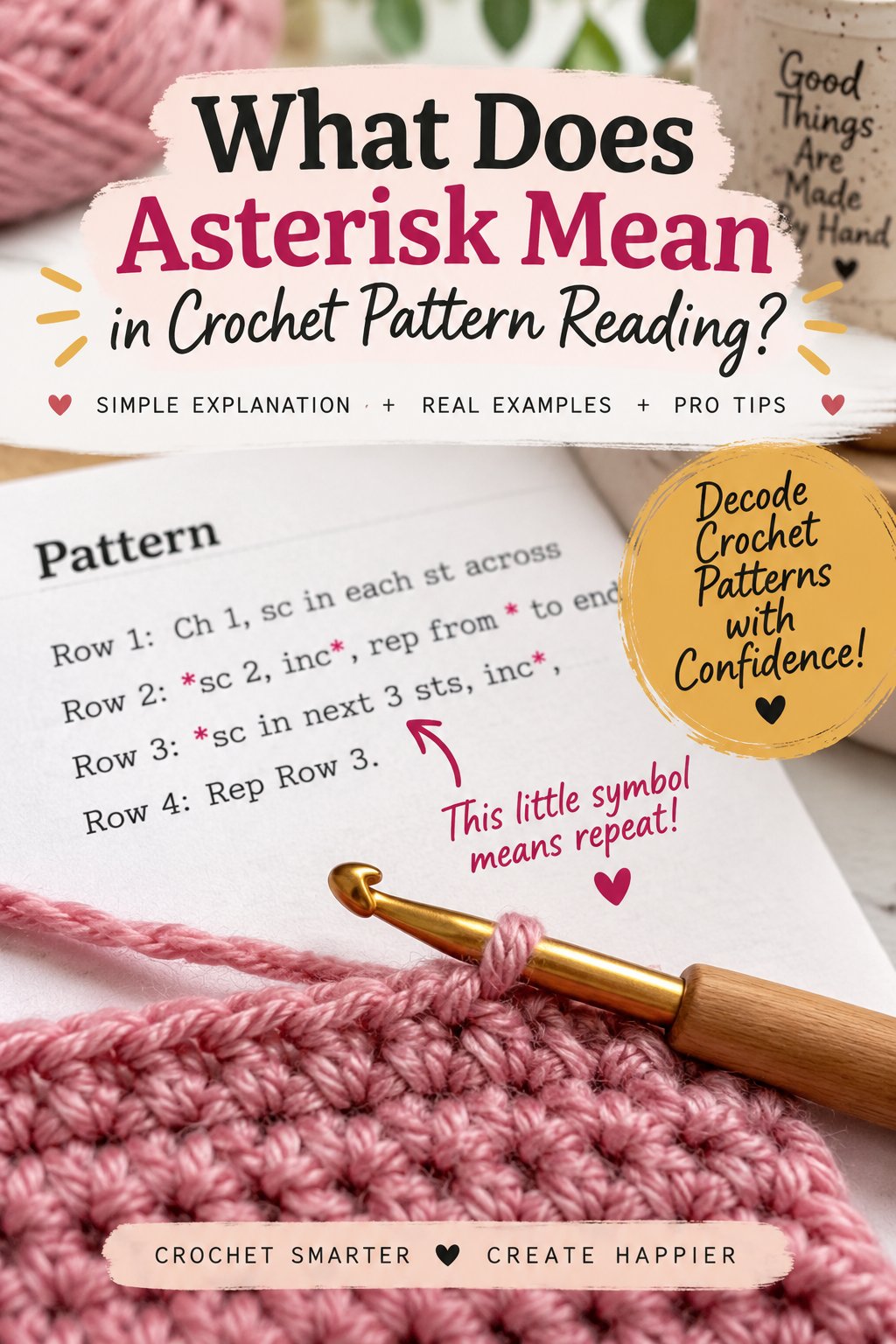
What does asterisk mean in crochet pattern instructions? An asterisk (*) marks the boundary of a stitch sequence that you must repeat, either a stated number of times or until a row or round reaches a specified point. The stitches before the asterisk are usually worked once, while the instructions after it form the repeat.
Key Facts / Quick Answer
A single asterisk usually marks where a repeated instruction begins.
“Repeat from *” means return to the asterisk and work the same sequence again.
“Repeat from * across” means continue until the row’s stated endpoint, not automatically beyond it.
A matching second asterisk can mark the end of a longer repeat block.
Parentheses usually group stitches, while brackets often group a larger repeat.
The final stitch count confirms whether the repeat was worked the correct number of times.
How Does an Asterisk Work in a Crochet Pattern?
An asterisk in a crochet pattern functions like a loop marker in computer instructions: it identifies the point where a repeated sequence starts. The pattern may tell you to repeat that sequence a fixed number of times, across the row, around the round, or until a landmark such as a corner or remaining stitch count.
Consider this instruction:
Sc in next 2 sts, * dc in next 2 sts, ch 1, sk 1 st; repeat from * across.
The first single crochet instruction is completed once. The asterisk begins the repeat group. You then work “dc in next 2 sts, ch 1, sk 1 st” repeatedly until the pattern’s stated endpoint.
The asterisk does not represent a stitch, chain, increase, decrease, or special technique. It is punctuation. You do not crochet an extra stitch where the symbol appears.
The First Sequence Is Usually Worked Once
The instructions before the first asterisk normally establish the row before the repeating section begins. The sequence after the asterisk is then performed for the first time immediately, followed by each required repetition.
For example:
Ch 2, dc in next 3 sts, * ch 1, sc in next 2 sts; repeat from * 4 times.
Work the chain and three double crochets once. Then work the asterisked sequence four times. The total is four repeated groups, not five.
A different construction changes the count:
Ch 2, * dc in next 3 sts, ch 1; repeat from * 4 times.
Here, the sequence begins at the asterisk and is worked four times. There is no independent copy before the first repeat.
| Pattern wording | First group status | Additional repeats | Total groups |
|---|---|---|---|
* sc, dc; repeat from * 5 times |
Included in five | 4 | 5 |
sc, dc, * ch 1, sk 1; repeat from * 4 times |
Included in four | 3 | 4 |
* sc, dc; repeat from * across |
Worked once | Until endpoint | Variable |
* sc, dc; repeat from * twice more |
Included in initial pass | 2 | 3 |
What Does “Repeat From *” Mean?
“Repeat from *” tells you to return to the asterisk and perform every instruction between that asterisk and the repeat endpoint. The repeat endpoint may be written as “repeat from *,” “repeat from * across,” “repeat from * to end,” or “repeat from * until 3 stitches remain.”
The wording after the sequence determines what happens next. A repeat is not automatically worked to the physical end of the row if the pattern names a different stopping point.
| Instruction phrase | Practical meaning | Stop when | Typical use |
|---|---|---|---|
repeat from * 3 times |
Work the starred group three total times | Group 3 is complete | Fixed motifs |
repeat from * across |
Continue the group across the available row | Row endpoint is reached | Flat stitch patterns |
repeat from * to end |
Continue until no instructed stitches remain | Final stated stitch or space | Simple rows |
repeat from * until 3 sts remain |
Stop before the final three stitches | Three stitches are unused | Shaped edges |
repeat from * around |
Continue around the entire round | Round marker or join point | Circular projects |
A semicolon often separates the repeat block from the instruction that follows it. For example:
Sc in next st, * 2 dc in next st, sk next st, sc in next st; repeat from * to last 2 sts, sc in each of last 2 sts.
The final two single crochets are worked after the repeated section. They are not part of the asterisked group.
What Do Matching Asterisks Enclose?
Some designers place a second asterisk at the end of a repeat block, such as * sc, ch 1, skip 1 st *. The matching symbols enclose the complete sequence to repeat. Other designers use one asterisk at the beginning and write “repeat from *,” so the pattern’s abbreviation key or style determines the exact convention.
A closing asterisk does not usually mean an extra action. It marks the boundary of the group. When a pattern uses * and **, read the surrounding sentence carefully because double symbols may indicate a nested repeat rather than a separate stitch instruction.
How Do Double Asterisks and Nested Repeats Work?
Double asterisks often identify a second repeat inside a larger repeat, but crochet notation is not governed by one universal punctuation standard. A pattern designer may use ** as a nested boundary, as a visual separator, or simply as a second marker, so the pattern legend takes priority over general convention.
Example:
Ch 3, * sc in next 2 sts, ** 2 dc in next st, sk next st; repeat from ** twice, sc in next st; repeat from * across.
The inner instruction between ** symbols is completed twice. The larger instruction beginning at * is then repeated across the row. This creates two levels of tracking:
- Follow the inner double-asterisk repeat.
- Finish the larger single-asterisk group.
- Return to the single asterisk for the next outer repetition.
Nested repeats are easier to manage when you rewrite the line with indentation or brackets. Do not assume that every pattern uses double asterisks identically.
| Notation | Likely role | Tracking level | Verification method |
|---|---|---|---|
* sc, dc; repeat from * |
Main repeat | 1 | Count outer groups |
** dc, ch 1; repeat from ** twice |
Inner repeat | 2 | Count inner groups |
* [sc, dc] 4 times |
Main block with count | 1 | Count four blocks |
* sc, (2 dc, ch 1) in next st |
Repeat plus grouped action | 1 | Count worked stitches |
** around corner; repeat from ** |
Designer-defined boundary | 2 | Check pattern legend |
The most common error is returning to the inner marker when the instruction says to return to the outer marker. Mark the two symbols with different colors before beginning.
How Many Times Should You Repeat the Asterisked Section?
The number of repetitions depends on the wording, the initial pass, and the row’s target stitch count. A fixed instruction such as “repeat from * 6 times” normally means six complete copies of the starred sequence, while “repeat 5 times” can mean five additional copies if the pattern separately worked the sequence before the repeat instruction.
Use the arithmetic below:
Total stitches used = setup stitches + stitches consumed by each repeat group × number of groups + finishing stitches
Suppose a row says:
Sc in next 2 sts, * dc in next 2 sts, ch 1, sk 1 st; repeat from * 5 times, sc in next 2 sts.
Each repeated group consumes three existing stitches: two stitches for the double crochets and one skipped stitch. The chain does not consume a stitch. The row therefore uses 2 setup stitches, 15 stitches through five groups, and 2 finishing stitches, for 19 source stitches.
The finished stitch count is different because each group produces three visible stitches, counting the chain space according to the pattern’s convention. Always compare the pattern’s stated count with the type of count it describes, such as stitches, spaces, or groups.
| Repeat group | Source stitches consumed | Visible outputs | Groups | Source stitches used |
|---|---|---|---|---|
sc, dc |
2 | 2 | 5 | 10 |
2 dc in next st |
1 | 2 | 6 | 6 |
dc, ch 1, sk 1 |
2 | 2 plus 1 space | 4 | 8 |
sc in 3 sts, ch 2 |
3 | 3 plus 1 space | 7 | 21 |
sc, dc, tr |
3 | 3 | 3 | 9 |
A Fixed Count and an “Across” Count Are Not Equivalent
A fixed repeat count gives a predictable number of pattern units. An “across” instruction depends on the row length, foundation chain, turning chain, stitch multiples, and any edge stitches. If the foundation chain is not a valid multiple, the final repeat may not fit.
For instance, a repeat requiring four foundation stitches plus one chain space may need a multiple of four, with separate edge stitches added afterward. The pattern should state the multiple, such as “multiple of 4 plus 2.” That arithmetic is more reliable than trying to force the final group into leftover stitches.
What Is the Difference Between Asterisks, Brackets, and Parentheses?
Asterisks, brackets, and parentheses all group crochet instructions, but their roles differ by location and designer convention. Parentheses commonly group several actions worked in one stitch or space, brackets often group a larger repeat, and asterisks typically point to a sequence repeated elsewhere in the sentence.
| Symbol or style | Common meaning | Example | Main counting question |
|---|---|---|---|
Asterisk * |
Repeat from a marked point | * sc, ch 1; repeat from * |
How many groups? |
Brackets [ ] |
Group a larger block | [dc, ch 1, dc] 3 times |
How many blocks? |
Parentheses ( ) |
Group an action or stitch cluster | (2 dc, ch 1, 2 dc) in corner |
Where is the group worked? |
| Written instruction | No shorthand grouping | sc, dc, sc, dc |
Which individual action comes next? |
Parentheses may also indicate a stitch count at the end of a row, such as (24 sts). That number is not an instruction to repeat anything. It is a checkpoint.
Brackets may be nested inside an asterisked section. In that case, read from the inside outward: complete the parenthetical action, complete the bracketed block, then repeat the asterisked sequence.
Why Parentheses Can Cause Confusion
The same punctuation can have different functions in one pattern. In 3 dc in next st (counts as 3 sts), the parentheses provide clarification. In (sc, ch 2, sc) in next corner, they group stitches worked into one location. In (sc, dc) 4 times, they may define a fixed repeat.
The stitch key, abbreviations list, and pattern notes resolve uncertainty. A designer who uses parentheses for repeats may not use brackets at all.
How Do You Read an Asterisked Row Step by Step?
Read an asterisked crochet row in a fixed order: identify the setup, locate the repeat boundary, determine the endpoint, calculate the group count, and verify the result. This process takes about 2-5 minutes for a first reading and usually less than 30 seconds after the pattern’s notation becomes familiar.
- Mark the setup instructions. Everything before the first asterisk is usually worked once.
- Underline the repeated sequence. Include every stitch, chain, skip, and space instruction until the stated repeat endpoint.
- Identify the endpoint. Look for a number, “across,” “around,” “to last,” or a named landmark.
- Calculate the stitch multiple. Determine how many source stitches each group consumes.
- Work one complete group slowly. Confirm that the sequence lands in the intended stitch or space.
- Track each completed group. Use tally marks, a row counter, or a marker.
- Complete the finishing instructions. These come after the repeat and are not automatically included.
- Check the final count. Compare both the number of stitches and the number of spaces when the pattern provides both.
This approach prevents a common failure: beginning at the asterisk but continuing past the instruction that ends the repeat. The semicolon, period, or phrase “repeat from *” often marks the transition.
Which Crochet Tools Make Repeats Easier?
The best repeat-tracking tool depends on group length and pattern complexity. A row counter records completed rows, but it does not always record how many repeats occurred within the current row, so a separate tally is useful for long or nested sequences.
| Tool | Typical USD cost | Setup time | Best repeat length |
|---|---|---|---|
| Pencil and printed pattern | $0.25-$2 | 1 minute | 2-10 stitches |
| Digital PDF annotation | $0-$15 | 2-5 minutes | Long written rows |
| Manual row counter | $3-$10 | 1 minute | 1-100 rows |
| Digital tally counter | $5-$15 | 1-2 minutes | 5-50 groups |
| Locking stitch markers | $4-$12 per pack | 1 minute | Repeats of 6-20 stitches |
In practice, highlighting the opening asterisk in yellow and the repeat endpoint in blue reduces rereading. Place a removable stitch marker at the first stitch of every fifth repeat when the group is long enough to make visual counting difficult.
A stitch marker cannot correct a wrong repeat boundary. It only reveals where your current group began.
What Happens When an Asterisked Row Does Not Count Correctly?
A failed stitch count usually comes from a wrong repeat boundary, a skipped chain space, or an incorrect interpretation of whether the first sequence was already worked. The fastest correction is to stop at the first mismatch, compare the written group with the stitches consumed, and undo only to that point.
| Symptom | Likely cause | Diagnostic check | Correction |
|---|---|---|---|
| One stitch too many per group | A skipped stitch was worked | Count source stitches in one group | Skip the named stitch |
| One stitch too few per group | A stitch was skipped accidentally | Compare each landing point | Work the missing stitch |
| Row ends before the final instruction | Repeat ran too many times | Recalculate endpoint | Stop at the named landmark |
| Extra partial motif remains | Foundation chain lacks required multiple | Divide chain count by repeat width | Add or remove setup stitches |
| Every row shifts sideways | Repeat began in wrong stitch | Inspect first group only | Undo to the asterisk boundary |
| Round has a gap at the join | Repeat crossed the marker | Compare group count around round | Stop at marker or join point |
The First-Group Test Finds Most Errors
Work only one repeat and write down two values: the number of stitches consumed and the number of stitches produced. If the group consumes four stitches but your hands use five, the interpretation is wrong before the row becomes difficult to repair.
This test also exposes whether a chain counts as a stitch. Many patterns specify “chain 2 counts as a double crochet,” while others use a turning chain only for height. The pattern’s notes override general habits.
How Are Asterisks Used in Crochet Rounds?
In crochet rounds, an asterisk repeats instructions around the circle until the beginning marker, join, corner, or stated stitch count is reached. Round repeats often include increases, chain spaces, or corner groups, so the endpoint matters more than the visual appearance of the completed circle.
Example:
Round 3: * Sc in next 2 sts, 2 sc in next st; repeat from * around.
Each group uses three source stitches and produces four single crochets. If Round 2 has 24 stitches, eight groups complete the round and produce 32 stitches.
A corner-based example differs:
** * 3 dc in corner space, dc across next side; repeat from * around.**
The asterisked group begins at each corner and continues through the next side. The phrase “around” means the full perimeter, not simply the next available stitches in a straight line.
| Round instruction | Repeat landmark | Typical result | Count focus |
|---|---|---|---|
* sc, 2 sc in next st; repeat around |
Beginning stitch marker | Circular increase | Source stitches |
* 3 dc in corner, dc across; repeat around |
Each corner | Square or rectangular shape | Corners and sides |
* sc in next 4 sts, inc; repeat 6 times |
Fixed group count | Evenly spaced shaping | Six increases |
* shell in next ch-space; repeat around |
Each chain space | Lace or motif round | Spaces, not stitches |
Do not continue past the round marker because the previous round appears to have extra space. The marker defines the structural endpoint.
What Are the Limits of Asterisk Notation?
Asterisks compress instructions, but they cannot explain a designer’s unstated assumptions. The symbol does not tell you whether a chain counts as a stitch, whether a repeat includes the first group, or whether “across” includes the turning chain unless the surrounding pattern provides that information.
The most important limitations are:
- Asterisks are not fully standardized across publishers.
- A single symbol may mark a start without showing the end.
- Double asterisks can mean nested repeats or a designer-specific boundary.
- Stitch counts may refer to stitches, spaces, groups, or post-increase totals.
- A repeat can be mathematically valid but visually wrong if worked into the wrong locations.
When notation conflicts with the stitch count, test the smallest complete section rather than guessing. Check the pattern’s abbreviation key, chart, project notes, and errata page. A professionally edited pattern should make the repeat boundary and endpoint recoverable from those sources.
What Is the Best Way to Practice Crochet Repeats?
The quickest practice method is a short swatch with a fixed repeat, a visible marker, and a written tally. Choose a four- to six-stitch sequence and work 5-10 groups, because that range is long enough to expose counting errors without creating a difficult project.
Try this practice line:
Ch 22, sc in second ch from hook, * ch 1, skip 1 chain, sc in next chain; repeat from * across.
Mark every completed group. At the end, count the chain spaces and single crochets separately. Then rewrite the same instruction using brackets to see how punctuation changes without changing the crochet action.
A beginner may understand the symbol in under five minutes, while accurate tracking typically takes 1-2 hours of deliberate practice across several swatches. Pattern fluency develops through repeated exposure to endpoints, stitch multiples, and finishing instructions, not through memorizing one punctuation rule.
Expert insight: The most reliable physical checkpoint is the repeat’s landing point, not the number of hand movements. If a group should end in a chain space but ends over a solid stitch, the error is structural even when the total count temporarily looks correct.
Frequently Asked Questions About What Does Asterisk Mean in Crochet Pattern
Does the asterisk include the instruction immediately before it?
Usually, no. Instructions before the asterisk are generally worked once, and the sequence beginning at the asterisk is repeated. However, a pattern may say “repeat the previous instructions from *,” or place the symbol at the start of the entire row. Follow the exact punctuation and repeat wording.
What does “repeat from * twice” mean?
“Repeat from * twice” commonly means work the asterisked sequence two additional times after completing its first occurrence. Some designers use the phrase to mean two total occurrences, so inspect whether the sequence was already introduced before the repeat instruction and verify the final stitch count.
Does a chain count as a stitch inside an asterisked repeat?
A chain counts as a stitch only when the pattern says so or when its stitch key defines that convention. A chain may instead create a space while consuming no source stitch. Check both the abbreviation notes and the row’s target count before calculating the repeat multiple.
Can an asterisk mean an increase?
An asterisk does not mean an increase by itself. The symbol only marks repeated text. An increase occurs when the repeated text instructs you to work multiple stitches into one stitch, such as “2 sc in next stitch” or “dc, ch 1, dc in the same space.”
Why does my final repeat not fit the row?
The final repeat may not fit because the foundation chain does not match the stated multiple, a skipped stitch was counted incorrectly, or “across” was interpreted as the entire row despite a finishing instruction. Recalculate the source stitches consumed by one group, then check the setup and endpoint.
Should I repeat an asterisked instruction in every round?
Repeat the asterisked instruction only in the round where it appears, unless the pattern explicitly carries it forward. Crochet patterns often change the repeat in the next round to create increases, shaping, texture, or alignment. Read each round as a separate instruction set.
Conclusion: What Does Asterisk Mean in Crochet Pattern Reading?
What does asterisk mean in crochet pattern instructions? It marks a repeat boundary, not a crochet stitch. Read the setup before the symbol once, work the starred sequence according to its stated count or endpoint, distinguish nested punctuation from the main repeat, and confirm the result with the row or round stitch count.