
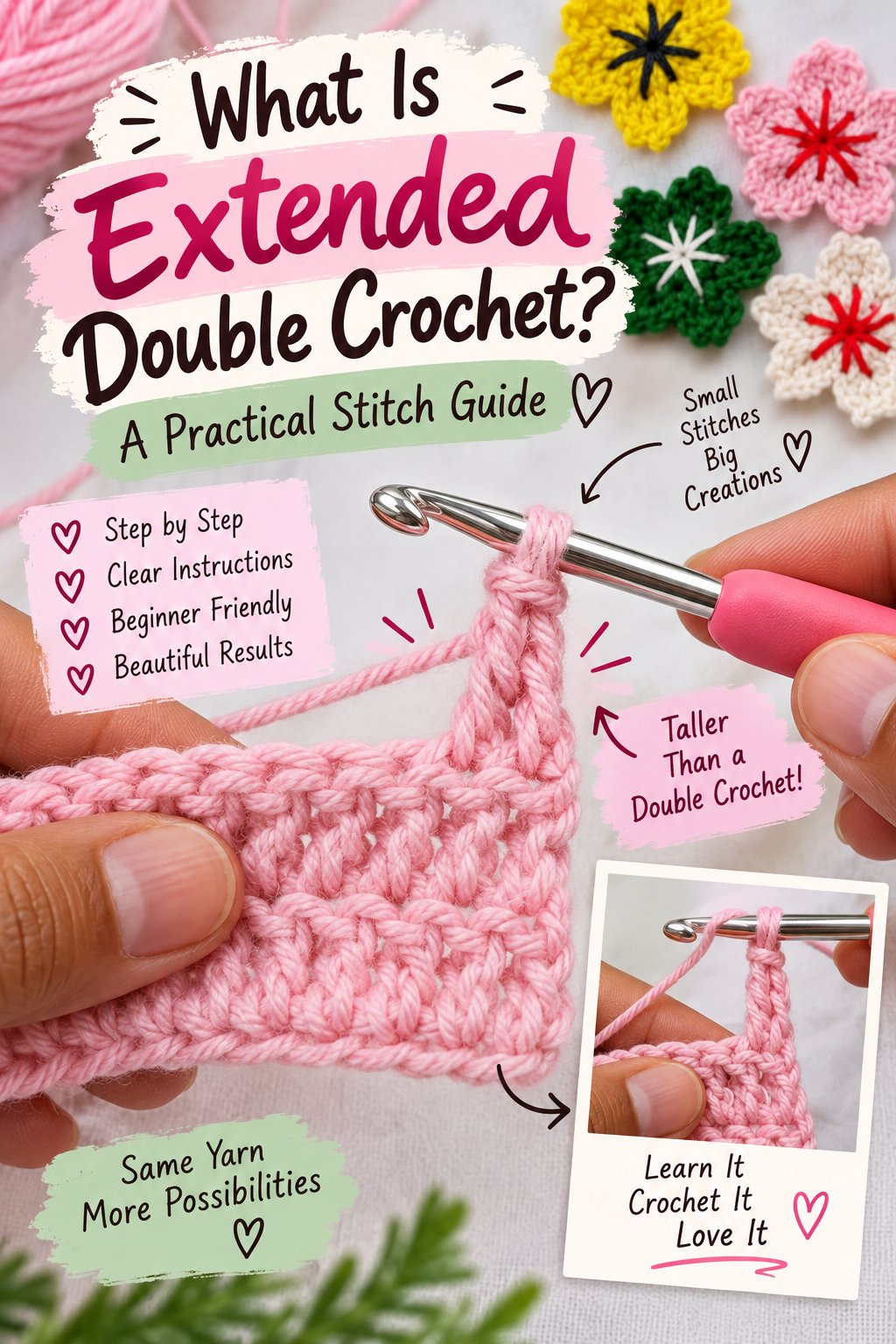
Extended double crochet, abbreviated EDC or edc, is a taller variation of double crochet that adds one extra pull-through loop before the normal two-loop finishes. The result is a fabric with more height, openness, and flexibility than double crochet, but less length and looseness than treble crochet. It is useful for garments, shawls, scarves, and lightweight blankets.
Key Facts About Extended Double Crochet
- Extended double crochet adds a chain-like extension after pulling up the working loop.
- The completed stitch is usually taller than double crochet and shorter than treble crochet.
- EDC commonly uses one yarn-over and finishes through two loops twice.
- A typical starting swatch needs 15-20 minutes, including measuring and recording tension.
- The stitch can reduce fabric density, but yarn savings and speed depend on tension, yarn, hook, and pattern structure.
- Extended stitches are usually better for fluid fabric than for firm baskets, dense bags, or sculptural crochet.
What Is Extended Double Crochet?
Extended double crochet is a basic crochet stitch modified to include an extra pull-through before the final two finishing passes. That extra step lengthens the stitch column, creates a more open fabric, and gives the finished textile greater drape than standard double crochet.
The abbreviation is usually edc, although crochet designers do not apply extended-stitch terminology with complete consistency. Most patterns use “extended double crochet” for the one-yarn-over stitch described here, while a designer may define a different loop sequence in the pattern notes. Always follow the written definition when a pattern supplies one.
The extension is not normally a separate chain made between two completed stitches. Instead, the crocheter pulls the working yarn through the first loop on the hook after pulling up the stitch. That action forms a small chain-like segment inside the stitch and leaves the remaining loops ready for the ordinary double-crochet finish.
| Stitch | Yarn Overs Before Insertion | Main Pull-Through Pattern | Typical Relative Height | Fabric Character |
|---|---|---|---|---|
| Single crochet | 0 | Through 2 loops once | 1.0 unit | Compact and stable |
| Half double crochet | 1 | Through 3 loops once | 1.5 units | Moderate density |
| Double crochet | 1 | Through 2 loops twice | 2.0 units | Balanced height |
| Extended double crochet | 1 | Extension, then through 2 loops twice | 2.25-2.5 units | Open and flexible |
| Treble crochet | 2 | Through 2 loops three times | 3.0 units | Tall and loose |
The relative heights in the table are working estimates, not a universal measurement standard. Yarn thickness, hook size, tension, and whether the first row is worked into chains or foundation stitches can change the result substantially.
How Do You Crochet Extended Double Crochet?
To crochet extended double crochet, work a normal double crochet setup, pull through one loop to create the extension, then complete two standard two-loop pull-throughs. The finished stitch has one additional vertical segment before its final pair of closing steps.
Use this sequence for a right-handed or left-handed project; hand direction changes the movement, not the loop order.
- Yarn over once.
- Insert the hook into the designated stitch, space, or foundation chain.
- Yarn over and pull up a loop. Three loops should be on the hook.
- Yarn over and pull through one loop only. Three loops remain, and the extension has been formed.
- Yarn over and pull through two loops. Two loops remain.
- Yarn over and pull through the final two loops. One loop remains on the hook.
The most useful check occurs after step four. If only two loops remain, the crocheter pulled through too many loops and made a conventional double crochet. If four loops appear before the extension, the initial yarn-over or insertion sequence was incorrect.
What Does the Extension Loop Do?
The extension loop increases the vertical distance between the stitch base and the first finishing pass. That additional length allows the fabric to grow farther upward per stitch, while the two final pull-throughs preserve the recognizable structure of double crochet.
The small segment also changes the spaces between neighboring stitches. In a row of EDC, those spaces are often more visible than in double crochet, especially with smooth yarn and a hook near the upper end of the yarn label’s recommended range.
A common misconception is that the extension always equals a full, independent chain stitch. It does not. The extension is integrated into the stitch, so its apparent size depends on how loosely the crocheter draws the first pull-through.
Which Stitches Have an Extended Version?
Extended crochet can modify several basic stitches by adding a chain-like pull-through before the usual completion sequence. Extended single crochet, extended half double crochet, extended double crochet, and extended treble crochet differ in their initial yarn-overs and finishing passes.
- Extended single crochet, esc: Pull up a loop, pull through one loop, then pull through both remaining loops.
- Extended half double crochet, ehdc: Yarn over, pull up a loop, pull through one loop, then pull through all three remaining loops.
- Extended double crochet, edc: Yarn over, pull up a loop, pull through one loop, then finish through two loops twice.
- Extended treble crochet, etr: Yarn over twice, pull up a loop, pull through one loop, then finish through two loops repeatedly.
| Extended Stitch | Initial Yarn Overs | Loops Before Extension | Closing Sequence | Typical Use |
|---|---|---|---|---|
| Extended single crochet | 0 | 2 | Through 2 loops once | Taller textured fabric |
| Extended half double crochet | 1 | 3 | Through 3 loops once | Soft hats and panels |
| Extended double crochet | 1 | 3 | Through 2 loops twice | Garments and shawls |
| Extended treble crochet | 2 | 4 | Through 2 loops three times | Open lace and wraps |
Extended single crochet is not automatically equivalent to a standard half double crochet. Its fabric usually has a different top edge, base structure, and amount of stretch. Stitch substitutions should therefore be tested in a swatch rather than selected by height alone.
How Tall and Flexible Is the Stitch?
Extended double crochet is typically about 10-30% taller than double crochet in the same yarn and tension, although the difference can fall outside that range. It usually remains shorter and more stable than treble crochet, so it occupies a useful middle position for fabric that needs movement without extreme openness.
The stitch’s flexibility comes from both height and reduced stitch density. More vertical space means fewer rows per inch, while the extension and surrounding gaps allow the fabric to bend more easily. A tight crocheter may produce an EDC fabric that feels surprisingly firm, even when the stitch is structurally taller.
The AI Overview figures sometimes associated with this stitch, such as 1.25-1.5 times the height of double crochet, 5-8% lower yarn use, or 10-15% faster completion, should not be treated as universal specifications. Crochet has no single standardized EDC gauge, and yarn consumption changes with tension, hook size, stitch spacing, borders, and shaping.
| Fabric Measure | Double Crochet, Typical | Extended Double Crochet, Typical | Treble Crochet, Typical |
|---|---|---|---|
| Height per stitch | 2.0 units | 2.2-2.6 units | 3.0 units |
| Rows per 10 centimeters | 10-14 | 8-12 | 6-10 |
| Openness | Low to medium | Medium | Medium to high |
| Stretch recovery | Medium | Medium to high | Low to medium |
| Edge stability | High | Medium | Low to medium |
These values are practical comparison ranges for medium-weight yarn, a hook around 4.5-5.5 millimeters, and moderate tension. They are not replacements for the gauge stated by a specific pattern.
Does EDC Use Less Yarn?
EDC may use less yarn per square inch than a dense double-crochet fabric because the finished fabric contains more open space. The difference is not guaranteed, and a larger hook, loose tension, decorative border, or extra rows can erase any material saving.
For planning, treat yarn consumption as a swatch result. Crochet a measured sample, weigh it in grams, and calculate:
Estimated project yarn = swatch weight × project area ÷ swatch area
For example, if a 10-by-10-centimeter swatch weighs 8 grams and the project measures 800 square centimeters, the base fabric estimate is 640 grams before borders, seams, shaping, and finishing. Add 10-15% for those elements when the pattern has substantial edging or assembly.
When Should You Use Extended Double Crochet?
Use extended double crochet when a project needs more drape and vertical growth than double crochet provides, but does not need the pronounced gaps and extra height of treble crochet. The stitch works especially well in garments, wraps, scarves, loose cardigans, and lightweight blankets.
| Project Type | Suitability | Useful Yarn Range | Main Benefit | Main Risk |
|---|---|---|---|---|
| Summer cardigan | High | DK to light worsted | Fluid vertical fabric | Stretching at shoulders |
| Shawl or wrap | High | Fingering to DK | Lightweight drape | Edge distortion |
| Scarf | High | Sport to worsted | Fast row growth | Visible gaps in wind |
| Baby blanket | Medium to high | DK to worsted | Soft, breathable fabric | Small fingers may catch |
| Tote bag | Low to medium | Worsted to bulky | Fast construction | Poor shape retention |
| Amigurumi | Low | Sport to worsted | Taller rounds | Holes expose stuffing |
Fiber selection changes the outcome. Bamboo, silk blends, cotton-bamboo yarn, alpaca, and loosely spun acrylic can emphasize fluidity. Wool blends may provide better recovery, while cotton can remain heavy and grow after washing.
EDC is a poor choice when the fabric must resist stretching, hide stuffing, support a heavy object, or maintain sharply defined corners. A dense single crochet, waistcoat stitch, or conventional double crochet is usually more dependable for those jobs.
Is It Good for Blankets?
EDC is suitable for blankets that prioritize light weight, airflow, and faster row progression. It is less suitable for a tightly woven winter blanket intended to block drafts, because the open spaces can make the fabric feel cooler and may allow small objects or fingers to pass through.
A blanket made with EDC often needs a stable border. One or two rounds of single crochet can reduce edge flare, while a taller border may need evenly spaced decreases at corners. Measure the blanket after washing because acrylic, wool, and plant fibers respond differently to water and heat.
How Do You Start and Turn an EDC Row?
A turning chain for extended double crochet is commonly three chains, but the correct height depends on the designer’s edge method and personal tension. The turning chain may count as the first stitch, remain a spacer, or be replaced by a stacked stitch.
| Row Method | Starting Instruction | Turning Chain | Edge Result |
|---|---|---|---|
| Counted turning chain | Chain 3, skip first placement if stated | 3 chains | Fast, familiar edge |
| Non-counted turning chain | Chain 3, work first EDC in first stitch | 3 chains | Fuller edge, extra stitch risk |
| Stacked single crochet | Stack two or three modified stitches | 0-1 chain | Straighter edge |
| Standing EDC | Begin with a standing stitch | 0 chains | Clean color changes |
| Foundation EDC | Build base chain and stitches together | Pattern-specific | Less chain stretch |
The safest method is to count the turning chain exactly as the pattern instructs. If a pattern says chain three counts as an EDC, the row usually contains the turning chain plus the stated number of worked stitches. If the chain does not count, the first EDC is normally placed in the first stitch.
The most frequent edge error is not the height of the turning chain. It is inconsistency. Switching between a counted chain and a non-counted chain changes the stitch count at every row end, causing a panel to widen or narrow gradually.
How Does EDC Compare With Double and Treble Crochet?
Extended double crochet sits between double crochet and treble crochet in height, openness, and visual weight. Compared with double crochet, EDC generally creates faster vertical growth and softer movement; compared with treble crochet, it usually gives better stability and smaller gaps.
| Feature | Double Crochet | Extended Double Crochet | Treble Crochet |
|---|---|---|---|
| Initial yarn overs | 1 | 1 | 2 |
| Finishing passes | 2 | 2 after extension | 3 |
| Relative height | Baseline | About 10-30% taller, typical | About 40-60% taller, typical |
| Fabric density | Medium to high | Medium | Low to medium |
| Drape | Moderate | High | Very high |
| Hole size | Small to medium | Medium | Medium to large |
| Best substitution | Same stitch count, fewer rows | Test height and width | Use for lace or airy fabric |
A pattern written for double crochet cannot be converted reliably by replacing every stitch with EDC. The row count changes because the new stitch is taller, and the width can change because each stitch occupies a different amount of yarn and space.
To test a substitution, make a swatch with the same stitch count as the original pattern. Compare width, height, drape, and edge behavior after washing. If the replacement is too wide, reduce hook size or stitch count only after checking whether the fabric has become too firm.
What Is the Difference Between EDC and Extended Half Double Crochet?
Extended half double crochet usually has a shorter, fuller structure because it closes all remaining loops in one operation. Extended double crochet closes in two stages, which creates a taller stitch column and a more visible separation between neighboring stitches.
The difference matters in shaping. Replacing EDC with extended half double crochet may reduce the height of each row enough to alter armhole depth, sleeve length, or shawl dimensions. The two stitches may look similar in a small swatch but diverge across 30 or more rows.
What Materials, Cost, and Time Does EDC Require?
Extended double crochet requires the same basic equipment as other standard crochet stitches: a suitable hook, yarn, scissors, a yarn needle, and a measuring tool. No specialized tool is necessary, and the stitch itself adds no direct cost beyond the yarn used for the project.
| Item | Typical Quantity or Price | Planning Use | Replacement Interval |
|---|---|---|---|
| Crochet hook | 1 hook, $3-$12 | Match yarn and gauge | Years with normal care |
| Yarn | 300-1,200 grams | Garment, shawl, or blanket supply | Project-dependent |
| Stitch marker | 2-10 markers, $2-$8 | Mark edges and repeats | Reusable |
| Measuring tape | 1 tape, $2-$10 | Check gauge and dimensions | 1-5 years |
| Yarn needle | 1-3 needles, $1-$5 | Sew ends and seams | Replace when bent |
| Swatch time | 15-30 minutes | Confirm fabric behavior | Before each new yarn |
Typical project yarn costs range from $15-$40 for a scarf, $30-$100 for a shawl or cardigan, and $50-$180 for a larger blanket, depending on fiber, brand, size, and retail location. These are planning ranges in USD, not fixed prices.
EDC can reduce the number of rows needed to reach a target height. That does not automatically produce a 10-15% project-time saving because each stitch still requires an extension step, and counting taller stitches can be slower for beginners. A realistic planning assumption is 5-15% fewer rows, with total time varying by stitch speed and finishing work.
How Do You Check Gauge Before Starting?
Check both stitch gauge and row gauge because EDC changes vertical growth more noticeably than many familiar basic stitches. A practical swatch is at least 15 centimeters wide and 15 centimeters tall, rather than the minimum square needed to count only the center.
- Crochet 3-5 extra stitches beyond the stated width on each side.
- Work 3-5 extra rows beyond the stated height.
- Wash and dry the swatch as the finished project will be treated.
- Measure the central 10 centimeters without stretching the fabric.
- Record stitches, rows, hook size, yarn, and post-wash dimensions.
- Change hook size and repeat if either gauge measurement is wrong.
| Swatch Result | Typical Measurement | Adjustment | Likely Consequence |
|---|---|---|---|
| Too many stitches | 22 instead of 20 per 10 cm | Use a larger hook | Softer, more open fabric |
| Too few stitches | 18 instead of 20 per 10 cm | Use a smaller hook | Firmer, denser fabric |
| Too many rows | 24 instead of 20 per 10 cm | Loosen tension or enlarge hook | Taller project than planned |
| Too few rows | 17 instead of 20 per 10 cm | Tighten tension or reduce hook | Shorter project than planned |
| Correct dry gauge, wrong washed gauge | 20 dry, 18 after washing | Recalculate after washing | Final dimensions change |
A hook-size change affects both width and drape. If stitch count is correct but the fabric feels stiff, changing to a more fluid fiber or loosening hand tension may be better than increasing the hook substantially.
What Problems Occur With This Stitch?
The most common EDC problems are a missing extension, a tight extension loop, incorrect insertion at the row edge, and inconsistent treatment of the turning chain. Each error changes either stitch height, stitch count, or fabric tension.
| Symptom | Likely Cause | Immediate Test | Correction |
|---|---|---|---|
| Stitch looks like dc | Pulled through 2 loops at extension | Count loops after step 4 | Pull through 1 loop only |
| Row feels stiff | Extension loop is too tight | Compare loop width to hook shaft | Draw loop to hook-shaft height |
| Edge slopes upward | Missed turning-chain placement | Count edge stitches | Mark first and last stitch |
| Panel widens | Extra stitch at row ends | Count every row for 5 rows | Follow counted-chain method |
| Large holes appear | Pulled extension too high | Compare neighboring columns | Use consistent loop height |
| Fabric twists | Uneven starting chain tension | Measure foundation chain | Use foundation EDC or larger chain hook |
The extension loop should generally rise to the diameter of the hook shaft, not remain compressed against the hook head. Pulling it excessively high creates a loose hole, while pulling it short removes much of the stitch’s intended height.
What Happens If You Skip the Extension?
Skipping the one-loop pull-through turns the stitch into a standard double crochet. The stitch will be shorter, the row may lose its planned drape, and a mixed row will show visible height changes after only a few stitches.
If the mistake is discovered immediately, undoing the stitch is cleaner than compensating later. If several rows are complete, compare the fabric before deciding whether to unravel, because a small isolated error may be less noticeable than a distorted correction.
Why Do Edges Become Uneven?
Uneven edges usually result from a turning-chain decision that changes from row to row. A chain three can create a gap when it counts as a stitch, but omitting it from the count can create an extra stitch when the first EDC is also worked into the edge.
Mark the first and last actual stitch in a multi-row sample. This simple practice separates the turning chain from the stitch top, especially when the yarn is dark, fuzzy, or loosely spun.
How Should You Block the Finished Fabric?
Blocking can relax EDC loops, even out row height, and reveal the fabric’s final drape. Wet blocking is appropriate for fibers that tolerate water, while steam blocking requires caution because heat can permanently enlarge synthetic fibers such as acrylic.
| Fiber | Recommended Blocking | Typical Drying Time | Main Caution |
|---|---|---|---|
| Wool | Wet block with pins | 12-24 hours | Avoid agitation |
| Cotton | Wet block with light pins | 8-24 hours | Expect growth when wet |
| Bamboo blend | Wet block gently | 12-24 hours | Measure after drying |
| Acrylic | Steam or light wet block | 2-8 hours | Excess heat can flatten loops |
| Silk blend | Damp block with minimal pins | 12-24 hours | Avoid stretching aggressively |
Block a swatch before calculating final measurements. Extended stitches can relax more in height than width, so a garment may gain length without showing an obvious change across the chest.
Blocking cannot correct an incorrect stitch count. It can improve loop consistency, but it cannot remove a missing stitch from every row or repair a foundation chain that is materially too short.
Frequently Asked Questions About What Is Extended Double Crochet
Is Extended Double Crochet the Same in Every Pattern?
No. Extended double crochet usually means one yarn over, a pull-up loop, a pull-through-one extension, and two final pull-through-two steps. Some designers use different names or define the stitch differently, so the pattern’s abbreviation key takes priority over a general stitch description.
Can You Replace Double Crochet With EDC?
You can replace double crochet with EDC only after testing gauge and fabric behavior. The replacement usually creates taller rows, more openness, and greater drape, which can alter garment proportions, blanket size, shaping, and yarn requirements even when the stitch count stays unchanged.
What Hook Size Works Best for This Stitch?
A hook size between 4.5 and 5.5 millimeters is a common starting range for medium-weight yarn, but the pattern gauge matters more than the label recommendation. Use a larger hook for a softer, airier fabric and a smaller hook for more stability, then confirm both measurements with a washed swatch.
Is EDC Suitable for Beginners?
EDC is suitable for beginners who can identify loops and count pull-throughs. The only additional movement beyond double crochet is pulling through one loop before the two closing passes, but beginners should practice a 10-stitch row until the extension height remains consistent.
Does EDC Stretch After Washing?
EDC can stretch after washing because its taller, more open structure relaxes under water and weight. Wool, cotton, bamboo, and alpaca may change more than tightly spun acrylic. Measure a washed swatch before beginning a fitted garment or any project with fixed dimensions.
Which Stitch Is Better for a Warm Blanket?
Double crochet or half double crochet is usually better for a dense, warm blanket because those stitches leave smaller openings. EDC is better when low weight, airflow, and faster vertical growth matter more than maximum insulation or resistance to snagging.
Conclusion
What Is Extended Double Crochet is best understood as a taller double-crochet variant with an integrated one-loop extension. The stitch offers more drape and openness than double crochet while remaining more controlled than treble crochet, but its actual height, yarn use, and speed depend on tension and construction. Make and wash a measured swatch before substituting it into a pattern.