
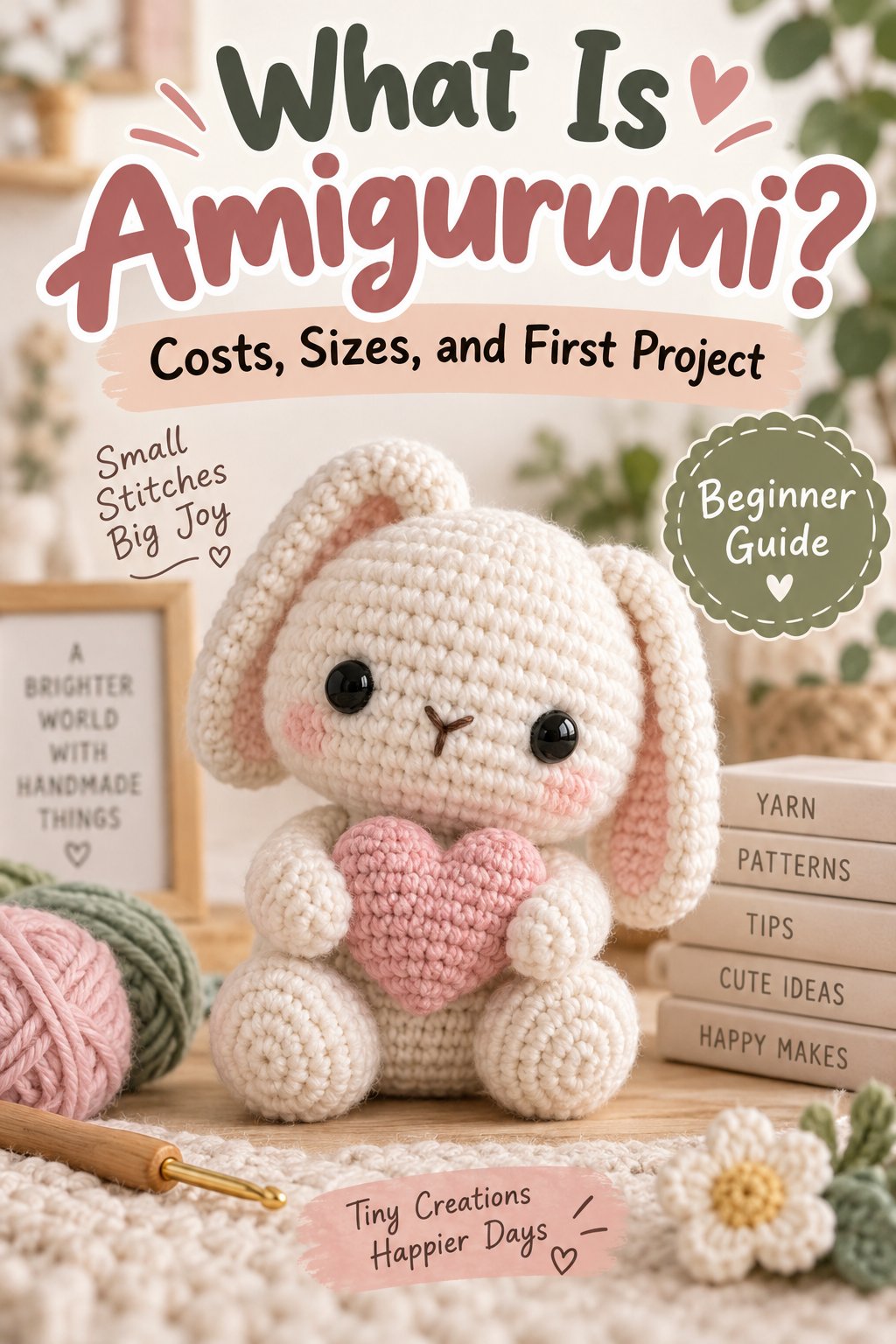
Amigurumi is the Japanese craft of crocheting or knitting small, three-dimensional stuffed figures from yarn. Most designs use dense single crochet in continuous rounds, then increases and decreases to shape an animal, character, food, or person. Separate parts are stuffed, embroidered, and sewn together unless the pattern uses a no-sew construction.
Key Facts / Quick Answer
Amigurumi usually uses a hook smaller than the yarn label recommends, creating fabric dense enough to contain stuffing.
A beginner project typically costs $5-$15 in materials and takes 2-6 hours.
Cotton and acrylic yarn are common; cotton gives sharper stitches, while acrylic is softer and often cheaper.
The core techniques are a magic ring, single crochet, increases, invisible decreases, stuffing, and assembly.
Plastic safety eyes are unsuitable for babies and young children because they can detach; embroidered features are safer.
A finished item’s selling price must include materials, labor, packaging, platform fees, and pattern-license restrictions.
What Does Amigurumi Mean?
Amigurumi means a small knitted or crocheted stuffed object, usually a toy or decorative figure. The Japanese term combines ami, associated with knitting or crocheting, and nuigurumi, meaning a stuffed doll or stuffed toy.
The word describes a construction method and a category of objects, not one required animal, yarn brand, stitch count, or facial style. A crocheted mushroom, whale, doll, keychain, plant, or fantasy creature can qualify if the piece is built as a stuffed three-dimensional form.
Amigurumi became widely visible outside Japan during the late 1990s and early 2000s, when Japanese popular culture, kawaii design, online craft communities, and accessible crochet patterns expanded internationally. The exact origin of the form is less certain than the meaning of the word. Claims that amigurumi began through a single historical exchange between China and Japan simplify a longer history of textile toys, dolls, knitting, and crochet.
Kawaii means cute or charming in Japanese. Kawaii design influenced the familiar visual style of oversized heads, compact bodies, simple eyes, and small mouths, but realistic wildlife, articulated dolls, food replicas, and abstract sculptures also belong to the craft.
How Does Amigurumi Work?
Amigurumi works by shaping a tightly crocheted or knitted tube, sphere, oval, or cone around a hollow interior. In crochet, single crochet creates a relatively short, dense fabric, while increases widen the form and decreases narrow it.
A typical crocheted figure begins at the center of a round piece. The maker adds stitches at controlled intervals to create a flat circle, stops increasing to build height, then decreases to close the shape after inserting stuffing. The same geometry produces heads, bodies, paws, tails, ears, and snouts.
The Core Construction Sequence
- Make a magic ring or alternative adjustable start. The ring closes the center hole and prevents stuffing from escaping.
- Crochet the first round. Six single crochet stitches are common for a compact sphere, although patterns vary.
- Increase evenly. Six added stitches per round often enlarge a sphere smoothly.
- Work even rounds. Maintaining the stitch count creates the side walls of the form.
- Decrease gradually. Invisible decreases reduce gaps and preserve a clean surface.
- Add stuffing before the opening becomes too small. A tapestry needle or stuffing tool reaches tight corners more effectively at this stage.
- Close and assemble. Fasten off securely, hide the yarn tail inside, and sew components using matching yarn.
The six-stitch sphere is a useful teaching model, not a universal formula. A pattern may begin with four, five, seven, or eight stitches because the designer is controlling proportions, stitch texture, or a character’s silhouette.
Why Is Tight Tension Important?
Tight tension matters because the fabric must hold polyester fiberfill without visible holes. Excessively loose stitches create stuffing gaps, while excessively tight stitches make the fabric rigid, distort decreases, and increase hand fatigue.
A practical starting point is a hook 1-2 millimeters smaller than the yarn label’s general recommendation. For example, medium-weight acrylic commonly labeled for a 5.0-millimeter hook may produce better toy fabric with a 3.5-4.0-millimeter hook. The correct size depends on the crocheter’s tension, so the fabric test matters more than the label.
A useful test is a stuffed swatch or small tube. If light passes through the stitch spaces after moderate stuffing, reduce the hook size. If the yarn splits, the hook catches repeatedly, or the stitches become difficult to form, increase the hook slightly.
What Materials Do You Need?
A basic amigurumi kit requires yarn, a suitable hook, stuffing, a tapestry needle, scissors, a stitch marker, and a pattern. Safety eyes, embroidery floss, pins, and wire are optional additions that depend on the figure and its intended user.
| Material | Typical beginner specification | Typical cost | Primary function |
|---|---|---|---|
| Yarn | 50-100 g cotton or acrylic, 80-180 m | $3-$8 | Crocheted outer fabric |
| Crochet hook | 3.0-4.0 mm ergonomic hook | $3-$10 | Forms dense stitches |
| Polyester stuffing | 100-250 g bag | $4-$9 | Fills the three-dimensional shape |
| Tapestry needle | 5-7 cm blunt needle | $2-$6 | Joins parts and hides tails |
| Stitch markers | 10-20 removable markers | $2-$8 | Tracks round starts and increases |
| Safety eyes | 6-12 mm pair or multipack | $2-$8 | Adds facial features to older-user toys |
The lowest-cost setup can use leftover yarn, a single hook, household scissors, and polyester filling from an inexpensive bag. A more complete beginner purchase usually falls between $15 and $35, especially when the crafter must buy tools rather than use an existing kit.
Cotton is easier to inspect because its stitch definition is crisp and its surface has limited fuzz. Acrylic is often softer, lighter, and more forgiving of repeated handling. Chenille and blanket yarn create plush results but conceal stitches, making them poor choices for a first project unless the pattern is designed for them.
Which Yarn and Hook Should Beginners Choose?
Beginners generally get the clearest results from smooth worsted-weight cotton or acrylic yarn paired with a 3.0-4.0-millimeter hook. Light-colored yarn makes individual loops easier to identify, which reduces counting errors during the first several projects.
| Yarn category | Common weight | Typical hook for toys | Beginner suitability | Typical result |
|---|---|---|---|---|
| Sport cotton | 2 | 2.0-2.75 mm | Good after basic practice | Small, firm, detailed figure |
| Worsted acrylic | 4 | 3.0-4.0 mm | Very good | Medium, soft, economical figure |
| Worsted cotton | 4 | 3.0-4.0 mm | Very good | Crisp, structured figure |
| Chenille blanket yarn | 6 | 4.0-6.0 mm | Limited for beginners | Large, soft, low-visibility figure |
| Embroidery floss | 0 | 0.5-1.25 mm | Poor first choice | Micro-amigurumi under 5 cm |
The yarn label’s hook recommendation is designed for the yarn’s ordinary use, often a flexible garment or blanket. Amigurumi needs a smaller hook because its fabric must resist stretching. The right reduction is determined by stitch tightness, not by a fixed universal number.
One practitioner rule is to choose the yarn first and then match the pattern’s gauge. Substituting a bulky yarn into a worsted-weight pattern changes the finished height, stuffing requirement, eye placement, and limb proportions even when the stitch counts remain identical.
What Are the Main Types of Amigurumi?
Amigurumi types differ by visual style, scale, construction method, and surface treatment. Classic kawaii figures emphasize simplified proportions, realistic designs imitate anatomy, no-sew patterns reduce assembly, and micro figures use extremely fine yarn or thread.
- Classic kawaii: Large head, compact body, simple eyes, and limited facial embroidery.
- Realistic or lifelike: Anatomical shaping, color changes, textured yarn, wire, or individually formed features.
- Seamless or no-sew: Limbs and body are joined during crocheting, reducing later sewing.
- Micro-amigurumi: Usually under 5 centimeters, made with embroidery floss or thread and a hook below 1.5 millimeters.
- Wearable or functional figures: Keychains, bag charms, pincushions, ornaments, and miniature cases.
- Character-inspired figures: Designs based on recognizable fictional or branded entities, which require special attention to copyright and commercial-use rules.
| Type | Typical finished size | Typical technique | Main trade-off |
|---|---|---|---|
| Kawaii animal | 10-20 cm tall | Single crochet, safety eyes | Easy silhouette, limited anatomy |
| Realistic animal | 15-35 cm long | Shaping, color changes, brushing | Higher detail, longer assembly |
| No-sew figure | 8-18 cm tall | Joined limbs and continuous rounds | Fewer seams, harder planning |
| Micro figure | 1-5 cm tall | Thread, 0.5-1.25 mm hook | Tiny scale, difficult counting |
| Keychain charm | 4-8 cm tall | Compact body, reinforced loop | Portable, limited facial detail |
Scale affects more than appearance. A 4-centimeter charm needs less stuffing but greater stitch precision, while a 30-centimeter plush may require internal support, stronger seams, and a larger budget for filling.
How Long Does a Project Take and Cost?
A simple beginner amigurumi usually takes 2-6 hours and costs $5-$15 in consumed materials. A complex realistic figure commonly takes 10-40 hours, with total consumed materials around $25-$100, depending on size, yarn, accessories, and failed prototypes.
| Project level | Typical height | Active time | Consumed materials | Typical examples |
|---|---|---|---|---|
| First small project | 8-12 cm | 2-6 hours | $5-$15 | Ball, mushroom, simple chick |
| Basic animal | 12-20 cm | 4-10 hours | $8-$25 | Bear, cat, whale |
| Detailed character | 18-30 cm | 10-25 hours | $20-$60 | Doll, dragon, costumed figure |
| Large realistic plush | 25-45 cm | 20-40+ hours | $40-$100+ | Anatomical animal, articulated creature |
These figures describe typical hobby costs in the United States and exclude the initial purchase of reusable hooks, scissors, and needles. Local yarn prices, import costs, sales tax, and pattern prices can change the total substantially.
A finished toy priced for sale must include labor. If a maker spends six hours on a $10 project and values labor at $15 per hour, labor alone is $90 before materials, packaging, payment fees, shipping supplies, and taxes. Handmade pricing therefore cannot be inferred from yarn cost alone.
Can You Sell Finished Figures?
You can sell original finished figures, but commercial rights depend on the pattern license and the design’s intellectual-property status. A pattern may permit personal use while restricting mass production, digital redistribution, brand use, or sales of finished items.
| Selling factor | Typical amount or range | Included in calculation | Common omission |
|---|---|---|---|
| Materials | $5-$40 per item | Yarn, stuffing, eyes, thread | Test pieces and waste |
| Labor | $12-$30 per hour | Crocheting, sewing, finishing | Design and customer messages |
| Packaging | $1-$6 per item | Box, mailer, label, care card | Tissue and protective wrap |
| Marketplace fee | 5%-15% of order value | Platform and payment charges | Listing and advertising fees |
| Small-item retail price | $25-$90 | Materials, some labor, overhead | Full hourly wage |
A realistic product description should identify dimensions, fiber content, cleaning method, attached parts, and intended age range. Handmade does not automatically mean child-safe.
Is Amigurumi Different From Other Plush Crafts?
Amigurumi differs from sewn plushies because it forms a three-dimensional shell from yarn rather than cutting and joining flat fabric panels. Compared with needle felting, it offers a stronger structural base for repeated handling but usually produces less fine surface detail.
| Method | Primary material | Typical construction time | Shape control | Best use |
|---|---|---|---|---|
| Amigurumi crochet | Yarn and hook | 2-40+ hours | Excellent for rounded forms | Stuffed figures and charms |
| Sewn plush | Fabric and machine or hand needle | 1-12 hours | Excellent for flat patterns | Production plush and garments |
| Needle felting | Wool roving and barbed needle | 2-20 hours | Excellent for surface detail | Sculptures and small decorations |
| Knitted toy | Yarn and knitting needles | 4-30 hours | Good for flexible forms | Soft dolls and animals |
| Polymer-clay model | Polymer clay and oven | 2-15 hours | Excellent for hard detail | Miniatures and display pieces |
Traditional Western crochet often uses taller stitches such as double crochet for drape, lace, or blankets. Amigurumi usually favors single crochet because a shorter stitch creates a compact grid that tolerates stuffing and preserves shape.
Needle felting can create fur, noses, and subtle facial transitions that crochet cannot reproduce as efficiently. Its barbed needles and loose fibers require different safety practices, and a felted surface may be less suitable for rough handling than a tightly crocheted shell.
How Do You Assemble and Finish a Figure?
Assembly determines whether a crocheted figure remains aligned after handling. The head, limbs, ears, and tail should be positioned with pins before permanent sewing, because moving a finished seam is slower than correcting the layout beforehand.
A reliable finishing workflow is:
- Stuff each component gradually, pushing filling into corners with a blunt tool.
- Check firmness after every small addition rather than packing the entire piece once.
- Pin the head and limbs at several points to test symmetry.
- Use a tapestry needle and long yarn tail to pass through both joining surfaces.
- Sew through the same structural rows repeatedly, alternating sides.
- Pull the seam closed without compressing the fabric into a hard ridge.
- Knot securely, bury the tail inside the piece, and trim only after testing the seam.
- Add embroidered eyes, mouth, cheeks, or markings after the major parts are stable.
Stuffing should make the form resilient but not stretch the stitch columns. A useful practical check is to squeeze the piece: it should compress slightly and return to shape without exposing filling or creating permanent creases.
Wire armatures can make advanced figures poseable, but exposed or poorly capped wire creates puncture hazards. Wire is unsuitable for baby toys and requires secure internal coverage, strong joints, and a clear age restriction.
Is Amigurumi Safe for Babies and Young Children?
Amigurumi is not automatically safe for babies because small detachable parts, loose fibers, hard eyes, wire, and weak seams create hazards. For infants and toddlers, use embroidered facial features, firmly secured yarn tails, washable materials, and reinforced construction.
Plastic safety eyes lock into place more securely than ordinary craft eyes, but they can still detach when a toy is pulled, chewed, or repeatedly washed. Embroidered eyes eliminate that hard detachable component, although embroidery must also be anchored so threads cannot loosen.
Avoid these components in infant-directed toys:
- Plastic safety eyes, buttons, beads, bells, and magnets.
- Wire armatures, pipe cleaners, and exposed plastic supports.
- Long loops, unsecured tassels, and loose yarn tails.
- Fibers that shed heavily or finishes that cannot tolerate washing.
- Weakly sewn limbs that can separate under pulling.
A maker should follow applicable product-safety requirements in the sales region. In the United States, the Consumer Product Safety Commission publishes guidance and regulations relevant to children’s products, including testing obligations that may apply to toys sold commercially. A hobby gift and a retail children’s product do not carry identical compliance responsibilities.
What Mistakes Cause Poor Results?
Most early failures come from incorrect tension, lost round counts, misread stitch placement, or stuffing added at the wrong stage. The visible symptom usually identifies the cause: holes point to loose fabric, spiraling seams can indicate inconsistent increases, and lumpy decreases often indicate the wrong decrease method.
| Symptom | Likely cause | Correction | Prevention |
|---|---|---|---|
| Stuffing shows through | Hook too large or tension too loose | Reduce hook by 0.5-1 mm | Test a stuffed swatch |
| Head leans sideways | Uneven increases or assembly angle | Recount rounds and repin | Mark the round start |
| Visible decrease bumps | Standard decrease or skipped loops | Use invisible front-loop decrease | Practice on a sample sphere |
| Lumpy body | Uneven stuffing pressure | Add small amounts gradually | Rotate while filling |
| Spiral seam shifts | Missed stitch or inconsistent tension | Identify the first stitch | Use a contrasting marker |
| Shape looks inside out | Wrong fabric orientation | Turn before closing | Identify the front loop ridge |
The right side of crocheted amigurumi commonly shows a neat “V” stitch surface, with the work curling slightly inward as rounds rise. Some designers intentionally use the reverse side for texture, so orientation is a design choice rather than an absolute rule.
An invisible decrease usually works through the front loops of two stitches, then completes the single crochet through the resulting loops. It reduces the horizontal bump created when both full stitches are pulled together.
Expert insight: stuffing changes stitch tension after the crochet is complete. A lightly filled sphere can appear correct while open seams remain hidden, then become distorted when packed firmly. Stuff in stages and evaluate the silhouette from several angles.
What Is a Good First Project?
A good first project has one main body, few color changes, minimal sewing, and a finished height of about 8-15 centimeters. A round ball, simple chick, mushroom, or one-piece whale teaches the essential techniques without making limb alignment the main challenge.
The first project should ideally include:
- Six to twelve stitches in the starting ring.
- Single crochet only, or single crochet plus one simple color change.
- Fewer than 50 total rounds.
- Zero to four separate parts.
- Embroidered eyes instead of tiny plastic accessories.
- A pattern with written instructions and stitch counts.
Use a stitch marker in the first stitch of every continuous round. Count the completed stitches before moving to the next round, because one missed increase can alter the circumference and shift every later feature.
Patterns use abbreviations differently. Before starting, identify whether “inc” means two single crochet in one stitch, whether “dec” means an invisible decrease, and whether the designer counts the starting chain or slip stitch as a stitch.
What Advanced Techniques Add?
Advanced amigurumi techniques improve shape, texture, durability, and assembly speed. They include invisible joins, surface crochet, color-change control, loop shaping, needle sculpting, wire-free posing, and integrated limbs.
| Technique | Skill level | Typical extra time | Main benefit | Main risk |
|---|---|---|---|---|
| Invisible color change | Intermediate | 10-30 minutes | Cleaner stripes | Uneven tension |
| Needle sculpting | Intermediate | 15-60 minutes | Defined muzzle or cheeks | Over-tightened fabric |
| Surface crochet | Intermediate | 10-40 minutes | Raised markings | Loose applied loops |
| No-sew limbs | Advanced | 30-120 minutes | Fewer seams | Complex pattern geometry |
| Brushed yarn texture | Advanced | 20-90 minutes | Fur-like surface | Fiber shedding |
| Internal armature | Advanced | 30-180 minutes | Posing ability | Safety and seam stress |
An invisible join is useful when closing a finished piece or changing colors at a visible edge. It can make a seam look cleaner, but it does not replace a secure knot and buried tail.
Embroidered eyes often produce a more controlled, premium appearance than plastic eyes because the maker can adjust size, spacing, and expression. The trade-off is time: a pair of embroidered eyes may take 10-30 minutes, while inserting safety eyes may take less than two minutes.
Frequently Asked Questions About What Is Amigurumi
Is amigurumi always crocheted?
No. Amigurumi can be crocheted or knitted, although crochet is more common because single crochet creates compact three-dimensional fabric and makes increases easy to control. Knitted versions use techniques such as knitting in the round, decreases, short rows, and seaming to produce stuffed figures.
Can amigurumi be machine washed?
Some amigurumi can be machine washed, but the safe method depends on fiber, filling, attachments, and seam strength. A gentle cold cycle inside a mesh bag is less aggressive than hot washing, while air drying protects acrylic, cotton, embroidered features, and glued components from heat damage.
Why does my circle become a hexagon?
A crocheted circle can look hexagonal when increases are stacked in the same vertical positions. Staggering increases across rounds distributes the added stitches more evenly, while six regularly aligned increases often create visible corners. Many patterns accept this effect because stuffing and later rounds soften the geometry.
Can knitting make the same type of toy?
Yes. Knitting can produce stuffed animals with smooth fabric, flexible shaping, and fine colorwork, but knitted fabric is often more elastic and may need careful seaming to prevent stuffing from showing. Crochet remains the more common beginner route because its stitch structure is easier to inspect and count.
How do you wash a handmade stuffed figure?
Check the yarn label first, remove detachable accessories when possible, and use cool water with mild detergent. Press out water rather than wringing the toy, reshape the stuffing while damp, and dry it completely in open air. Never store a damp stuffed figure, because the interior can retain moisture.
How small can a figure be?
Micro-amigurumi can measure less than 5 centimeters and may use embroidery floss with a hook from 0.5-1.25 millimeters. The lower limit is determined by the maker’s eyesight, hand control, yarn behavior, and pattern complexity rather than by a formal size standard.
Conclusion
Amigurumi is a structured form of knitted or crocheted sculpture that combines dense yarn fabric, geometric shaping, stuffing, and detailed finishing. For a first project, choose light worsted-weight cotton or acrylic, a 3.0-4.0-millimeter hook, a simple 8-15-centimeter pattern, and embroidered features when safety matters. Understanding what is amigurumi means understanding both its cute visual tradition and the practical engineering that keeps a small fabric figure firm, balanced, washable, and durable.