
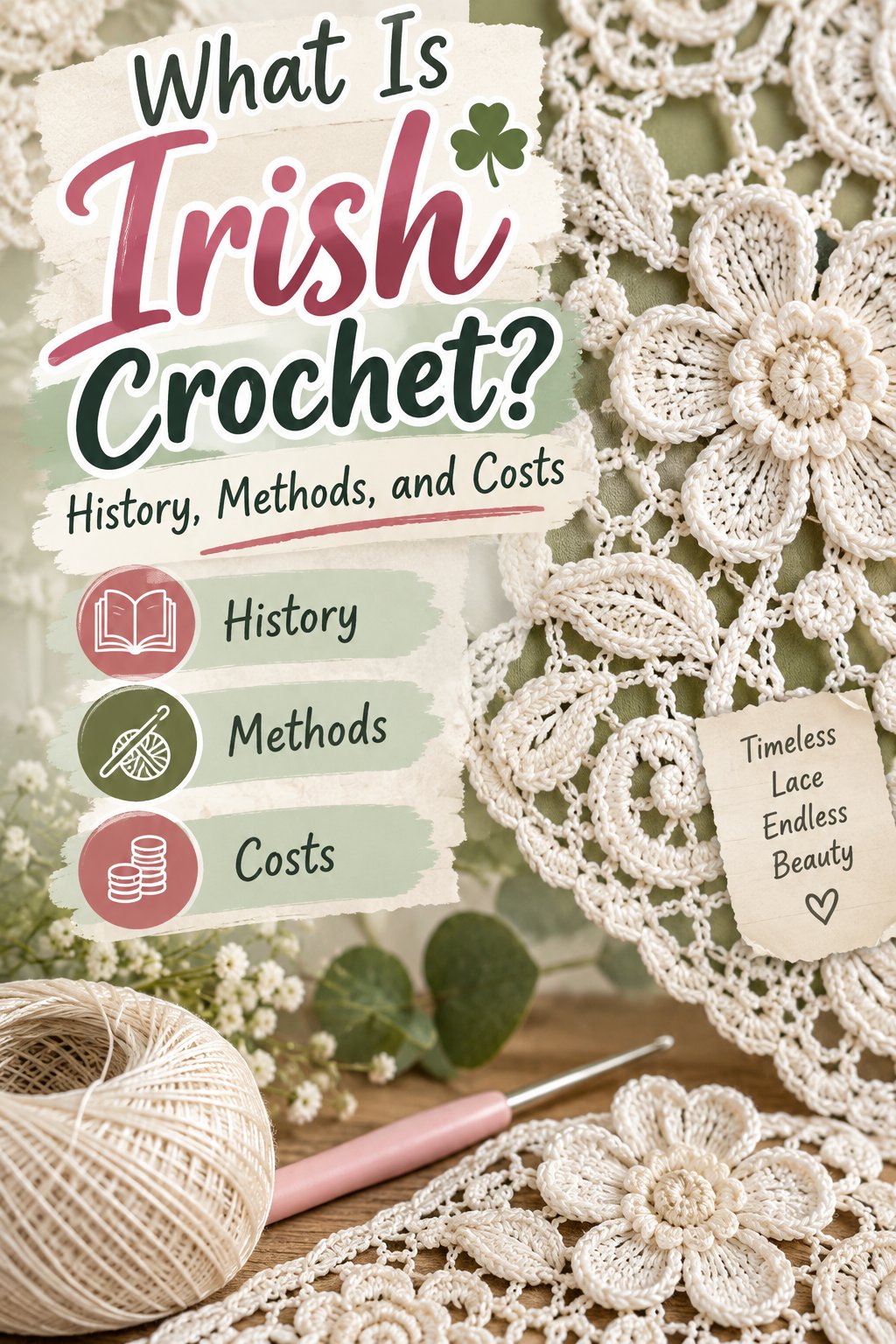
Irish crochet is a 19th-century lace-making technique that combines raised botanical motifs with a separately worked, irregular crochet mesh. Makers arrange flowers, leaves, cords, and scrolls on a template, then connect them from the reverse with fine chains, picots, knots, and small crochet stitches to create sculptural lace fabric.
Key Facts About Irish Crochet
- Irish crochet developed in Ireland during the 19th century and drew inspiration from expensive Venetian needle lace.
- The lace is assembled from separate motifs rather than worked continuously in rows.
- Padding cord, often called cordonnet or foundation cord, gives flowers and leaves their raised profile.
- Motifs are arranged face down on a paper or fabric template before the background mesh is crocheted.
- Traditional tools include fine cotton or linen thread and steel hooks commonly measuring about 0.5-1.5 mm.
- A small accessory may require 15-30 hours, while a complex garment can require 200-500 or more hours.
What Is Irish Crochet Lace?
Irish crochet lace is a freeform or semi-planned lace structure in which solid, dimensional motifs are joined by an open crochet ground. The motifs usually depict roses, shamrocks, leaves, grapes, tendrils, and scrolls, while the connecting mesh fills the irregular spaces left between them.
The method differs from ordinary crochet because the maker does not usually crochet the entire garment from the first chain to the final round. A collar, yoke, or panel is treated as an arrangement of components. This makes the work adaptable to curved outlines, although it also creates more decisions about spacing, balance, and tension.
The term “Irish crochet” can describe both the technique and the finished lace. “Crochet lace” is broader and may include filet crochet, pineapple crochet, Bruges crochet, and other openwork methods. Irish crochet specifically signals the motif-based construction, relief, and joining process.
Anatomy of the Lace
| Component | Typical material or size | Function | Visible result |
|---|---|---|---|
| Main motif thread | Mercerized cotton, sizes 10-40 | Builds flowers, leaves, and cords | Dense raised forms |
| Padding cord | Cotton cord or several thread strands | Supports relief stitches | Rounded edges and ridges |
| Joining thread | Fine cotton, sizes 40-100 | Creates the mesh ground | Light open background |
| Template | Paper, muslin, or cotton fabric | Fixes project shape | Controlled garment outline |
| Temporary stitches | Sewing thread and needle | Holds motifs during assembly | Removable construction support |
A strong piece has contrast between dense motif areas and open ground. If the mesh becomes as visually heavy as the motifs, the lace loses the airy quality associated with the technique.
Where Did Irish Crochet Come From?
Irish crochet emerged in the mid- to late-19th century, when Irish makers adapted the visual language of Venetian needle lace to a faster hooked method. The technique became especially important during and after the Great Famine of 1845-1852 because lace production offered income that could be generated in homes and small workshops.
The famine did not create every component of the method from nothing. European lace traditions, Irish craft practice, commercial pattern books, and entrepreneurial teaching networks all contributed to its development. Mademoiselle Éléonore Riego de la Branchardière helped popularize crochet lace through widely circulated pattern books, although the production of Irish crochet involved many regional makers rather than one inventor.
In practice, the cottage-industry model divided labor. One person might make motifs, another might join them, and a local dealer could collect and sell the finished lace. Clones in County Monaghan became strongly associated with a distinctive form of Irish crochet, while other areas developed their own motifs and construction habits.
The National Inventory of Intangible Cultural Heritage in Ireland describes Irish crochet lace as “a distinctive form of lace-making which uses crochet stitches to create three-dimensional motifs.” That wording matters because the relief is not a decorative afterthought. It is one of the technique’s defining structural features.
Historical Development
| Period | Development | Typical product | Market context |
|---|---|---|---|
| 1840s-1850s | Crochet lace expands during famine-era hardship | Collars, cuffs, small trims | Household income |
| 1860s-1890s | Pattern books and commercial networks spread motifs | Capes, bodices, table pieces | European fashion trade |
| 1890s-1910s | Baby and fine repetitive styles gain popularity | Edwardian collars and yokes | Department-store and private markets |
| Mid-20th century | Industrial textiles reduce demand | Heirloom pieces and teaching samples | Declining commercial production |
| 21st century | Designers revive freeform and colored versions | Jewelry, garments, art textiles | Craft, fashion, and heritage markets |
Irish crochet was historically valued partly because a hook could produce lace more quickly than some needle-lace methods. “Faster” did not mean easy. A detailed garment still required hundreds of small components, careful arrangement, and extensive joining.
How Does Irish Crochet Work?
Irish crochet works in four connected phases: motifs are made first, the design is arranged on a template, the open ground is crocheted around the pinned forms, and the completed lace is released and blocked. The technique is worked largely from the back, so the maker must judge the front appearance indirectly during assembly.
1. Make the Raised Motifs
The maker begins with individual flowers, leaves, wheels, cords, or scrolls. A padding cord is covered with tight stitches, often single crochet or related dense stitches, so the thread builds around rather than merely beside the support.
A flower can be shaped by increasing around a central ring, folding petals, or working petals over a cord. Leaves may use increases for width and decreases for a pointed tip. The exact pattern varies, but the aim is a firm form with controlled curvature.
Padding must remain consistent. A cord that changes thickness produces motifs with uneven edges, and a loosely held cord allows the border to flatten after washing.
2. Prepare and Arrange the Template
The project outline is drawn on paper, muslin, or another stable, non-stretch surface. Motifs are placed with the right sides facing the template, which means the visible front usually faces downward during joining.
Large elements should be positioned first. Smaller leaves, bars, and curls can then fill awkward spaces without forcing the main composition out of shape. Basting is safer than relying only on pins for a large garment because pins can shift, snag thread, or leave a motif slightly rotated.
3. Crochet the Mesh Ground
The joining thread is often finer than the motif thread. From the wrong side, the maker works chains, single crochet, double crochet, picots, bars, and decorative knots across the spaces between motifs.
The ground is not necessarily a regular square or diamond grid. Freeform Irish crochet uses changing loop lengths and connection points, which allows the mesh to follow curved leaves and irregular outlines. The background should connect motifs without pulling them together.
The mesh is where many first projects fail. A chain loop that looks loose on the board may tighten after release, while a loop that looks neat may become too slack when the lace is blocked. A small test section is more reliable than judging tension from one isolated loop.
4. Release, Inspect, and Block
When every motif is connected, remove the basting stitches and lift the lace carefully from the template. Inspect the front before washing or pressing because repairs are easier while the joining thread remains accessible.
Blocking establishes the final outline. Pin the lace to the intended dimensions, cover it with a damp cloth if the fiber permits, and allow it to dry fully. Direct high heat can flatten padded motifs or alter cotton thread tension.
Construction Sequence
- Select motif and mesh threads with compatible fiber content.
- Draw the finished outline at full scale.
- Crochet and label enough motifs for the planned composition.
- Place large motifs first, then fill gaps with leaves and small elements.
- Pin or baste the arrangement with right sides facing the template.
- Test the joining mesh in one corner before covering the entire piece.
- Work the ground from the reverse, checking the front after each section.
- Secure loose ends without creating hard knots on visible edges.
- Remove temporary supports and inspect joins.
- Block to the template dimensions and dry completely.
What Are the Main Styles of Irish Crochet?
The main styles include traditional freeform Irish crochet, Clones lace, Rosslea lace, baby Irish crochet, and contemporary interpretations from Eastern Europe. These labels overlap in practice, and “modern Eastern European style” describes a recent design direction more than a single historical regional lace tradition.
- Traditional freeform Irish crochet: Irregular motifs and a mesh ground planned around the project outline.
- Clones lace: A County Monaghan tradition associated with the textured Clones knot and compact raised forms.
- Rosslea lace: A Fermanagh-associated style known for particular local patterns and openwork arrangements.
- Baby Irish crochet: Smaller repeated motifs placed in more regular trellis, shell, or geometric frameworks.
- Contemporary colored work: Modern pieces using several colors, mixed thread weights, and asymmetrical compositions.
| Style | Motif scale | Ground pattern | Typical visual character | Common use |
|---|---|---|---|---|
| Freeform traditional | 2-8 cm | Irregular mesh | Sculptural and organic | Yokes, collars, panels |
| Clones lace | 1-6 cm | Compact joining areas | Textured knots and dense relief | Heritage lace, trims |
| Rosslea lace | 1-5 cm | Structured openwork | Fine regional patterning | Collars, cuffs, inserts |
| Baby Irish crochet | 0.5-3 cm | Planned trellis or shells | Repetitive and delicate | Edwardian-style accessories |
| Contemporary colored work | 1-12 cm | Variable freeform mesh | Asymmetrical, high-contrast | Fashion and art textiles |
The label “baby” refers to motif size and delicacy, not necessarily an item made for babies. Fine thread, small shapes, and repetitive placement are the relevant characteristics.
Which Tools and Threads Do You Need?
Traditional Irish crochet requires a fine steel hook, smooth thread, a stable template, sharp scissors, pins, and a method for securing the work. Beginners can practice the assembly logic with thicker yarn, but ordinary yarn will not reproduce the scale, drape, or surface definition of heirloom lace.
Thread numbering can confuse new makers. In common cotton sizing systems, a higher number generally indicates a finer thread, so size 80 is thinner than size 20. Labels vary by manufacturer, however, and thread weight should be checked against the actual strand rather than inferred from the number alone.
| Project stage | Typical thread range | Hook range | Practical purpose |
|---|---|---|---|
| Practice motifs | Cotton yarn or thread size 10-20 | 1.5-3.5 mm | Learn shaping and padding |
| Standard motifs | Cotton size 20-40 | 0.75-1.25 mm | Build wearable lace |
| Fine joining mesh | Cotton size 40-80 | 0.5-0.9 mm | Reduce visual weight |
| Heirloom fine lace | Cotton size 80-100 | 0.4-0.7 mm | Produce very delicate ground |
| Linen interpretation | Fine linen thread | 0.6-1.25 mm | Create firmer, crisp lace |
Typical supply costs in the United States are approximately $15-$50 for thread, hooks, pins, and a small template. A ball or spool of mercerized cotton commonly costs $3-$8, while a steel or ergonomic lace hook often costs $5-$12.
A corkboard or dense foam board covered with muslin works well for temporary mounting. Avoid soft foam that compresses under pins because changing depth alters motif placement and mesh tension.
How Much Time and Money Does Irish Crochet Take?
Irish crochet costs relatively little in raw materials but demands substantial labor. A small motif may take 20-45 minutes, while an accessory can require 15-30 hours and an intricate garment 200-500 or more hours, depending on motif count, thread fineness, and the amount of freeform joining.
| Project | Typical materials cost | Typical labor time | Main time driver |
|---|---|---|---|
| Single rose or leaf sample | $3-$10 | 20-45 minutes | Petal or leaf shaping |
| Small collar or cuff pair | $15-$40 | 15-30 hours | Repeated joins and blocking |
| Handbag panel | $25-$75 | 25-60 hours | Lining and dense edges |
| Yoke or bodice insert | $30-$100 | 60-150 hours | Curved template and fitting |
| Intricate wedding garment | $150-$500 | 200-500+ hours | Motif volume and finishing |
Retail resale prices vary more than supply costs. A small vintage collar may sell for $50-$250, while a documented, well-preserved garment can command $300 to several thousand dollars. Provenance, condition, fiber quality, design originality, and repair history affect value more than the name alone.
A maker pricing a commission should calculate materials plus labor, not materials alone. At $20 per hour, a 75-hour panel already contains $1,500 in labor before design, communication, shipping, or overhead.
How Does Irish Crochet Compare With Other Lace?
Irish crochet differs from filet crochet, tatting, needle lace, and bobbin lace because it combines separate raised crochet motifs with a hand-built ground. Filet crochet is generally planned as a row-by-row grid, while tatting forms rings and chains with a shuttle or needle rather than constructing padded crochet motifs.
| Technique | Construction method | Surface relief | Planning logic | Typical best use |
|---|---|---|---|---|
| Irish crochet | Motifs joined by mesh | High, often 3D | Freeform or semi-planned | Garments and sculptural panels |
| Filet crochet | Row-by-row filled grid | Low, mostly flat | Charted squares | Curtains and geometric motifs |
| Tatting | Knotted rings and chains | Low, crisp edges | Repeated units | Edgings and doilies |
| Needle lace | Stitches over a support | Variable, often raised | Shaped sections | Fine couture and heirlooms |
| Bobbin lace | Interlaced threads on pillow | Low to moderate | Pricked pattern | Narrow trims and yardage |
Irish crochet is a poor choice when the project requires rapid yardage, perfectly repeated geometry, or a fully reversible surface. It is well suited to irregular outlines and three-dimensional decoration, but it consumes more planning time than a charted square-based method.
Is Irish Crochet Difficult for Beginners?
Irish crochet is difficult mainly because assembly and tension control matter as much as stitch knowledge. A beginner who can make chain, single crochet, double crochet, slip stitch, and increases can learn a basic motif, but a polished garment requires fine-thread handling and spatial planning.
Start with a 10-15 centimeter sampler rather than a full shawl. Use a medium cotton thread and a hook around 1.5-2.5 mm, then make one flower, two leaves, and a short section of mesh. This reveals whether the maker enjoys the repetitive joining work before expensive materials are purchased.
Common Failure Points
| Problem | Likely cause | Visible symptom | Correction |
|---|---|---|---|
| Motifs curl inward | Padding cord too loose | Edge loses definition | Maintain even cord tension |
| Mesh puckers | Joining loops too short | Lace contracts after release | Add longer test loops |
| Motifs rotate | Inadequate pinning or basting | Flowers sit off-axis | Anchor centers and outer points |
| Ground looks heavy | Joining thread too thick | Mesh competes with motifs | Use finer thread |
| Lace stretches unevenly | Template or board shifts | Outline changes after blocking | Use a rigid full-scale template |
| Ends show on front | Poor hiding route | Dark dots or ridges | Secure ends inside dense motifs |
Expert insight: The most common beginner mistake is measuring mesh by eye while the work is pinned. Measure the released sampler instead. A loop can appear proportional under board tension yet shrink enough after unpinning to distort two neighboring motifs.
Expert insight: Padding cord controls shape more reliably than extra surface stitches. Adding stitches to compensate for a loose foundation usually creates a bulky motif rather than a firm one.
Expert insight: Fine thread does not automatically create finer lace. A large hook, loose tension, or thick joining stitch can make size 40 thread look coarse, while a disciplined maker can produce a clean ground with a less expensive thread.
How Should You Wash, Block, and Store It?
Irish crochet should be washed gently by hand in cool or lukewarm water, rinsed without twisting, and dried flat to its measured shape. The correct care method depends on fiber, dye stability, age, and previous damage, so an antique or weakened piece should be assessed before immersion.
For a sound cotton piece, use a small amount of mild detergent and support the lace with both hands when lifting it from the water. Press moisture into a towel rather than wringing. Pin the damp lace to a measured template, place pins around curves and points, and let it dry fully.
Do not hang wet lace. The weight of water can stretch mesh openings and pull padded motifs out of alignment.
| Care situation | Safe starting method | Main risk | Better practice |
|---|---|---|---|
| New mercerized cotton | Cool hand wash | Color bleeding | Test a hidden thread first |
| Vintage cotton collar | Minimal immersion | Fiber fracture | Consult a textile conservator |
| Linen lace | Gentle wash and flat dry | Excess stiffness | Block while damp |
| Stained heirloom | Do not scrub locally | Permanent distortion | Document and assess first |
| Long-term storage | Acid-free tissue and flat box | Compression and yellowing | Refold rarely and inspect yearly |
Store lace flat in acid-free tissue inside a breathable archival box. Keep it away from direct sunlight, high humidity, wood acids, and metal that can rust.
How Can You Identify Authentic Irish Crochet?
Authentic Irish crochet is identified by construction evidence, not by a floral appearance alone. Look for separately formed motifs, padded relief, irregular joining mesh, and slight variation in connection points that reflects hand assembly.
A machine-made lace may imitate flowers but usually repeats the ground with uniform spacing and lacks the layered construction of padded crochet. A modern hand-crocheted piece can still be authentic in technique even if it was made outside Ireland, because “Irish crochet” names a method as well as a historical tradition.
When examining a vintage piece, turn it over. The reverse may reveal how motifs were basted, where joining threads cross, and whether the raised forms were crocheted independently. A sewn lace appliqué can resemble the front of Irish crochet but will not show the same crochet-built motif structure.
| Identification clue | Hand Irish crochet indication | Possible alternative |
|---|---|---|
| Motif edges | Covered cord and dense stitches | Flat machine embroidery |
| Background | Uneven hand-connected openings | Regular machine net |
| Reverse | Crochet joins and hidden ends | Sewn appliqué backing |
| Relief | Raised petals and leaf veins | Foam or fabric padding |
| Variation | Small spacing differences | Repeated automated pattern |
Labels, family records, maker marks, and documented Irish provenance increase historical significance, but geography alone does not prove technique. Construction remains the first test.
Which Project Should You Choose?
Choose a sampler or small collar if you want to learn motif assembly, a handbag panel if you want a contained practical project, and a garment only if you can maintain a full-scale template and commit to repeated fitting checks. The right project depends on tolerance for slow work, eyesight, hand comfort, and desired drape.
| Goal | Recommended project | Thread approach | Expected commitment |
|---|---|---|---|
| Learn padded motifs | 10-15 cm sampler | Size 10-20 cotton | 2-5 hours |
| Practice mesh | Small coaster or panel | Size 20-40 cotton | 5-12 hours |
| Make wearable trim | Collar or cuffs | Size 20-60 cotton | 15-30 hours |
| Test garment fitting | Yoke or sleeve insert | Size 30-80 cotton | 60-150 hours |
| Create heirloom lace | Full garment | Size 60-100 cotton | 200-500+ hours |
Irish crochet is especially suitable for collars, cuffs, yokes, sleeves, decorative bags, framed panels, and removable garment inserts. It is less suitable for projects that need uniform stretch, low labor, or easy machine washing.
Frequently Asked Questions About What Is Irish Crochet
Is Irish crochet the same as regular crochet?
Irish crochet is a specialized form of crochet lace, not a synonym for all crochet. Regular crochet is often worked continuously in rows or rounds, whereas Irish crochet usually uses separate raised motifs that are arranged and joined with a fine mesh background.
What is the Clones knot used for?
The Clones knot is a textured crochet element associated with Clones lace from County Monaghan. The maker wraps thread around the hook or a support to form a raised, compact looped feature, then secures it with a connecting stitch. Its exact execution varies among patterns and teachers.
Can Irish crochet be made with yarn?
Irish crochet can be practiced with yarn, but ordinary yarn changes the scale and drape of the finished work. Medium yarn and a 3.5 mm hook are useful for learning motif placement, while fine cotton or linen thread is needed for traditional lace proportions and an open mesh.
Why is the lace made upside down?
Motifs are commonly arranged with their right sides against the template so the joining work can be formed from the reverse. This keeps many connection points and thread ends away from the visible surface, although the maker must repeatedly inspect the front to control the composition.
Can Irish crochet be repaired?
Irish crochet can often be repaired when damage is limited to a few mesh links or loose ends. Extensive breaks in padded motifs, brittle antique thread, or severe discoloration require conservation rather than ordinary crochet repair because added tension can enlarge the original damage.
Is Irish crochet still made in Ireland?
Irish crochet is still practiced in Ireland through individual makers, heritage projects, workshops, and contemporary textile work. The technique is also made internationally, particularly by designers who adapt traditional motifs, colored threads, and freeform layouts for current garments and art pieces.
Conclusion
Irish crochet is a motif-based lace technique defined by raised crochet forms, padding cord, and a separately joined mesh ground. Its history connects Irish cottage production with Venetian lace influence, while its practical identity lies in the sequence of making, arranging, joining, releasing, and blocking. For a first project, begin with a small sampler or collar, use compatible fine thread, and budget labor as carefully as materials. That is what Irish crochet requires: controlled relief, deliberate composition, and patience measured in hours rather than rows.