
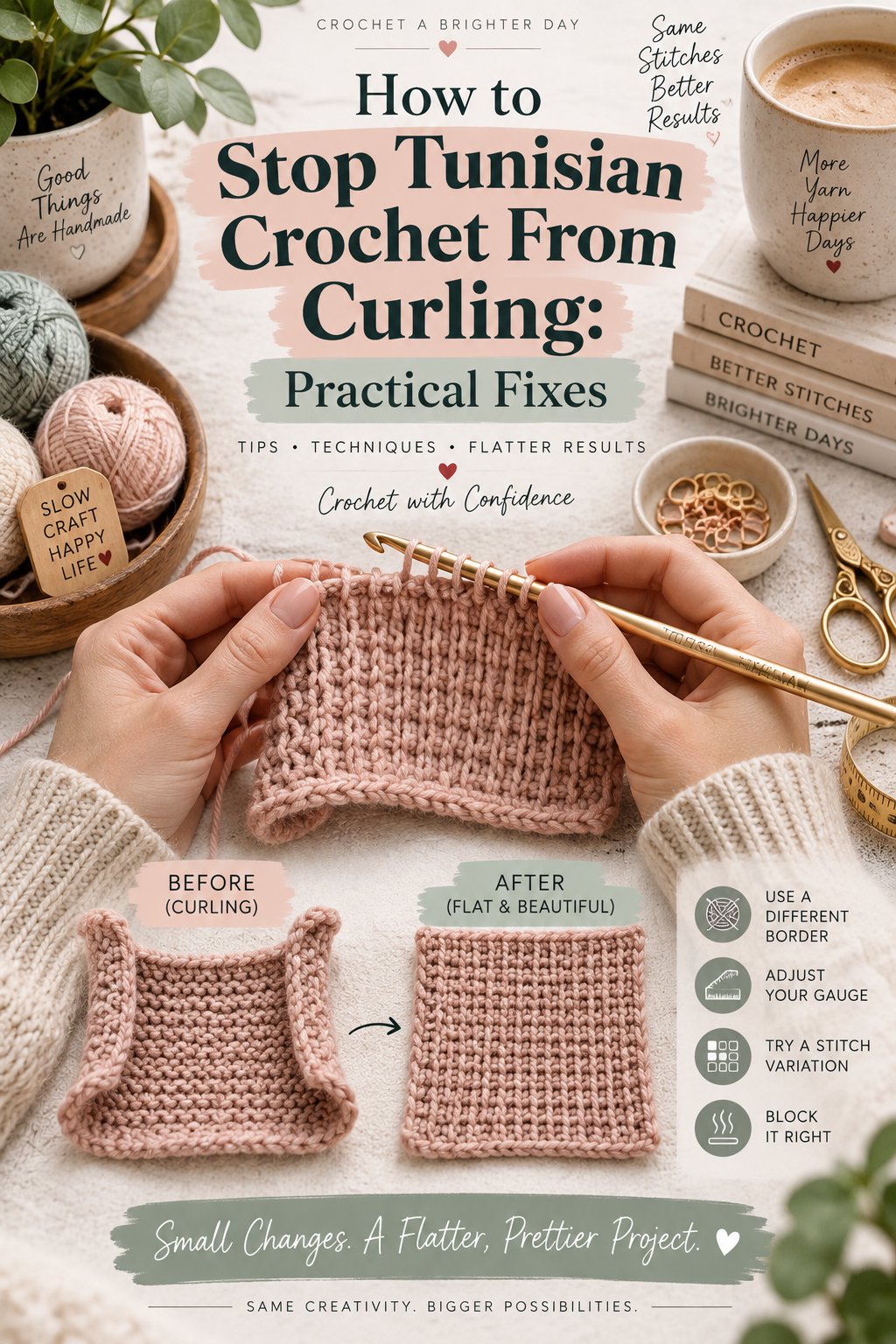
How to Stop Tunisian Crochet From Curling depends on correcting tension, stitch structure, and finishing. Tunisian crochet naturally rolls because the forward pass and return pass place different forces on opposite fabric faces. A larger hook, relaxed loops, balancing stitches, a firm border, and fiber-appropriate blocking can flatten most projects without sacrificing the intended drape.
Key Facts and Quick Answer
Use a Tunisian hook 1-2 mm larger than the yarn label’s standard crochet recommendation, then make a gauge swatch.
Keep the foundation chain, edge loops, and return pass as relaxed as the center stitches.
Tunisian Knit Stitch and Tunisian Simple Stitch usually curl more than Tunisian Purl Stitch or Honeycomb Stitch.
A 3-5-row balancing section or a traditional crochet border can reduce edge roll before finishing.
Wet-block wool and many cotton projects for 12-24 hours; steam-block acrylic from a distance because direct heat can permanently flatten or melt texture.
Block to the finished dimensions, not merely until the fabric looks flat while pinned.
Why Does Tunisian Crochet Curl?
Tunisian crochet curls because the fabric develops unequal longitudinal and transverse tension between its forward and return passes. The foundation edge, side edges, and stitch orientation can each contribute, so changing only the final finishing step does not always solve a fabric that was built too tightly.
In the forward pass, the hook collects loops across the row. Those vertical elements create the visible columns associated with Tunisian Simple Stitch, Tunisian Knit Stitch, or another selected stitch. In the return pass, the crocheter draws yarn through the loops in stages, forming a chain-like structure across the back.
The two passes do not use yarn in identical ways. A dense return pass can contract across the row, while the front-facing columns resist that contraction differently. Tight working tension increases the imbalance. A small hook makes each loop shorter and more compressed, which gives the fabric less room to settle flat.
The foundation chain can create a second problem. A tightly crocheted chain acts like a narrow, rigid lower edge while the Tunisian rows expand above it. That difference pulls the bottom inward. Side edges can behave similarly when the first and last loops are smaller than the center loops.
Curl is therefore structural, not automatically a sign of poor workmanship. Some stitches have a strong tendency to roll even when the tension is consistent.
What the Forward and Return Passes Do
| Fabric area | Construction action | Common tension effect | Visible result |
|---|---|---|---|
| Forward pass | Loops are picked up across the row | Vertical bars become compact | Front face feels firm |
| Return pass | Yarn is drawn through loops from left to right | Crosswise contraction can increase | Back face pulls inward |
| Foundation edge | Chain supports the first Tunisian row | Tight chain resists expansion | Lower edge rolls upward |
| Side edges | First and last loops repeat each row | Small edge loops concentrate force | Left and right edges curl inward |
An important correction is that the return pass is not independently “wrong” or always denser than the front. Curl results from the relationship between both passes, the yarn, the hook, the stitch, and the crocheter’s tension. That distinction matters because making only the return pass extremely loose can create ladders, uneven row height, or a distorted selvedge.
How to Prevent Curl Before It Starts
The most effective prevention combines a larger hook, relaxed edge handling, and a stitch pattern with opposing directional forces. Prevention works best during the gauge stage, because a finished panel with severe curl may need reshaping, a border, or partial frogging.
Choose the Right Hook Size
A Tunisian hook commonly needs to be 1-2 mm larger than the standard crochet hook suggested for the yarn. The larger shaft increases loop height and reduces compression, but the correct size depends on whether the project needs drape, density, warmth, or dimensional stability.
Use the yarn label’s recommendation as a starting point, not a Tunisian specification. For example, yarn labeled for a 5.0 mm crochet hook might begin testing at a 6.0 mm or 6.5 mm Tunisian hook.
| Yarn label recommendation | First Tunisian hook test | Second test | Likely fabric change |
|---|---|---|---|
| 3.5 mm | 4.5 mm | 5.0 mm | More flexible, less compact |
| 4.0 mm | 5.0 mm | 5.5 mm | Moderate drape increase |
| 5.0 mm | 6.0 mm | 6.5 mm | Noticeably softer fabric |
| 6.0 mm | 7.0 mm | 8.0 mm | Looser, warmer, less rigid |
Make two swatches rather than assuming the biggest hook is best. A hook that reduces curl may also produce oversized stitches, visible gaps, weak edges, or a fabric too loose for a blanket.
Relax the Edge and Return Pass
Keep the first and last working loops close to the height of the center loops. Pulling edge loops tight creates a drawstring effect, and the repeated edge tension accumulates over every row.
During the return pass, draw the yarn through smoothly without cinching the horizontal chain. The loops should slide over the hook with mild resistance. If the hook bends the fabric sharply or the return chain looks visibly narrower than the forward row, reduce hand pressure and test again.
A practical tension test is to pause after five rows and lay the swatch on a table. If the center lies flat but both edges form tight tubes, the problem is probably edge tension. If the entire swatch forms a shallow cylinder, the hook size or stitch pattern is the stronger suspect.
Build a Balanced Foundation
The foundation chain should not be tighter than the Tunisian rows. For a long foundation, use a hook slightly larger than the working hook, work the chain loosely, or begin with a foundation method that creates more flexible loops.
Do not automatically size up for every foundation. An excessively loose chain can create scalloped lower edges. The target is consistent width, not maximum looseness.
Which Tunisian Stitches Curl Most?
Tunisian Knit Stitch and Tunisian Simple Stitch generally curl more strongly than Tunisian Purl Stitch and balanced combinations. Stitch direction changes how much each row pulls toward the front or back, so a stitch substitution can alter both curl and fabric behavior.
| Stitch or method | Typical curl level | Fabric thickness | Stretch and drape | Suitable use |
|---|---|---|---|---|
| Tunisian Simple Stitch | High | Medium | Low to moderate | Blankets, panels, textured accessories |
| Tunisian Knit Stitch | Very high | Thick | Moderate | Dense garments, warm accessories |
| Tunisian Purl Stitch | Low | Medium | Low | Borders, balancing rows, flat panels |
| Tunisian Honeycomb | Low | Medium-thick | Moderate to high | Scarves, garments, cushions |
| Tunisian Reverse Stitch | Low to moderate | Medium | Moderate | Borders and contrasting sections |
| Alternating TSS and TPS | Moderate to low | Medium | Moderate | Edges, transitions, broad panels |
Tunisian Honeycomb Stitch balances forward-facing and recessed stitches, which often produces a flatter surface than a large area of Tunisian Knit Stitch. The trade-off is additional pattern tracking and a different texture on each side.
Tunisian Purl Stitch can help counteract curl, but it is not a universal cure. A narrow purl section may flatten one edge while the main body continues to roll. The balancing section needs enough rows or width to influence the fabric’s overall tension.
Use Alternating Stitches at the Edges
A practical edge treatment is to work 3-5 rows of Tunisian Honeycomb, Tunisian Purl, or another balancing pattern at the beginning and end of a panel. For side edges, add a stable selvedge or plan a traditional crochet border after the panel is complete.
For a Tunisian Knit Stitch scarf, a balanced beginning might use five rows of alternating Tunisian Simple Stitch and Tunisian Purl Stitch, followed by the knit-stitch body. Repeat the same treatment at the end. Symmetry matters because a flat beginning and a curling ending can still make the finished scarf buckle.
Which Fix Works Best for a Finished Piece?
Blocking is the first finishing option for a completed piece, but its permanence depends on fiber content and the severity of the original curl. A border supplies physical restraint, while blocking changes the fiber’s temporary or permanent shape.
| Method | Typical active time | Waiting time | Best fibers | Main limitation |
|---|---|---|---|---|
| Wet blocking | 15-25 minutes | 12-24 hours | Wool, cotton, linen, blends | Needs complete drying |
| Steam blocking | 10-20 minutes | 30-90 minutes | Acrylic, wool, blends | Heat can damage fibers |
| Spray blocking | 10-15 minutes | 4-12 hours | Mildly responsive fibers | Weak for severe curl |
| Crochet border | 30-120 minutes | None | All fibers | Adds width and stiffness |
| Reworking rows | Project-dependent | None | All fibers | Uses additional yarn and time |
Wet-Block Wool, Cotton, and Linen Carefully
Wet blocking works by saturating the fabric, arranging it while damp, and allowing it to dry in the desired dimensions. Wool and wool blends respond particularly well because their fibers can relax and hold a reshaped form after drying.
Cotton and linen can flatten under wet blocking, but they may stretch when wet and remain wider or longer than expected. Measure the damp panel and compare it with the intended size. Do not pull aggressively to eliminate curl, because the final fabric may become permanently oversized.
Superwash wool often stretches more than untreated wool. Pinning a wet superwash panel to an exact measurement is important, especially for garments and sleeves.
Use rust-resistant pins and a breathable surface. Leave the panel undisturbed until the interior is fully dry, not merely dry at the edges.
Steam-Block Acrylic Without Melting Texture
Acrylic usually responds poorly to ordinary wet blocking because water alone does not reset its shape in the same way that heat-sensitive animal fibers can. Steam can relax acrylic, but excessive heat permanently softens, flattens, or fuses the plastic fibers, a process crocheters often call “killing” the acrylic.
Pin the piece to the desired dimensions, hold the steamer or steam iron approximately 25 mm, or 1 inch, away, and let steam pass over the surface without touching the yarn. Allow the piece to cool completely before removing the pins.
Test the method on a swatch first. A swatch reveals whether the yarn develops shine, loses stitch definition, or becomes unnaturally limp.
Never press a hot iron directly onto Tunisian fabric. Direct contact can crush raised stitches and leave a glossy patch that cannot be reversed.
Add a Structural Border
A border is often the most dependable solution for a blanket, placemat, or scarf that must remain flat during ordinary use. Traditional single crochet or half double crochet can add perimeter stability, but a border also increases the final dimensions.
Work one round first and place the panel on a flat surface. If the edge still ripples, the border is too tight or contains too many stitches. If the edge cups, the border is too short or too tightly tensioned.
| Border approach | Typical rounds | Width added per side | Result |
|---|---|---|---|
| Single crochet | 1-2 | 4-10 mm | Firm, narrow edge |
| Half double crochet | 1-3 | 8-20 mm | Softer, wider frame |
| Tunisian Purl section | 3-5 rows | Pattern-dependent | Integrated texture |
| Ribbed crochet border | 2-4 rounds | 10-25 mm | Flexible but structured |
Corners require special attention. Add enough stitches to turn without pulling, but avoid arbitrary increases that create flares. A test corner on a small swatch is faster than removing a full border.
A Practical Repair Sequence
Follow the least destructive intervention first. Reworking is appropriate only when the yarn, stitch, or finished dimensions make blocking and edging inadequate.
- Identify the curl location. Record whether the bottom, sides, or entire panel rolls.
- Measure the relaxed swatch. Note width, height, and the amount of lift at the edge.
- Check the yarn fiber. Separate wool, cotton, linen, acrylic, and blends before choosing heat or moisture.
- Inspect the stitch pattern. TSS and TKS usually need more balancing than Honeycomb or TPS.
- Test the hook size. Make a small swatch with a hook 1 mm larger, then another 2 mm larger.
- Compare edge tension. Match the first and last loops to the center-loop height.
- Block a sample. Use wet blocking for responsive natural fibers and cautious steam for acrylic.
- Add a border if needed. Choose a firm, proportionate edging that does not buckle.
- Rework only when necessary. Restart if the fabric remains cylindrical, changes dimensions excessively, or cannot meet the project’s functional needs.
The mistake most people make is blocking the full project before diagnosing the cause. A swatch can show whether the curl returns after drying, which tells you whether finishing alone is enough.
When Should You Restart Instead of Blocking?
Restart when the unblocked fabric is dramatically denser than the required gauge, when the edges remain tightly tubular after a controlled test, or when the project needs a flat surface that a border would make too rigid. Blocking can reshape fabric, but it cannot reliably transform an unsuitable stitch and hook combination into the intended gauge.
| Condition after swatching | Recommended action | Why |
|---|---|---|
| Curl decreases by half after blocking | Continue and finish | Fiber responds well |
| Curl remains severe, gauge is correct | Add balancing rows or border | Structure needs restraint |
| Fabric is 15% or more too narrow | Increase hook or rework | Blocking may overstretch it |
| Acrylic loses texture under steam | Stop heating | Further steam may permanently flatten it |
| Edge loops are visibly tighter | Correct tension first | Blocking will not remove the cause |
| Panel forms a rigid tube | Change stitch or hook | Structural imbalance is excessive |
A blanket can tolerate more curl than a garment yoke or bag base. Function determines the acceptable threshold. A rolled scarf edge may be intentional; a rolled cardigan hem can distort the entire fit.
Costs, Time, and Project Planning
Most prevention costs nothing when the crocheter already owns a larger hook, but buying a dedicated Tunisian hook changes the budget. Typical prices vary by material, length, cable design, and whether the hook is sold singly or in a set.
| Supply or intervention | Typical USD cost | Typical time | Planning note |
|---|---|---|---|
| Single aluminum Tunisian hook | $5-$15 | Immediate | Useful for one yarn weight |
| Interchangeable Tunisian set | $25-$90 | 5-10 minutes setup | Covers several cable lengths |
| Foam blocking mats | $15-$30 | 5 minutes setup | Reusable for many projects |
| Rust-resistant T-pins | $6-$15 | 2-5 minutes setup | Avoid ordinary steel pins |
| Three-round crochet border | $3-$12 yarn cost | 30-120 minutes | Depends on perimeter length |
| Wet blocking | $0-$30 | 15-25 minutes active | Drying usually takes 12-24 hours |
A long panel may require a cable hook even when the stitch gauge is correct. If the loops crowd the cable, they compress and can reproduce the same tension problem that the larger hook was meant to solve.
Troubleshooting Common Edge Problems
Why Does the Foundation Edge Curl?
A foundation edge curls when its chain or pickup loops are tighter than the first Tunisian rows. The lower edge then acts as a contracted band, pulling the fabric upward.
Use a larger hook for the chain, loosen the chain tension, or work a flexible foundation. If the first row is already complete, a foundation border can hide minor distortion, but severe contraction usually requires reworking.
Why Do Only the Side Edges Roll?
Side-only curl usually indicates tight first or last loops, insufficient selvedge stitches, or the natural direction of the chosen stitch. Compare the outermost loops with the center. If the outside loops are visibly smaller, tension is the primary cause.
A border can correct mild side curl. For a narrow scarf, two or three rows of a balancing stitch along each side may be less bulky than a full traditional crochet frame.
Why Does the Fabric Curl Again After Washing?
A piece can curl after washing when the fibers relax unevenly, the fabric was not dried in its finished dimensions, or heat reactivated synthetic memory. Wash and dry a swatch using the same method intended for the project.
Wool should be reshaped while damp and dried flat. Acrylic should be washed gently and dried according to the yarn manufacturer’s instructions, because high dryer heat may alter the fabric more than careful steam blocking.
Can More Blocking Damage Tunisian Crochet?
Blocking can damage Tunisian crochet when the fabric is stretched beyond its natural gauge, acrylic is overheated, or wet wool is handled roughly. Excessive pinning can create sharp points at the edges, while pulling a cotton panel too far can produce permanent distortion.
Block to the measurement required by the pattern. Do not treat complete flatness as the only success criterion.
Expert Rules That Prevent Repeat Problems
Swatch in the actual stitch. A Tunisian Simple Stitch swatch cannot predict the curl, density, or drape of Tunisian Knit Stitch. The stitch’s structure matters as much as the yarn label.
Measure after finishing. Record the blocked width and height, then wash the swatch once. If the dimensions change by more than approximately 5%, include that change in the project plan.
Balance before framing. A border should stabilize an acceptable fabric, not conceal a severely unsuitable one. If the center remains curled, a perimeter frame may create a flat-looking edge around a distorted interior.
Keep the return pass consistent. Beginners often loosen every return pass after hearing that tight returns cause curling. Excessive looseness produces uneven row height, so aim for smooth, repeatable movement instead of the largest possible loops.
Frequently Asked Questions About How to Stop Tunisian Crochet From Curling
Does Tunisian crochet always curl at the beginning?
Tunisian crochet does not always curl severely, but many stitch patterns show some initial roll. Tunisian Simple Stitch and Tunisian Knit Stitch are especially prone to it. A larger hook, relaxed foundation chain, balanced edge rows, and blocking usually reduce mild curl before the project grows.
Is Tunisian crochet better with a larger hook?
A Tunisian hook 1-2 mm larger than the standard crochet recommendation often produces a flatter, more flexible fabric. The larger hook is not automatically better for every project, because blankets, bags, and structured garments may need the density of a smaller hook. Always compare swatches for gauge and drape.
Should I block Tunisian crochet before adding a border?
Block the panel first when its dimensions or curl are uncertain. Pre-blocking shows whether the yarn responds to moisture or steam and prevents a border from hiding a major structural problem. For mild curl, you can add the border first and perform final blocking afterward.
Which yarn is easiest to flatten?
Wool and wool blends are generally easiest to reshape through wet blocking, while cotton and linen can also respond but may stretch. Acrylic usually needs cautious steam. Fiber blends behave according to their dominant and most heat-sensitive component, so a small test swatch is safer than relying on the label alone.
Can a Tunisian crochet blanket lie flat without a border?
A Tunisian blanket can lie flat without a border when the hook size, foundation tension, stitch pattern, and finishing are balanced. Large areas of Tunisian Knit Stitch often benefit from a border because their dense vertical structure generates stronger roll. A border remains optional for a properly tensioned, blocked panel.
How many rows should a Tunisian crochet border have?
A practical starting point is 3-5 rows of Tunisian Purl, Honeycomb, or another balancing stitch at the beginning and end of a panel. A traditional crochet border commonly uses 1-3 rounds. Choose the number by the panel’s curl and final proportions, not by a fixed universal rule.
Conclusion
How to Stop Tunisian Crochet From Curling starts with prevention: use a hook 1-2 mm larger, keep the foundation and edge loops relaxed, and choose balancing stitches where needed. Diagnose the fiber and stitch before blocking, then wet-block responsive natural fibers, steam acrylic cautiously, or add a proportionate border when physical restraint is necessary.