
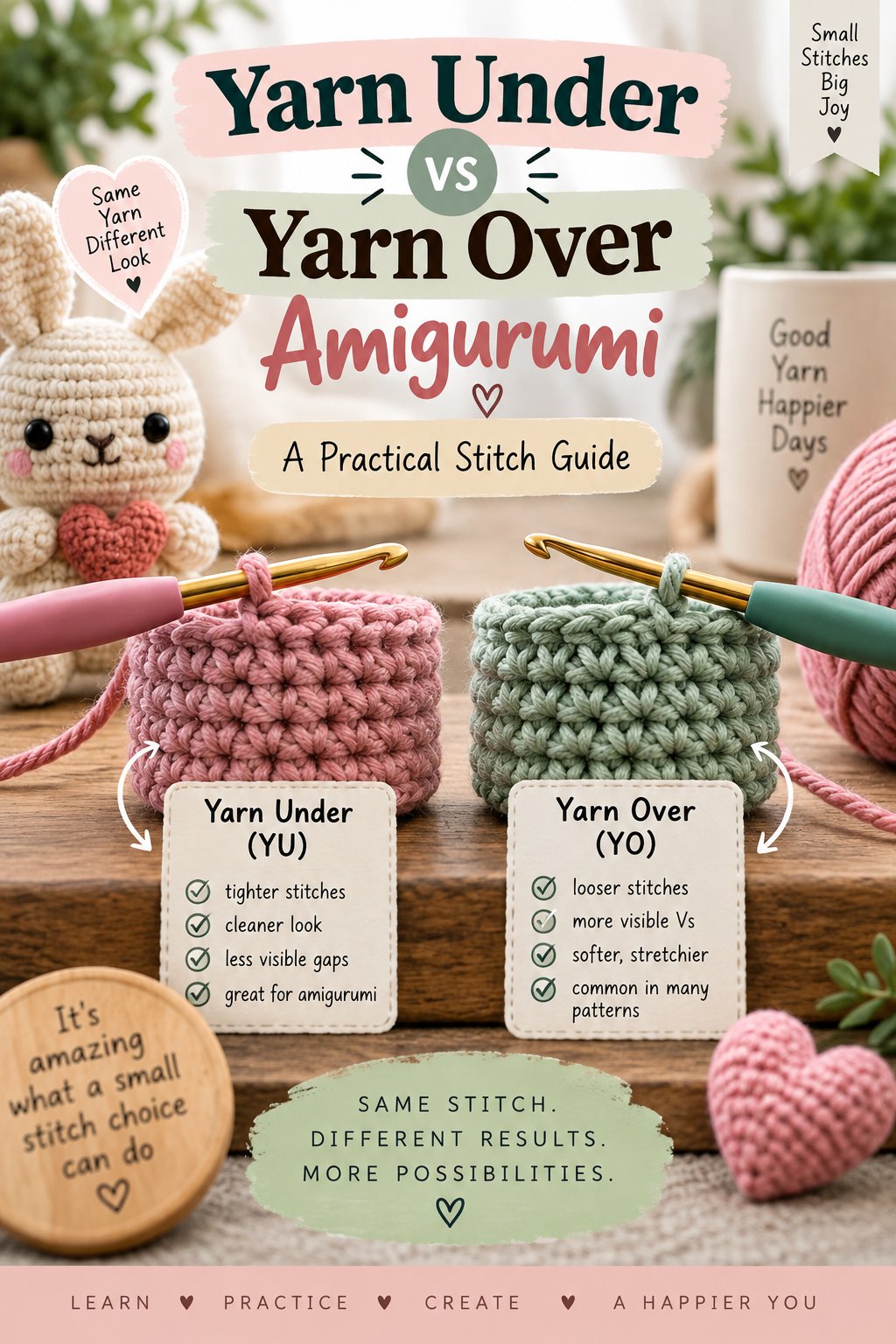
Yarn Under vs Yarn Over Amigurumi compares two ways to wrap yarn during single crochet. Yarn over produces the familiar V-shaped stitch with more flexibility, while the common yarn-under hybrid produces a compact X-shaped stitch with denser fabric, altered gauge, and cleaner stacked colorwork.
Key Facts / Quick Answer
YO/YO is the conventional single crochet method and usually creates visible V-shaped stitches.
YU/YO is the common amigurumi yarn-under method: yarn under when drawing up the loop, then yarn over to finish the stitch.
YU/YO typically makes fabric shorter and denser, but the exact change depends on yarn, hook, tension, and stitch count.
A typical 10 cm amigurumi test may become 8.5-9.5 cm with YU/YO, although no universal percentage applies.
Yarn under can reduce stuffing visibility, but a smaller hook, tighter tension, or invisible decrease may solve the same problem.
Test a 10 cm swatch before changing a published pattern, and keep the wrapping style consistent throughout the project.
What Yarn Under and Yarn Over Mean
Yarn over and yarn under describe how the hook captures yarn during a crochet movement. In amigurumi, the distinction matters because single crochet is repeated hundreds of times, so a small change in loop geometry accumulates across every round.
With a yarn over, the hook passes under and behind the working yarn, then catches the strand over the hook. With a yarn under, the hook approaches from above the strand and catches it by drawing the yarn down and through the loop. Different designers sometimes describe the motion from the hook’s perspective, so the finished fabric is a more reliable reference than the label alone.
Most amigurumi makers compare these three constructions:
| Construction | First pull-through | Final pull-through | Usual appearance |
|---|---|---|---|
| YO/YO | Yarn over | Yarn over | V-shaped single crochet |
| YU/YO | Yarn under | Yarn over | X-shaped single crochet |
| YU/YU | Yarn under | Yarn under | Very compact, twisted stitch |
The YU/YO hybrid is usually what crochet patterns mean when they recommend “yarn under” for amigurumi. Pure YU/YU is possible, but it often makes the fabric excessively tight and slows insertion into the next stitch. It also increases finger, thumb, and wrist effort for many crocheters.
How the wrap changes a single crochet
A single crochet has two main pull-through actions. First, the hook draws up a loop through the stitch. Second, the hook pulls through both loops on the hook to complete the stitch.
Changing the wrap on the first action changes how the two legs of the completed stitch sit. Changing the second action changes the twist and compression of the stitch. The hybrid YU/YO method therefore gives a compact base loop while retaining a conventional closing motion.
The difference is small at one stitch and significant across a sphere. On a 48-stitch round, even a fraction of a millimeter in average stitch width can change the circumference by several millimeters. Across 20 rounds, reduced stitch height can change the toy’s proportions.
Why Does Yarn Under Make an X Stitch?
Yarn under usually makes an X-shaped single crochet because the first loop is drawn through with the strand crossing in a different direction. The crossing changes the orientation of the stitch legs, so the rows look like repeated X marks rather than aligned V shapes.
The X appearance is clearest with smooth, tightly spun yarn in a contrasting color. Cotton yarn often shows the structure more sharply than acrylic because its lower halo leaves the stitch surface exposed. Chenille and velvet yarn can hide much of the difference, although the underlying gauge still changes.
| Fabric attribute | YO/YO typical result | YU/YO typical result | Practical consequence |
|---|---|---|---|
| Stitch symbol | V | X | Different visual identity |
| Stretch across fabric | Moderate | Low to moderate | YU/YO resists stuffing expansion |
| Row height | Baseline | Commonly 5-15% shorter | Spheres can become squat |
| Stitch width | Baseline | Often 3-10% narrower | Circumference can shrink |
| Surface spacing | Small gaps under tight tension | Smaller gaps | Less stuffing visibility |
| Color-change alignment | Can lean diagonally | Often stacks more vertically | Cleaner stripes and motifs |
The X does not automatically mean the fabric is better. It means the fabric has a different architecture. A stiff X stitch can improve shape retention, while a flexible V stitch can make limbs easier to bend and stuffed bodies easier to sculpt.
Yarn Under vs Yarn Over Amigurumi: Practical Comparison
Yarn Under vs Yarn Over Amigurumi is best decided through gauge, not through a universal claim that one method is always tighter. A typical smooth-yarn comparison shows YU/YO producing a smaller, denser piece, but hook diameter and personal tension can outweigh the wrapping method.
The following figures are practical ranges for a 10 cm target toy made with worsted-weight acrylic and a 3.0-3.5 mm hook. They are not laboratory constants, because yarn brands, loop height, stuffing pressure, and crocheter technique alter the result.
| Metric | YO/YO typical range | YU/YO typical range | Interpretation |
|---|---|---|---|
| Finished diameter | 9.5-10.5 cm | 8.5-9.7 cm | YU/YO often produces a smaller body |
| Visible fabric gaps | 1-3 mm | 0-2 mm | Lower gap size reduces stuffing show-through |
| Yarn used for a 100 g project | 70-100 g | 60-90 g | Shorter stitches can reduce consumption |
| Crochet time for a small sphere | 90-130 minutes | 100-150 minutes | Tight insertion may slow the work |
| Hook size range | 3.0-3.5 mm | 2.5-3.25 mm | YU/YO does not require a smaller hook |
| Fabric stretch | About 10-20% | About 5-12% | Approximate hand-stretch range |
The percentage difference is not predictable enough to replace a swatch. A relaxed YO crocheter may produce looser fabric than a firm YU/YO crocheter using the same hook. The useful measurement is the finished circumference and height after light stuffing, not the stitch label by itself.
What changes in the finished toy?
A yarn-under body generally feels firmer and keeps a round or oval shape with less expansion. The same stitch count may produce a smaller toy, a narrower limb, or a shorter head depending on which dimension receives the greatest compression.
A yarn-over body usually has more give. That flexibility helps when stuffing gradually, attaching parts, or inserting safety eyes, but excessive looseness can expose white or colored stuffing between stitches. A smaller hook can reduce those holes without changing the familiar V-shaped surface.
Expert insight: Stuffing is part of the gauge system. A lightly stuffed sphere can measure smaller than a firmly stuffed sphere made with identical stitches, so measure amigurumi samples after applying the intended stuffing pressure.
How Do Hook Size and Tension Compare With Yarn Under?
A smaller hook tightens a yarn-over fabric while preserving the V stitch, whereas yarn under changes the stitch structure and usually reduces stretch. The best choice depends on whether the problem is open spacing, excessive elasticity, an unwanted appearance, or pain during repetitive work.
| Method | Hook change | Surface pattern | Best correction target | Main drawback |
|---|---|---|---|---|
| YO/YO with original hook | 0 mm | V | Soft, flexible fabric | May show stuffing |
| YO/YO with smaller hook | Minus 0.5-1.0 mm | V | Smaller holes | Can become hard to insert |
| YU/YO with original hook | 0 mm | X | Dense fabric and stacked colorwork | Changes pattern gauge |
| YU/YO with larger hook | Plus 0.25-0.5 mm | X | Reduce excessive tightness | May still alter row height |
| Invisible decrease | 0 mm | V or X retained | Gaps at shaping points | Does not tighten the whole body |
When a project has acceptable stitches but gaps only at decreases, switching the entire toy to yarn under is excessive. An invisible decrease changes the front loops used during a decrease and removes a common wedge-shaped hole without changing every round.
When the entire body shows stuffing, first check hook size and tension. If a 3.5 mm hook with YO produces open fabric, testing a 3.0 mm hook may solve the problem while maintaining the pattern’s intended V texture.
Why invisible decreases are a separate solution
An invisible decrease addresses a local construction problem. Yarn under addresses the geometry of every stitch. These methods can be combined, but they should not be treated as interchangeable.
For example, a 36-stitch sphere may show six small openings around a decrease round. Invisible decreases can close those six points. Yarn under may reduce general spacing across all 36 stitches, but it cannot guarantee that each shaping junction will close cleanly.
When Should You Choose Each Technique?
Choose YU/YO when dense fabric, vertical colorwork, and firm shape retention matter more than maximum flexibility. Choose YO/YO when a pattern was written for standard crochet, when hand comfort is limited, or when a softer fabric and familiar V texture are preferred.
Use these selection criteria:
- Choose YO/YO for loose-fitting garments, flexible limbs, soft sculptural surfaces, and patterns designed around standard gauge.
- Choose YU/YO for compact toys, high-contrast stripes, tapestry details, and projects where stuffing shows through.
- Choose a smaller YO hook when the V stitch must remain visible but the fabric needs fewer gaps.
- Choose invisible decreases when holes appear mainly at shaping points.
- Choose a larger YU/YO hook when yarn under gives the right appearance but makes insertion uncomfortable.
- Choose neither forced tightness nor YU/YU when hand pain begins, because tension damage can accumulate before the project looks wrong.
For arthritis, tendon irritation, or carpal tunnel symptoms, standard YO may be easier because the hook travels through the stitch with less resistance. No crochet method is medically appropriate for everyone. Stop when pain persists, adjust grip and hook size, and seek clinical advice for recurring symptoms.
Expert insight: A tight fabric is not the same as a strong fabric. Over-compressed stitches can split yarn plies, dull the hook finish, and make stuffing push back against seams, which can distort embroidery and attached limbs.
How Do Yarn Types Affect the Choice?
Smooth acrylic and cotton reveal the largest visual difference between X and V stitches, while chenille and velvet conceal stitch definition but still respond differently in gauge and stuffing pressure. Yarn thickness, twist, elasticity, and halo matter as much as the wrapping method.
| Yarn type | Visual difference | Typical hook range for amigurumi | Main concern |
|---|---|---|---|
| Worsted acrylic | High | 2.5-3.5 mm | Stuffing gaps and split plies |
| Mercerized cotton | Very high | 2.0-3.0 mm | Firm fabric and hand fatigue |
| Chenille blanket yarn | Low | 4.0-6.0 mm | Missed stitches and seam bulk |
| Velvet yarn | Low to moderate | 3.5-5.0 mm | Nap direction and shedding |
| Sport cotton | High | 1.75-2.5 mm | Slow work and compact limbs |
With chenille, the X may be difficult to see, so choose the technique based on gauge and comfort rather than appearance. A yarn-under motion can still make a chenille toy denser, but excessive compression may crush the pile and make the surface look uneven.
Cotton has little natural stretch compared with many acrylic yarns. A cotton YU/YO fabric can become rigid quickly, particularly below a 2.5 mm hook. A cotton YO fabric may provide enough flexibility for stuffing without creating large openings.
How Should You Adjust a Pattern?
A pattern written for YO/YO should not be converted to YU/YO without checking both stitch count and row height. The stitch count usually remains mathematically correct, but the finished measurements, shaping curve, and placement of facial features can change.
Follow this conversion process:
- Make two samples using the same yarn: one YO/YO and one YU/YO.
- Use the intended hook first, then record stitches and rows across 10 cm.
- Measure after stuffing if the final project is a stuffed sphere or oval.
- Compare circumference and height with the pattern’s stated dimensions.
- Change hook size by 0.25-0.5 mm before changing stitch counts.
- Add or remove rows only after checking proportions, especially around increases and decreases.
- Commit to one wrapping style for the complete body, limbs, and matching accessories.
Suppose a pattern calls for a 10 cm body at 20 rounds, but YU/YO produces 8.8 cm at the same stitch count. Adding two rows may increase height without fixing circumference. Increasing the hook by 0.25 mm may restore width while changing the X stitch less dramatically than adding rows.
| Pattern measurement | YO/YO sample | YU/YO sample | Likely adjustment |
|---|---|---|---|
| 20 stitches per 10 cm | 20 | 22-24 | Use a larger YU hook |
| 24 rows per 10 cm | 24 | 26-29 | Check body height |
| 30 cm circumference | 30 cm | 26-29 cm | Increase hook or stitch count |
| 12 cm body height | 12 cm | 10.5-11.5 cm | Add rows only after width correction |
| 8 mm safety-eye placement | Correct | 3-6 mm low or high | Place after stuffing and shaping |
Do not switch techniques halfway through one continuous body. The boundary can create a visible waist because the upper rounds have a different circumference and height. If a change is unavoidable, place it at a seam or design transition, then test the join before continuing.
What Happens During Colorwork and Decreases?
Yarn under often improves stacked stripes because the X-shaped stitches can align more vertically, while yarn over may create a slight diagonal jog at color changes. Neither method eliminates jogs completely, because round construction, carried yarn, and the location of the color change also control alignment.
| Construction detail | YO/YO behavior | YU/YO behavior | Recommended action |
|---|---|---|---|
| Single-round stripe | Possible diagonal jog | Often straighter stack | Test one repeat |
| Tapestry carry | More flexible | Denser front surface | Keep carried yarn loose |
| Invisible decrease | V-shaped surface | X-shaped surface | Match the body technique |
| Standard decrease | More visible hole risk | Tighter but still possible gaps | Avoid pulling excess tension |
| Frequent color changes | More stretch at joins | Cleaner compact joins | Weave ends securely |
Colorwork creates a separate tension problem. A tight yarn-under fabric does not permit carried yarn to float freely, so carrying the unused color too tightly can pucker the round. Leave enough slack for the fabric to spread around the fullest point of the toy.
Expert insight: The cleanest color-change round often comes from changing the final pull-through of the previous stitch, not from pulling the new color through after the stitch is complete. That placement keeps the new color at the correct stitch height and reduces a visible step.
Is Pure Yarn Under Worth Using?
Pure YU/YU is rarely the best default for amigurumi because it compresses both pull-through actions and can create excessive resistance. It may suit a small test swatch or a specific designer’s method, but YU/YO usually provides most of the density benefit with less strain.
| Feature | YU/YO hybrid | YU/YU pure method |
|---|---|---|
| Stitch density | High | Very high |
| Surface clarity | Clear X | Compact X or twisted mark |
| Hook insertion | Moderate resistance | High resistance |
| Hand effort | Moderate to high | High to very high |
| Pattern compatibility | Common | Uncommon |
| Recommended use | Main amigurumi fabric | Controlled experiments |
The main practical risk is cumulative fatigue. A crocheter may finish a small sample without difficulty, then experience thumb or wrist discomfort after several thousand tightly manipulated stitches.
YU/YU also makes it harder to maintain even tension around increases. A stitch that is already compressed can become visibly smaller if the crocheter pulls the finishing loop too firmly. For most toys, YU/YO offers the better compromise.
How Much Time and Money Does Each Method Require?
Yarn under usually costs nearly the same in materials as yarn over, but a denser fabric may reduce yarn consumption by roughly 5-15% in a comparable small project. The larger budget variable is labor, because tight insertion and slower stitch completion can add 10-25 minutes to a 2-hour toy.
These are typical planning figures for a 10-15 cm acrylic plush:
| Project item | YO/YO estimate | YU/YO estimate | USD planning range |
|---|---|---|---|
| Main yarn | 35-55 g | 30-50 g | $3-$8 |
| Crochet time | 90-120 minutes | 105-145 minutes | Labor varies by maker |
| Stuffing | 20-35 g | 15-30 g | $1-$3 |
| Safety eyes | 1 pair | 1 pair | $0.30-$1.50 |
| Hook replacement risk | Low | Low to moderate | $4-$12 per hook |
The yarn saving rarely changes the retail cost meaningfully because a partial skein still has to be purchased. If the same project takes 20 minutes longer, labor value can exceed the value of the saved yarn.
A smaller hook also has a cost. Very tight crochet increases the chance of hand discomfort and can make inexpensive aluminum hooks feel rough at the throat. A polished steel or ergonomic hook may reduce friction, but equipment cannot compensate for forceful tension.
How Can You Test the Best Method?
A controlled 10 cm test is more reliable than comparing two finished toys made weeks apart. Use the same yarn, hook, stitch count, stuffing amount, and hand position so that the wrapping technique remains the main changed variable.
Record the following:
| Test point | Measurement to record | Useful threshold |
|---|---|---|
| Flat swatch width | Stitches across 10 cm | Within 1 stitch of target |
| Flat swatch height | Rows across 10 cm | Within 1-2 rows of target |
| Stuffed sample width | Circumference or diameter | Within 5% of pattern |
| Stitch opening | Largest visible gap | Under 2 mm for dense toys |
| Comfort | Pain or fatigue after 15 minutes | Zero persistent pain |
| Completion speed | Stitches per 10 minutes | Compare both methods |
If YU/YO gives a 9% smaller sample but causes pain after 15 minutes, it is not the correct technique for that project. If YO/YO produces 2 mm gaps and a 0.5 mm smaller hook closes them comfortably, changing hook size may be the more efficient solution.
Common Mistakes and Their Fixes
The most common mistake is treating yarn-under tension as a cosmetic choice. It changes gauge, stuffing behavior, shaping, color alignment, and the amount of force needed to enter each stitch.
| Mistake | Observable result | Immediate fix | Long-term fix |
|---|---|---|---|
| Switching YO to YU mid-body | Waist or uneven curve | Undo to transition round | Keep one method throughout |
| Pulling YU loops too tightly | Hook will not enter next stitch | Relax working yarn | Use a larger hook |
| Adding rows without checking width | Tall, narrow toy | Measure circumference | Adjust hook or stitch count |
| Overstuffing dense fabric | Seams spread or distort | Remove 5-10 g stuffing | Fill in smaller increments |
| Tight carried color | Puckered stripe | Release float slack | Check stretch every round |
| Counting by appearance | Missed increases | Mark first stitch | Count completed stitches |
Do not judge a stuffed body while it is still being filled. Stuffing can force open the spaces between stitches and make a previously suitable gauge look loose. Fill in small portions, rotate the toy, and check the surface after each addition.
A yarn-under stitch can also hide a missed stitch because the X structure is visually compact. Use a stitch marker at the start of every round and count increases by position, not only by the apparent width of the row.
Frequently Asked Questions About Yarn Under vs Yarn Over Amigurumi
Does yarn under use less yarn?
YU/YO often uses slightly less yarn because its stitches are shorter and more compressed. A typical reduction is about 5-15% for a comparable small acrylic toy, but yarn weight, hook size, tension, stuffing, and stitch count can reverse that result. The skein price usually remains unchanged.
Can I use yarn under with chenille yarn?
Yes, but the visual X may be difficult to see in chenille. Judge the method by fabric density, hook comfort, and finished dimensions instead of stitch definition. A yarn-under hybrid can reduce stuffing gaps, while excessive tightness may crush the chenille pile and make the toy’s surface uneven.
Should I change the hook size when switching techniques?
Start with the pattern’s recommended hook and make a measured sample. If YU/YO produces a body more than 5% smaller than the pattern target or makes insertion uncomfortable, increase the hook by 0.25-0.5 mm. Change stitch counts only after testing hook size.
Which method is better for amigurumi color changes?
YU/YO often gives straighter stacked colorwork because the X-shaped stitches compress and align vertically. It does not remove every jog, since round construction and color-change placement still matter. Keep carried yarn loose, and change colors during the final pull-through of the preceding stitch.
Can yarn under prevent stuffing from showing?
YU/YO can reduce general stuffing visibility by making the fabric denser, but it cannot repair every gap. Overstuffing, large shaping decreases, and loose carried yarn can still create openings. A smaller YO hook or invisible decreases may solve a specific gap with less change to the whole fabric.
Is yarn under bad for people with hand pain?
YU/YO can increase resistance during hook insertion and may require more thumb and wrist force, especially with cotton yarn and small hooks. YO/YO may feel easier for some crocheters, but comfort depends on grip, tool shape, tension, and breaks. Persistent pain warrants stopping and seeking qualified medical advice.
Conclusion
Yarn Under vs Yarn Over Amigurumi is a choice between two stitch architectures, not merely two hand motions. YO/YO preserves the familiar V shape and usually offers more flexibility, while YU/YO creates a compact X surface that can improve density, color alignment, and shape retention. Test both methods over 10 cm, measure the stuffed result, and choose the construction that meets the pattern’s dimensions without forcing your hands.