
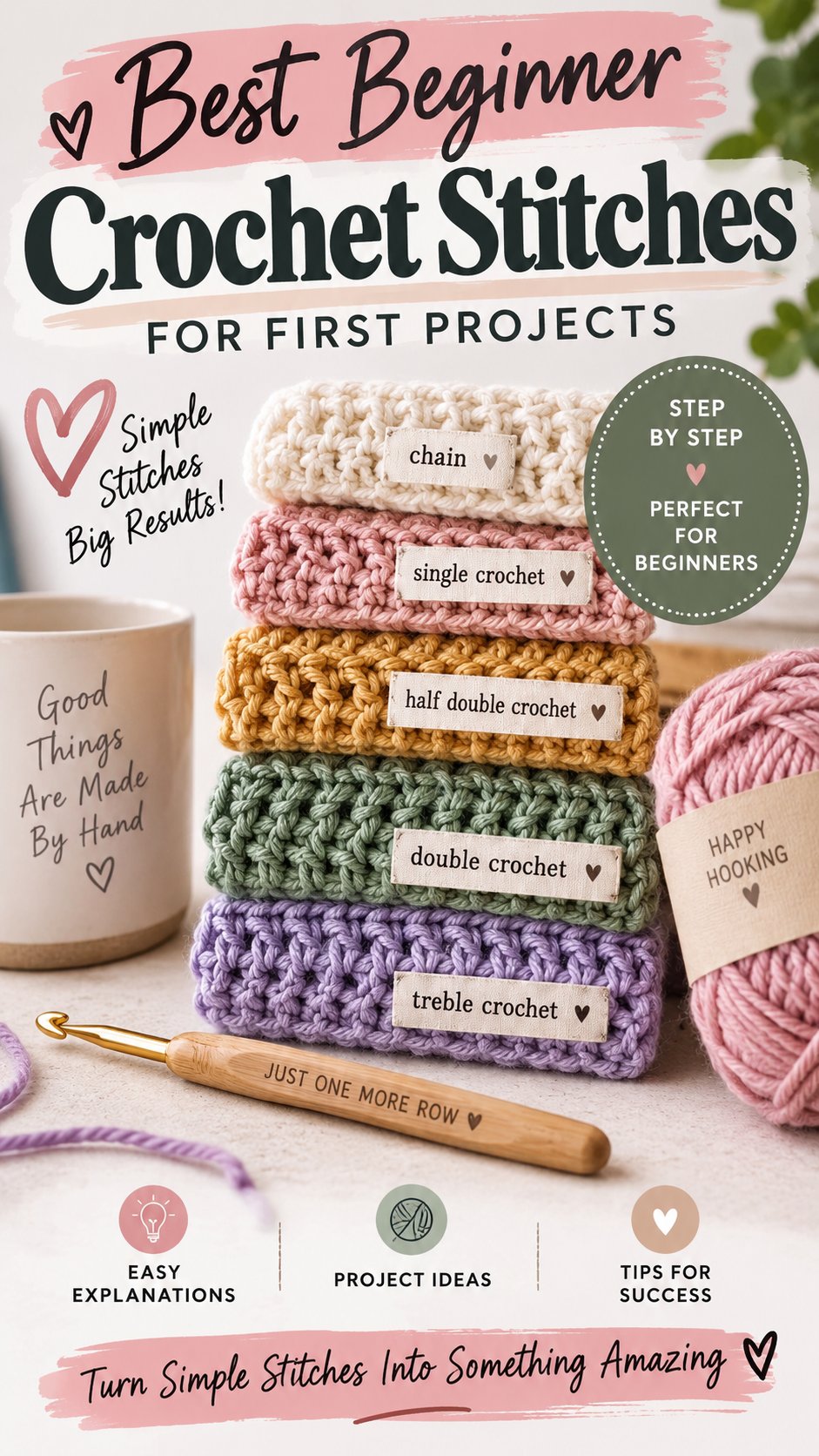
Best beginner crochet stitches are slip stitch, single crochet, half double crochet, and double crochet because they teach the core motions used in most patterns. Together, they cover joining, dense fabric, moderate texture, and open drape. A smooth medium-weight yarn and a 5.0 mm hook make these stitches easiest to see and control.
Key Facts and Quick Answer
- Slip stitch makes no meaningful fabric height and joins rounds, moves yarn, or creates low-profile edging.
- Single crochet creates dense, firm fabric for amigurumi, baskets, coasters, and structured bags.
- Half double crochet provides a balanced combination of speed, softness, height, and moderate density.
- Double crochet works quickly and creates flexible fabric with visible spaces, which suits blankets and scarves.
- A typical beginner setup costs $10-$25 USD, excluding shipping, when purchased as individual budget supplies.
- A useful first practice sample is 20-25 stitches across 10-15 rows, followed by a small project that uses one primary stitch.
What Are the Best Beginner Crochet Stitches?
The best starting sequence is slip stitch, single crochet, half double crochet, then double crochet. Each stitch adds one new coordination challenge while preserving the same basic actions: yarn over, insert the hook, draw up a loop, and pull through the required loops.
A slip stitch is the shortest stitch and adds almost no height. Single crochet teaches controlled insertion and produces a stable grid. Half double crochet adds a yarn over before insertion, while double crochet adds another pull-through stage and creates taller, faster rows.
These stitches are beginner-friendly because patterns combine them into textured stitches, ribbing, granny motifs, baskets, toys, and garments. They are not the only useful starting techniques. A foundation single crochet or foundation half double crochet can replace a long chain when a pattern requires a stretchier or neater lower edge.
The Four-Stitch Learning Order
- Make a slip knot and foundation chain. Practice 20 chains without tightening the loops.
- Work single crochet rows. Learn where the first and last stitches sit.
- Work half double crochet rows. Coordinate the starting yarn over and taller loops.
- Work double crochet rows. Practice two pull-through stages and consistent row height.
- Combine stitches. Try a simple moss stitch, which alternates single crochet and chain spaces.
The first stitch to master is usually single crochet, not slip stitch, because single crochet provides enough height to reveal mistakes while remaining easy to count. Slip stitch is technically simple but can feel tight and difficult to insert into repeatedly.
How Does a Crochet Stitch Work?
A crochet stitch forms when a hook draws yarn through existing loops, chains, or spaces. The number of yarn overs, the number of pull-through stages, and the insertion location determine the stitch’s height, density, stretch, and surface texture.
A basic stitch begins with a loop on the hook. The crocheter inserts the hook into a chain or previous stitch, catches the working yarn, and pulls up a loop. The hook then draws yarn through one or more loops until one loop remains.
A visible crochet stitch usually has a front loop and a back loop at its top, forming a V shape. Inserting under both loops creates the standard fabric. Working through the front loop only or back loop only creates horizontal ridges and can change stretch.
Stitch Anatomy Beginners Should See
- Working loop: The active loop on the hook.
- Top V: The two strands forming the top of a completed stitch.
- Post: The vertical body of a taller stitch.
- Space: An opening between stitches or beneath a chain.
- Turning chain: Chains used to raise the yarn to the next row’s height.
- Foundation chain: The starting chain or chainless foundation row.
The common sequence is yarn over, insert, yarn over, pull up a loop, then complete the stitch. Single crochet has two loops after pulling up the yarn and one final pull-through. Half double crochet has three loops and one final pull-through. Double crochet has three loops followed by two separate pull-throughs.
What Supplies Should a Beginner Buy?
A beginner needs one smooth yarn, one compatible hook, a pair of scissors, and a blunt tapestry needle. Stitch markers are optional for a straight practice swatch but become valuable when counting rounds, marking edges, or following repeated pattern sections.
The Craft Yarn Council states, “The Craft Yarn Council has developed a standard yarn weight system,” which labels medium worsted yarn as weight 4. Labels also list a recommended hook range, fiber content, washing instructions, and approximate yardage.
| Supply | Recommended beginner specification | Typical USD cost | Why it matters |
|---|---|---|---|
| Crochet hook | Aluminum or ergonomic, 5.0 mm, US H-8 | $3-$8 | Fits most medium weight yarn |
| Practice yarn | Smooth acrylic, weight 4, 170-200 g total | $5-$10 | Light color reveals loops |
| Tapestry needle | Blunt tip, large eye, 2-3 inch shaft | $2-$5 | Weaves in yarn ends safely |
| Stitch markers | Locking plastic, pack of 10-20 | $2-$6 | Marks edges and round starts |
| Small scissors | Sharp 3-5 inch craft scissors | $3-$8 | Cuts yarn cleanly |
| Measuring tape | Flexible tape, centimeter and inch markings | $2-$5 | Checks gauge and dimensions |
A typical individual starter kit costs $10-$25 USD before shipping. A larger kit with several hooks, tools, and yarn commonly costs $20-$45, but extra colors and specialty hooks do not improve initial learning.
Choose pale yellow, cream, light blue, or another solid color. Black yarn hides stitch tops, chenille obscures insertion points, and eyelash yarn makes loop counting unnecessarily difficult.
How Many Chains Should You Make?
A turning chain usually matches the approximate height of the next stitch, but the exact number depends on the pattern and whether the chain counts as a stitch. Single crochet often uses one chain, half double crochet often uses two, and double crochet often uses three, yet many modern patterns use shorter chains to reduce uneven edges.
| Working stitch | Common turning chain | Typical chain-count treatment | Edge result |
|---|---|---|---|
| Slip stitch | 0-1 chains | Usually does not count | Low, nearly flat edge |
| Single crochet | 1 chain | Often does not count | Compact edge |
| Half double crochet | 1-2 chains | Pattern-dependent | Moderate edge height |
| Double crochet | 2-3 chains | May count as first stitch | Taller edge with possible gap |
Read the pattern’s abbreviation key before assuming the turning chain counts. If a pattern says “chain 2, turn, double crochet in the first stitch,” the chain may be a turning chain only. If it says “chain 3 counts as a double crochet,” skip the first stitch and work into the next one.
For practice, mark the first and last true stitch with locking markers. This prevents the common mistake of treating a turning chain as a stitch in one row and as a non-stitch in the next.
How Should Beginners Control Tension?
Beginner tension should be loose enough for the hook to slide through a stitch without force and consistent enough that neighboring stitches have similar loop size. Pain, tight chains, and difficulty inserting the hook indicate excessive grip or yarn tension rather than insufficient skill.
Hold the hook as a pencil or knife, whichever keeps your wrist neutral. Guide yarn with the opposite hand, but do not pinch the working strand tightly. Let the hook throat, rather than the pointed tip, draw the yarn through loops.
| Tension symptom | Likely cause | Immediate adjustment | Expected change |
|---|---|---|---|
| Hook will not enter next row | Tight loops | Relax fingers and pull less | Wider stitch openings |
| Fabric curls upward | Tight foundation chain | Use a larger chain hook | Flatter lower edge |
| Holes vary in size | Uneven yarn feed | Slow down and reset grip | More consistent spaces |
| Hands ache within 15 minutes | Bent wrist or clenched hook | Pause and change grip | Reduced hand strain |
| Swatch is too wide | Loose tension | Use smaller hook or tighten feed | Smaller stitch width |
An expert rule is to keep the working loop on the hook shaft, not pressed against the narrow throat. The shaft gives the loop a repeatable diameter. This single habit often improves consistency more quickly than trying to control every stitch consciously.
How Do Beginner Stitches Compare?
Single crochet is the densest practical starting stitch, while double crochet is the fastest for building height. Half double crochet offers the most balanced fabric for beginners because it is faster than single crochet without creating the large spaces common in double crochet.
| Stitch | US abbreviation | Approximate height | Fabric behavior | Typical uses |
|---|---|---|---|---|
| Slip stitch | sl st | 0.1-0.2 cm | Flat and firm | Joining rounds, edging |
| Single crochet | sc | 0.5-0.8 cm | Dense and structured | Amigurumi, coasters |
| Half double crochet | hdc | 0.8-1.1 cm | Soft and moderately dense | Hats, cowls, sweaters |
| Double crochet | dc | 1.2-1.8 cm | Open and flexible | Blankets, scarves |
The measurements are typical results from medium weight yarn and a 5.0 mm hook, not universal specifications. Yarn fiber, hook size, stitch tension, and whether the stitch is worked into a chain or a row all change the final dimensions.
Speed, Stretch, and Yarn Use
| Stitch | Typical stitches per 10 cm | Relative row speed | Stretch level | Relative yarn use |
|---|---|---|---|---|
| Slip stitch | 18-25 | Slow for fabric | Low | High for little height |
| Single crochet | 14-18 | Slow | Low to moderate | High |
| Half double crochet | 12-16 | Medium | Moderate | Medium-high |
| Double crochet | 9-14 | Fast | Moderate to high | Medium |
Double crochet does not always use less yarn per finished item. It builds rows quickly, but its taller loops can consume substantial yarn per stitch. A pattern’s gauge and finished dimensions determine yardage more reliably than stitch name alone.
Which Stitch Should You Use for a First Project?
The best first project uses one main stitch, a rectangular or circular shape, and a forgiving finished size. Single crochet suits a coaster or small pouch, half double crochet suits a beanie or cowl, and double crochet suits a scarf or small blanket.
| First project | Recommended stitch | Typical starting size | Typical completion time | Main skill learned |
|---|---|---|---|---|
| Coaster | Single crochet | 12-14 cm square | 30-60 minutes | Straight edges |
| Dishcloth | Single or half double crochet | 20-25 cm square | 1.5-3 hours | Counting rows |
| Scarf | Half or double crochet | 15-20 cm wide | 4-8 hours | Consistent width |
| Basic beanie | Half double crochet | 50-58 cm circumference | 3-6 hours | Working in rounds |
| Amigurumi ball | Single crochet | 8-12 cm diameter | 2-4 hours | Increases and decreases |
| Small blanket | Double crochet | 75-100 cm wide | 12-30 hours | Managing long rows |
A scarf is visually simple but can become monotonous and expose every edge error. A 15 cm coaster or 20 cm dishcloth gives faster feedback, uses less yarn, and makes restarting painless.
Avoid starting with a fitted sweater, intricate lace shawl, or black chenille toy. Those projects add shaping, gauge dependence, difficult visibility, or finishing demands before basic stitch control is reliable.
A Simple Fourteen-Day Practice Plan
| Days | Practice target | Quantity | Progress check |
|---|---|---|---|
| 1-2 | Slip knots and chains | 5 chains of 20 | Loops remain similar size |
| 3-5 | Single crochet rows | 10 rows of 20 stitches | Width changes less than 1 cm |
| 6-8 | Half double crochet | 8 rows of 20 stitches | No skipped edge stitches |
| 9-10 | Double crochet | 8 rows of 15 stitches | Pull-through stages stay separate |
| 11-12 | Mixed texture | 10 rows of moss stitch | Chain spaces remain aligned |
| 13-14 | First small project | 1 coaster or dishcloth | Stitch count stays consistent |
Practice for 20-45 minutes rather than forcing a long session. Muscle memory improves through repeated accurate movements, while fatigue encourages tight gripping and skipped stitches.
How Do You Keep Rows Straight?
Straight rows depend on identifying the first and last actual stitch, maintaining the same stitch count, and handling the turning chain consistently. Most shrinking rectangles result from missing the last stitch, not from a mysterious change in yarn behavior.
Count the stitches at the end of every row during early practice. If the target is 20 stitches, write “20” on a note beside the work and recount before turning. Place a marker in the first and last stitch when the edge is difficult to see.
| Visible problem | Common diagnosis | Correction on next row | When to restart |
|---|---|---|---|
| Rectangle narrows | Last stitch missed | Mark final stitch | Restart if width falls over 10% |
| Rectangle widens | Extra stitch or turning chain counted | Confirm chain-count rule | Restart after two uneven rows |
| Large edge holes | Turning chain too tall | Use shorter chain if pattern allows | Keep if blocking will close gap |
| Diagonal edge | Mixed stitch heights | Count each stitch type | Restart the affected section |
| Row twists | Work turned inconsistently | Turn in the same direction | Restart if stitch tops invert |
The most useful practitioner habit is to inspect the top V of the final stitch before making the turning chain. Beginners often see the turning chain first and mistake it for the last stitch, adding an extra stitch that widens the project.
What Common Beginner Problems Mean
Most early crochet problems come from stitch identification, tension, or yarn choice. Each symptom points to a specific mechanical cause, so changing several variables at once makes correction harder.
Split Yarn
Split yarn occurs when the hook pierces individual plies instead of passing beneath the complete stitch loop. Smooth, tightly spun acrylic reduces splitting during practice. A rounded hook tip can also help, although a blunt tip may make tight stitches harder to enter.
Curling Foundation Chains
A foundation chain may curl because the chain is tighter than the first row or because the project naturally needs blocking. Make the chain with a larger hook, loosen the working loop, or use a chainless foundation for a more elastic lower edge.
Uneven Spaces in Double Crochet
Double crochet creates larger openings because its posts are taller and its fabric has fewer stitches per centimeter. If spaces look inconsistent, check whether some stitches use the same insertion point and whether each pull-through reaches the same loop height.
Working Into the Wrong Place
Standard stitches usually enter the top V, but patterns may instruct you to work into a chain space, front loop, back loop, or stitch post. Follow the written instruction rather than assuming every hook insertion belongs under two top loops.
A simple first project should teach one uncertainty at a time. Combining front-post stitches, color changes, increases, and foundation chains in the first sample creates too many possible causes when the fabric looks wrong.
What If a Pattern Uses UK Terms?
US and UK crochet abbreviations differ, so the same label can produce a different stitch. A US single crochet is called a UK double crochet, while a US double crochet is called a UK treble crochet.
| US term | UK term | Relative height | Action difference |
|---|---|---|---|
| Slip stitch | Slip stitch | 0.1-0.2 cm | No terminology change |
| Single crochet | Double crochet | 0.5-0.8 cm | No starting yarn over |
| Half double crochet | Half treble crochet | 0.8-1.1 cm | One starting yarn over |
| Double crochet | Treble crochet | 1.2-1.8 cm | One starting yarn over, two pull-through stages |
Look for a pattern note identifying US or UK terminology before beginning. Video tutorials also reveal the intended stitch height, so compare the finished sample rather than relying on abbreviations alone.
When Are These Stitches the Wrong Choice?
The four basic stitches are poor choices when the project requires a specific lace structure, substantial stretch recovery, highly elastic ribbing, or a seamless fitted shape. A beginner can use them as building blocks, but the simplest stitch is not automatically the best fabric.
Slip stitch fabric can become rigid and difficult to work repeatedly. Single crochet may produce a bag that lacks drape or a garment that feels too dense. Double crochet may create unwanted holes in a warm hat or allow stuffing to show through an amigurumi figure.
Consider alternatives when the project asks for:
- Foundation single crochet for a stretchy lower edge.
- Linked double crochet for a denser fabric with less open space.
- Front-post and back-post stitches for raised ribs.
- Moss stitch for a flat, reversible texture.
- Half double crochet in the third loop for horizontal ridges.
- Extended stitches when additional height is needed without large gaps.
Blocking can improve shape, but it cannot change a fundamentally unsuitable stitch structure. Acrylic often responds to controlled heat, while wool and cotton respond differently to wet blocking. Follow the yarn label before applying steam or heat.
Frequently Asked Questions About Best Beginner Crochet Stitches
Is single crochet or double crochet easier for a first project?
Single crochet is usually easier because it has one final pull-through and creates clearly defined, compact rows. Double crochet grows faster, but its taller posts and larger spaces make edge counting more demanding. Choose single crochet for a coaster or toy, and choose double crochet when speed and drape matter more than density.
What size crochet hook should a complete beginner use?
A 5.0 mm US H-8 hook paired with smooth medium weight yarn is a practical starting point. The yarn label may recommend a different range, often 4.5-6.5 mm. If stitches feel hard to enter, increase the hook by 0.5-1.0 mm before changing yarn.
How much yarn is needed for a beginner crochet project?
A coaster typically uses 15-30 g, a dishcloth uses 40-80 g, and a simple scarf may use 150-300 g of medium weight yarn. Actual consumption changes with stitch height, tension, width, and fiber. Buy one extra skein when color matching matters because dye lots can vary.
Should a beginner learn crochet in the round?
A beginner can learn rounds after making several straight rows with a stable stitch count. Working in the round introduces slip-stitch joins, continuous spirals, increases, and round markers. Start with a small beanie or amigurumi ball only after you can identify the first stitch reliably.
Why does my crochet fabric feel stiff?
Stiff crochet fabric usually results from tight tension, dense single crochet, a small hook, or a rigid fiber such as inexpensive cotton. Loosen your grip, try a hook 0.5-1.0 mm larger, or select a softer acrylic blend. Stiffness may be desirable for baskets but uncomfortable in garments.
Can left-handed people use the same beginner stitches?
Left-handed crocheters use the same stitches and abbreviations, but the hook movement and fabric orientation are mirrored. Choose a left-handed tutorial or reverse a right-handed video, then keep the same stitch counts and turning-chain rules. Marking the first stitch is especially useful because edge orientation may look unfamiliar.
Conclusion
The best beginner crochet stitches are slip stitch, single crochet, half double crochet, and double crochet, learned in that order and practiced with smooth weight 4 yarn. Start with a 5.0 mm hook, make a 20-stitch swatch, count every row, and choose a small project that matches the fabric you want. Once these foundations feel consistent, textured and shaped patterns become far easier to read.