
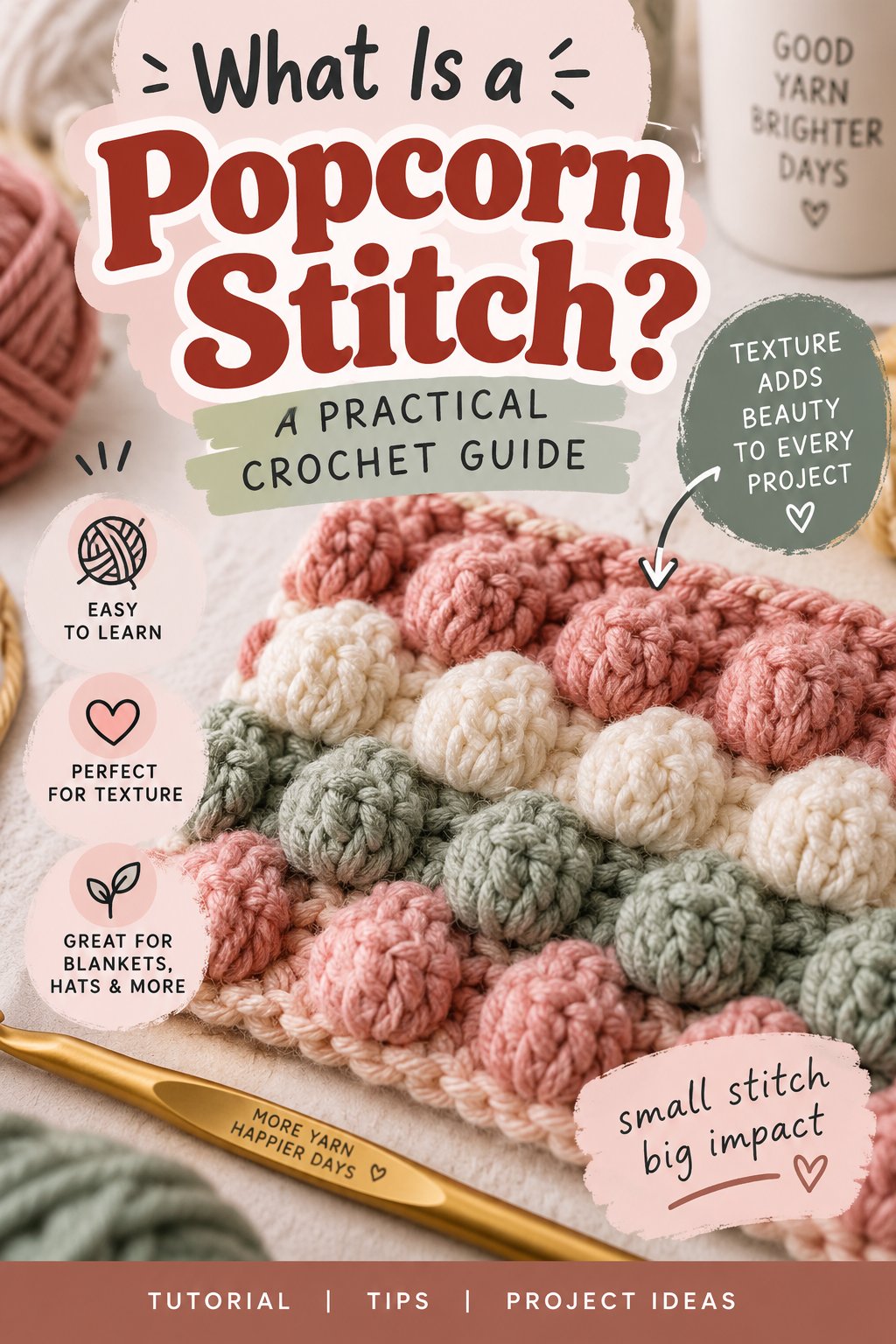
A popcorn stitch is a crochet texture made by grouping several complete stitches into one base stitch and closing the group into a raised, three-dimensional bump. The resulting cluster creates firm surface relief, usually on one side of the fabric, and works well for geometric motifs, blankets, bags, hats, and selected garments.
Key Facts
A standard popcorn uses five completed double crochets worked into one base stitch.
The active loop is dropped, then pulled through the first double crochet to close the cluster.
Popcorns are firmer and more pronounced than puff stitches, while bobbles use incomplete stitches closed together.
The texture usually faces the side where the closing loop is pulled through.
Typical yarn use rises by 30%-50% when a project contains many clusters.
A five-double-crochet popcorn commonly takes about twice as long as an ordinary double crochet.
What Is a Popcorn Stitch?
A popcorn stitch is a closed cluster of complete crochet stitches that forms a solid, rounded protrusion on the fabric surface. In the common five-double-crochet version, five double crochets are made in one stitch, then the active loop is drawn through the first double crochet so the group gathers into a compact raised shape.
The term describes the finished texture as well as the technique. A popcorn is not a separate yarn or material. It is a controlled concentration of stitch height and yarn into a small area, which changes the fabric’s thickness, weight, flexibility, and stitch count.
The cluster normally replaces one location in the row, even though it consumes the yarn and working time of several stitches. That mismatch explains why popcorn fabric can become dense or buckle when clusters are placed too close together.
The texture has a defined front and back. The side toward which the closing loop is pulled receives the visible bump, while the opposite side usually shows a shallow indentation or gathered base.
Popcorn Stitch Anatomy
| Component | Typical specification | Effect on fabric | What to check |
|---|---|---|---|
| Base location | 1 stitch or space | Controls horizontal placement | Confirm the pattern’s insertion point |
| Internal stitches | 5 double crochets | Produces a medium-large bump | Count completed stitches |
| Closing action | Loop through first stitch | Gathers the cluster | Keep the loop loose enough to manipulate |
| Locking chain | Usually 1 chain | Stabilizes the top | Follow the individual pattern |
| Visible height | About 1 double-crochet section | Adds surface relief | Compare with the swatch |
In practice, the most important distinction is completeness. Each internal double crochet is finished before the next one begins. If several double crochets remain incomplete and are closed together, the result is a bobble rather than a conventional popcorn.
How Does a 5-Double-Crochet Popcorn Work?
A five-double-crochet popcorn works by converting five completed stitches into one gathered cluster. The crocheter makes the five double crochets in the same base stitch, drops the active loop, inserts the hook through the first double crochet, and pulls the dropped loop through that stitch.
The sequence feels unusual because the hook temporarily leaves the active loop. That pause is the defining mechanical feature. The first double crochet acts as the anchor, and pulling the active loop through it folds the completed stitches into a rounded unit.
Use the following method unless a pattern gives different instructions:
- Make five double crochets in the same stitch or space. Finish each double crochet completely.
- Remove the hook from the active loop without pulling the yarn tight.
- Insert the hook from front to back through the top two loops of the first double crochet.
- Insert the hook into the dropped active loop.
- Pull the active loop through the first double crochet.
- Make one chain if the pattern specifies a locking chain.
- Continue into the next stitch or space according to the pattern repeat.
A pattern may call the result “5 dc popcorn,” “pc,” or “popcorn.” Abbreviations vary, so the pattern’s abbreviation key controls whether a chain is included and whether the cluster is made from the front or back.
What Happens If the Loop Is Pulled Too Tightly?
A closing loop that is too tight makes the popcorn hard to form and can distort the neighboring stitches. It can also leave a small, rigid top that is difficult to identify when the next row requires crocheting into the cluster.
A loose loop is safer during assembly. After the cluster closes, adjust the yarn until the popcorn is compact but still has a visible top. Do not yank the working yarn immediately after pulling through the first stitch.
How Many Stitches Does a Popcorn Count As?
A popcorn commonly occupies one base stitch in the row, but its internal construction contains several completed stitches. The next-row count depends on the pattern: some designers treat the closing chain as part of the cluster, while others instruct the crocheter to work into the popcorn top or the chain space beside it.
| Pattern instruction | Common next-row target | Counting implication | Typical result |
|---|---|---|---|
| “Work into popcorn” | Top loops of cluster | Cluster is one marked location | Direct vertical texture |
| “Chain 1 after popcorn” | Chain space | Chain may receive the next stitch | Small separation above bump |
| “Skip popcorn, work next stitch” | Following base stitch | Cluster remains decorative | Flat row crosses behind texture |
| “Popcorn in every fifth stitch” | Every fifth base stitch | Four plain stitches separate bumps | Regular dotted pattern |
The top of a popcorn can be visually confusing because several loops sit close together. Mark the first few clusters with removable stitch markers or count from the surrounding plain stitches rather than guessing from the bump alone.
Which Popcorn Variation Should You Use?
Popcorn variations differ mainly in stitch height, width, firmness, yarn consumption, and visual scale. Five double crochets create the familiar medium-large cluster, while half-double and treble versions change the silhouette and how strongly the texture projects.
Choose the variation according to the fabric rather than the name. A tall treble popcorn may look dramatic in a blanket motif but feel awkward in a fitted cuff, while a petite cluster can preserve drape in a lightweight shawl.
- Standard popcorn: Five double crochets create a balanced, recognizable bump.
- Half-double popcorn: Four or five half-double crochets produce a lower, wider shape.
- Treble popcorn: Four or five treble crochets create a taller, more elongated projection.
- Petite popcorn: Three or four shorter stitches reduce bulk for fine yarn.
- Back-side popcorn: The closing direction places the bump on the opposite fabric face.
| Variation | Internal stitches | Relative height | Best use | Typical yarn effect |
|---|---|---|---|---|
| Petite | 3-4 single or half-double stitches | Low | Fine shawls, cuffs | 15%-25% above flat texture |
| Half-double | 4-5 half-double crochets | Low-medium | Baby blankets, dense motifs | 25%-40% above flat texture |
| Standard | 5 double crochets | Medium | Blankets, bags, hats | 30%-50% above flat texture |
| Treble | 4-5 treble crochets | High | Large motifs, statement panels | 45%-65% above flat texture |
| Back-side | Pattern-dependent | Same as base stitch | Reversible layouts, relief patterns | Similar to matching front version |
The percentages in this table are practical planning ranges, not universal laboratory measurements. Fiber type, tension, spacing, and the number of clusters per row can move the result considerably.
When Should You Use a Back-Side Popcorn?
Use a back-side popcorn when the pattern needs relief on the reverse face or when alternating rows to create a sculptural surface. The closing direction changes which side receives the gathered bump, but it does not automatically make the entire fabric reversible.
Working a regular popcorn on a wrong-side row can place the bump behind the intended front. Pattern designers sometimes exploit that behavior in mosaics, textured stripes, and reversible geometric panels. Beginners should identify the public-facing side before starting every textured row.
How Much Yarn and Time Does It Need?
Popcorn stitches usually consume 30%-50% more yarn than an otherwise similar flat fabric when clusters appear regularly throughout the project. They also take about twice as long as ordinary double crochets because each cluster requires repeated insertions, loop management, and a closing step.
These are typical planning ranges, not fixed specifications. A blanket with one popcorn every ten stitches may use only slightly more yarn, while a dense all-over design can exceed the range because clusters crowd the fabric and increase row height.
For budgeting, make a measured swatch. Crochet a 10-by-10 stitch sample containing the intended popcorn frequency, weigh it in grams, then compare that weight with a flat sample of the same dimensions. The difference gives a more reliable estimate than multiplying the number of internal stitches.
| Project example | Flat version, typical time | Textured version, typical time | Extra yarn estimate | Material budget at $8 per skein |
|---|---|---|---|---|
| 12-inch cushion panel | 3-5 hours | 5-8 hours | 30%-45% | $16-$24 |
| Baby blanket, 30 by 36 inches | 15-22 hours | 25-40 hours | 30%-50% | $48-$80 |
| Adult scarf, 7 by 60 inches | 4-7 hours | 7-12 hours | 25%-45% | $16-$32 |
| Medium tote bag | 5-8 hours | 9-14 hours | 35%-55% | $24-$40 |
The dollar figures assume typical retail skeins priced at $8 and vary by fiber, brand, yardage, and local sales tax. Buy matching dye lots before beginning because a textured project can consume an extra skein unexpectedly.
An important practitioner rule is to budget by finished fabric weight, not by the nominal count of stitches. A popcorn contains five internal double crochets, but those stitches share a base location and do not expand the row five times horizontally.
What Yarn and Hook Work Best?
Smooth yarn with clear stitch definition shows the edges of a popcorn most effectively. Mercerized cotton, worsted-weight acrylic, ordinary wool, and wool blends are practical choices because their plies reveal the individual double crochets without burying the cluster.
Very fuzzy, brushed, eyelash, or heavily variegated yarn can hide the shape. Dark colors also reduce visual definition, especially when the project uses small petite clusters.
| Yarn choice | Definition | Typical hook range | Popcorn behavior | Suitability |
|---|---|---|---|---|
| Sport cotton | High | 3.25-4.00 mm | Crisp, firm, compact | Motifs and baby items |
| Worsted acrylic | Medium-high | 5.00-6.00 mm | Rounded, washable | Blankets and bags |
| Worsted wool | High | 5.00-6.00 mm | Springy, prominent | Hats and decorative panels |
| Chenille yarn | Low-medium | 5.00-6.50 mm | Soft, enlarged, less defined | Plush accessories |
| Mohair blend | Low | 3.50-5.00 mm | Halo obscures edges | Usually poor for learning |
Hook size controls more than gauge. A hook that is too small produces stiff clusters and makes the dropped loop difficult to retrieve. A hook that is too large creates loose, sagging popcorns, especially with smooth cotton that has limited elasticity.
A tapered hook can make it easier to enter the first double crochet and retrieve the dropped loop. An inline hook may provide stronger control for some crocheters, so the best choice depends on hand position, yarn friction, and whether the hook catches neighboring strands.
How Does It Compare With Other Texture Stitches?
A popcorn uses completed stitches grouped and closed, while a puff or bobble holds incomplete stitches on the hook until several loops are closed together. The construction difference changes the firmness, top shape, reversibility, and behavior when replacing one stitch with another.
| Feature | Popcorn | Puff | Bobble |
|---|---|---|---|
| Internal work | 3-7 complete stitches | Incomplete half-double-style stitches | Incomplete double-crochet-style stitches |
| Surface feel | Firm and structured | Soft and rounded | Dense and moderately firm |
| Usual projection | Strong on one side | Lower and cloud-like | Strong, often flatter on top |
| Working time | High | Medium | Medium-high |
| Common use | Geometric relief | Soft texture and warmth | Dots, flowers, raised motifs |
A puff stitch generally uses fewer completed stitch bodies and closes multiple held loops at once. A bobble usually creates a denser mass from incomplete double crochets, and its exact appearance varies widely among designers.
Substitution is not automatic. Replacing a five-double-crochet popcorn with a bobble can alter row height, yarn consumption, top width, and the number of loops available for the next row. Test one full pattern repeat before changing the stitch.
Popcorn Versus Bobble: Which Is Better?
A popcorn is usually better when the design needs a crisp, openable top and a clearly rounded surface. A bobble is often better when the pattern needs a compact bump with a controlled top and fewer separate completed stitches.
Choose a puff for softness or drape, a popcorn for pronounced relief, and a bobble for dense graphic dots. The correct choice depends on the fabric’s job, not on which stitch looks largest in a photograph.
Where Should You Use the Texture?
Popcorn texture works best where surface relief is decorative and moderate stiffness is acceptable. Blankets, cushion fronts, tote bags, hats, and motif centers can support the added bulk, while high-friction cuffs or smooth fitted garments may become uncomfortable or wear unevenly.
Consider the project’s contact points and care routine before committing to an all-over design.
- Blankets: Use spaced clusters to preserve drape and reduce weight.
- Bags: Use sturdy cotton, but line the interior if objects can catch the texture.
- Hats: Place bumps outside high-friction areas where they will not flatten quickly.
- Garments: Keep clusters in panels, yokes, or borders rather than dense underarm sections.
- Baby items: Use smooth, washable yarn and inspect the surface for snagging loops.
- Home décor: Dense repeats can create a stable, padded surface for cushions and wall hangings.
Popcorns are poor candidates for fabrics that must lie completely flat, pass through narrow hardware, or tolerate constant abrasion. A textured clutch can look effective, yet its raised surface may snag against zippers and coat fabric.
How Do You Keep Popcorns Even?
Even popcorns require consistent internal stitch count, stable tension, and uniform spacing. The most reliable method is to complete every internal stitch with the same yarn-over height, then close each cluster with comparable loop slack.
Make a gauge swatch that includes at least four pattern repeats across and four textured rows high. Measure the swatch after washing if the finished item will be washed, because cotton can relax and wool can change shape.
| Problem | Likely cause | Visible symptom | Correction |
|---|---|---|---|
| Flat bump | Tight or incomplete internal stitches | Cluster barely projects | Relax tension and complete every dc |
| Sagging bump | Excessively loose loop | Popcorn droops sideways | Use a smaller hook or tighten after closure |
| Uneven size | Different stitch heights | Clusters vary row to row | Match yarn-over and pull-up height |
| Fabric buckling | Too many clusters | Waves between motifs | Add plain stitches or reduce frequency |
| Lost top | Wrong insertion point | Next row cannot be located | Mark the cluster and inspect top loops |
| Bump on wrong side | Row worked from reverse | Texture faces away | Turn intentionally or reverse closure |
The mistake most people make is focusing on closing the popcorn while ignoring the five internal stitches. Uneven double-crochet height creates an irregular cluster that no final tightening can fully correct.
Another useful rule is to avoid compressing the completed group with your fingers. Hold the fabric near the base, keep the active loop accessible, and allow the stitches to gather naturally when the loop passes through the first stitch.
How Do You Repair a Missed Popcorn?
A missed popcorn can often be repaired by identifying whether the error occurred before or after the closing loop. If the cluster is still in the current row, undo the closing step, reinsert the hook through the first stitch, and pull the active loop through correctly.
If the next row has already been worked, targeted frogging is safer than trying to force a new bump through finished stitches. Remove only the affected section when the yarn path is clear, then rebuild the popcorn and reconnect the neighboring stitches.
A split strand at the first stitch can imitate a missing loop. Check for the two top loops before undoing the row, especially with cotton or tightly plied yarn.
How Should You Read a Popcorn Pattern?
A popcorn pattern should be read for four separate instructions: the number and type of internal stitches, the base insertion point, the closing direction, and the next-row placement. Pattern abbreviations alone are insufficient because designers use “pc,” “popcorn,” and “pop” differently.
Look for an abbreviation key, stitch diagram, or written note. A diagram may show a cluster symbol that represents the finished popcorn without revealing whether the designer expects a chain after it.
Before starting the project, confirm these details:
- Is the cluster made from three, four, five, or more stitches?
- Are the internal stitches single, half-double, double, or treble crochet?
- Does the active loop close through the first or last completed stitch?
- Is a chain required after closing?
- Should the next row enter the top, the chain space, or the following base stitch?
- Does the pattern require the bump on the public-facing side?
Pattern designers sometimes reverse the closing direction to control relief in alternating rows. That instruction is functional, not cosmetic, because it changes the face of the texture.
How Should Popcorn Fabric Be Blocked and Washed?
Popcorn fabric should be blocked gently around the raised clusters rather than pressed flat. Wet blocking is usually safer than direct ironing, while steam should remain near the surrounding fabric and away from prolonged contact with acrylic fibers.
Use the fiber’s care label as the governing instruction. Cotton can tolerate more moisture and shaping, wool needs careful temperature control to avoid felting, and acrylic can permanently flatten or glaze under excessive heat.
| Fiber | Preferred care | Main texture risk | Blocking approach |
|---|---|---|---|
| Cotton | Cool or warm wash | Relaxed, heavier fabric | Pin around clusters while damp |
| Acrylic | Cool wash, low heat | Heat-flattened bumps | Air dry and avoid direct iron |
| Wool | Cool hand wash | Felting and shrinkage | Shape flat without agitation |
| Cotton-acrylic blend | Label-dependent | Uneven relaxation | Test swatch before project |
| Chenille | Gentle wash | Crushed pile and fuzz | Minimal handling, dry flat |
Place pins in the flat spaces between clusters, not through the raised centers. Heavy books or aggressive pressing can erase the height that justified using the stitch.
Frequently Asked Questions About What Is a Popcorn Stitch
Is a Popcorn Stitch Hard for Beginners?
A popcorn stitch is manageable for beginners who can make consistent double crochets and control a dropped loop. The closing step is unfamiliar, but a four-cluster practice swatch usually reveals the technique. Use smooth worsted yarn, a light color, and a hook that allows the first stitch to open clearly.
Can You Make a Popcorn Stitch With Single Crochet?
You can make a small popcorn-like cluster from single crochets, although many patterns classify that result as a miniature bobble or gathered cluster rather than a standard popcorn. Single-crochet versions sit lower, use less yarn, and suit fine motifs where a five-double-crochet bump would be too bulky.
Why Does My Popcorn Stitch Face the Wrong Way?
A popcorn faces the wrong way when the row orientation or closing direction places the gathered loop on the reverse side. Turn the work intentionally, identify the project’s front, and follow the pattern’s specified front-side or back-side insertion method before making the next cluster.
Can You Crochet Into the Top of a Popcorn?
You can crochet into a popcorn top when the pattern identifies the top loops as the next-row entry point. Locate the two loops created by the closing action rather than inserting randomly into the rounded surface. If the pattern uses a chain space, crocheting into the cluster may change the stitch count.
Do Popcorn Stitches Shrink After Washing?
Popcorn stitches can change size after washing because the surrounding yarn relaxes, absorbs moisture, or felts. Cotton often becomes softer and wider, acrylic may flatten under heat, and wool may shrink with agitation. Wash a representative swatch, dry it as directed, and measure the texture before estimating the finished dimensions.
Are Popcorn Stitches Reversible?
Popcorn stitches are generally not fully reversible because the raised cluster is designed to project toward one fabric face. The reverse side shows a gathered base or indentation. Alternating front-side and back-side closures can create a two-faced design, but the result still differs from a genuinely reversible flat stitch.
Conclusion
A popcorn stitch is a structured crochet cluster made from several completed stitches and closed into a raised surface bump. The standard five-double-crochet version offers strong relief, but its added yarn use, slower construction, one-sided texture, and potential stiffness require a thoughtful swatch before a full project.
Choose the internal stitch type for the desired height, space clusters according to the fabric’s drape, and keep the closing loop loose enough to control. With those decisions handled, the popcorn stitch becomes a predictable design tool rather than a confusing variation of the bobble or puff stitch.