
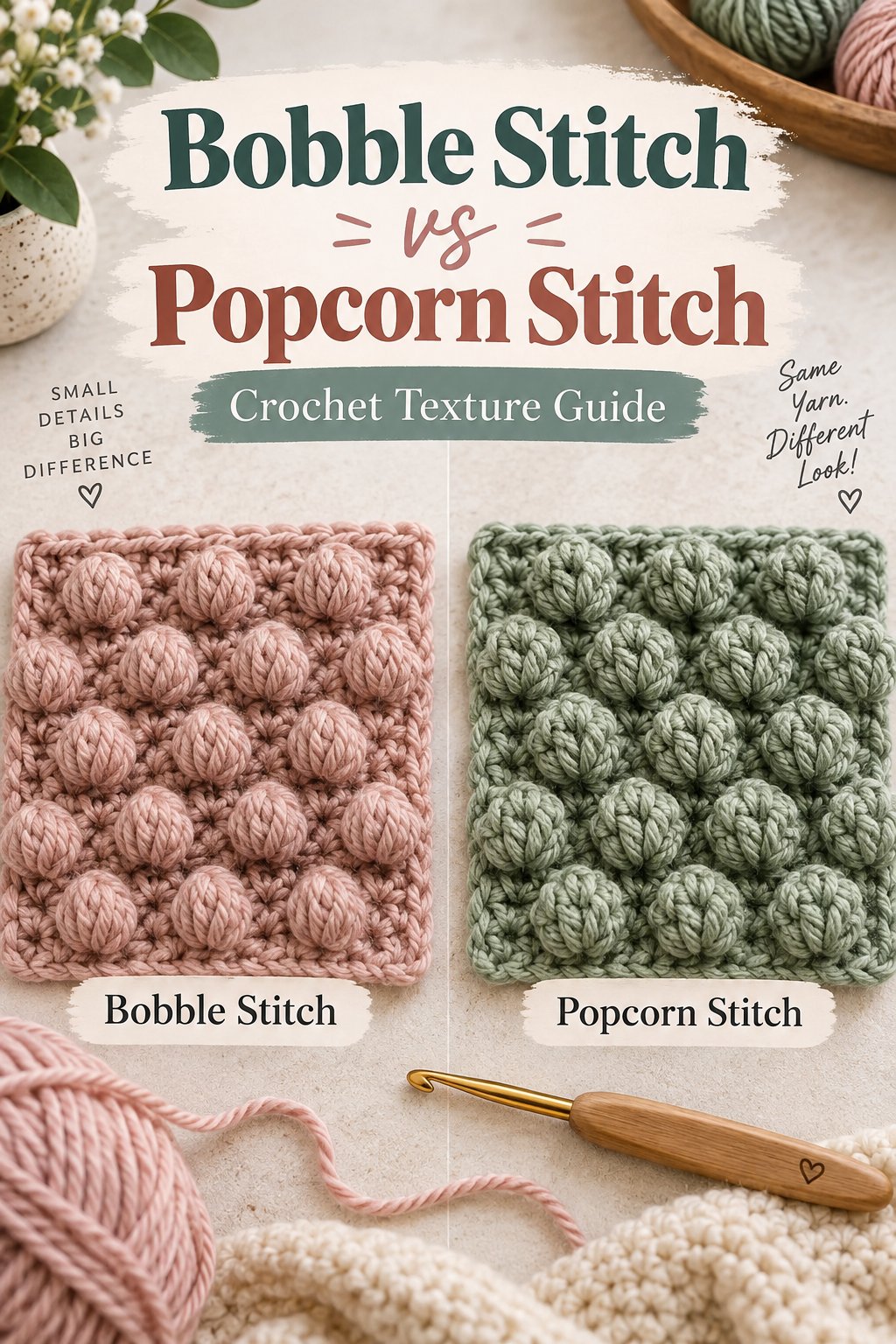
Bobble Stitch vs Popcorn Stitch compares two raised crochet clusters that create three-dimensional texture from one base stitch. A bobble usually combines incomplete stitches closed together at the top, while a popcorn uses complete stitches joined by pulling the active loop through the first stitch. The construction changes height, firmness, drape, yarn use, and working speed.
Key Facts and Quick Answer
- A bobble is normally made from 4 or 5 partially completed double crochets closed through their remaining loops.
- A popcorn is normally made from 4 or 5 completed double crochets joined by removing and re-entering the hook.
- A 5-double-crochet popcorn usually has a sharper, taller profile than a comparable bobble.
- A bobble generally works faster because the active loop stays on the hook throughout construction.
- Neither stitch has a universal yarn cost. A typical 5-stitch cluster consumes about 3-5 times the yarn of one ordinary double crochet, while project-level yarn use often rises by less than that percentage.
- Stitch names vary by designer. The written pattern’s abbreviations and special instructions take priority over generic definitions.
What Is the Difference Between a Bobble and a Popcorn?
A bobble closes several incomplete stitches together, producing a compact mound whose bulk depends on uncompleted stitch shafts and the final closing yarn-over. A popcorn completes every stitch first, then joins the group at the first stitch, which gives the cluster a more defined fold and a firmer dome.
Both techniques place several stitch actions into one base stitch, so both add thickness and consume more yarn than a flat double crochet. The practical difference is not simply appearance. A bobble changes the row with fewer loop-management steps, whereas a popcorn requires temporarily releasing the active loop and recovering it accurately.
Pattern writers do not use these names with complete consistency. One designer’s “bobble” may use five half double crochets, and another designer may call a five-double-crochet cluster a bobble even though the construction matches a popcorn. Read the stitch sequence rather than relying on the label.
Construction at a Glance
| Attribute | Bobble cluster | Popcorn cluster | Practical result |
|---|---|---|---|
| Typical 5-stitch method | 5 incomplete double crochets | 5 complete double crochets | Different loop handling |
| Closing action | Yarn over, pull through collected loops | Pull dropped loop through first stitch | Different surface shape |
| Active-loop handling | Active loop remains on hook | Active loop leaves hook temporarily | Popcorn needs more recovery control |
| Typical surface | Rounded, compact mound | Defined, folded dome | Popcorn has sharper relief |
| Row effect | Moderate height increase | Larger height increase | Popcorn can distort short rows more |
| Reverse side | Usually an indentation | Usually a flatter joined base | Backside texture differs |
How Construction Changes the Texture
The construction determines how much of each stitch is visible, where tension accumulates, and how the cluster sits against neighboring stitches. In practice, a bobble is usually denser at its center, while a popcorn exposes more completed stitch structure and folds forward or backward at its joining point.
How to Crochet a Typical Bobble
A typical 5-double-crochet bobble uses five partial double crochets worked into one base stitch. Each partial double crochet is stopped after pulling through the first two loops, leaving the final loop from that stitch on the hook.
- Yarn over and insert the hook into the designated base stitch.
- Pull up a loop, yarn over, and pull through two loops.
- Repeat the partial double crochet four more times in the same base stitch.
- Count six loops on the hook if the pattern uses five partial double crochets.
- Yarn over and pull through all collected loops.
- Work the pattern’s anchoring stitch in the next location.
The loop count is a useful control point. For five partial double crochets, six loops normally remain before the closing yarn-over. A different count signals either a different stitch type or an error.
A bobble often appears on the side opposite the side where it was worked, especially when the next row is turned or an anchoring stitch compresses its base. That behavior is common, not mandatory. A designer can specify a front-post method, a front-side placement, or a turning sequence that changes which face displays the bump.
How to Crochet a Typical Popcorn
A typical 5-double-crochet popcorn uses five fully completed double crochets in one base stitch. After the fifth stitch, the crocheter drops the active loop, inserts the hook into the top of the first double crochet, retrieves the dropped loop, and pulls it through.
- Work five complete double crochets into one base stitch.
- Remove the hook from the active loop without pulling the loop tight.
- Insert the hook from front to back through the top two loops of the first double crochet.
- Place the dropped active loop back on the hook.
- Pull the active loop through the first stitch.
- Tighten the join only until the group folds into a dome.
- Continue with the next stitch or the specified anchoring instruction.
The joining direction controls the visible face. A front-joined popcorn pushes toward the viewer, while a back-joined popcorn pushes away from the viewer. The same completed cluster can therefore produce a raised texture on either side of a fabric.
The most common popcorn error is pulling the dropped loop too tightly before the hook enters the first stitch. That reduces the opening, splits the stitch top, and creates an undersized cluster.
Standard Sizes and Stitch Variations
The number and height of component stitches determine the cluster’s width, height, density, and yarn requirement. A 3-stitch bobble can provide subtle texture in a garment, while a 6-stitch treble popcorn can create a large motif that overwhelms lightweight fabric.
| Variation | Component stitch | Typical cluster width | Typical use |
|---|---|---|---|
| 3-stitch bobble | 3 single or half double crochets | 6-10 mm | Fine garment texture |
| 4-stitch cluster | 4 double crochets | 9-14 mm | Repeating blankets and hats |
| 5-stitch bobble | 5 partial double crochets | 11-16 mm | Standard raised motifs |
| 5-stitch popcorn | 5 complete double crochets | 12-18 mm | Pillows, motifs, bold texture |
| 6-stitch popcorn | 6 complete treble crochets | 18-28 mm | Large decorative relief |
| HDC cluster | 4-5 half double crochets | 8-14 mm | Lower, softer bumps |
The measurements above are typical ranges for medium-weight yarn and hooks around 4.5-5.5 mm. Tension, fiber, hook size, and whether the cluster is worked into a chain space can change the result substantially.
Common variations include:
- Half-double-crochet bobbles: shorter and less angular than double-crochet versions.
- Treble popcorns: taller, looser, and more visually dramatic, but more likely to snag.
- Front popcorns: push the relief toward the fabric’s front face.
- Back popcorns: create recessed front texture or a raised reverse face.
- Alternating clusters: place bumps on alternating rows to reduce bulk.
- Motif clusters: use one raised group as the center of a flower, star, or medallion.
An expert rule of thumb is to keep large clusters at least one flat stitch apart when the fabric needs drape. Adjacent 5-stitch popcorns can consume the space of several ordinary stitches and create a stiff horizontal ridge.
Time, Yarn, and Budget
A bobble usually takes less time than a popcorn because it avoids dropping and recovering the active loop. Yarn use is higher for both techniques, but a project rarely becomes 3-5 times larger overall because clusters replace only selected flat stitches rather than every stitch in the fabric.
Typical Swatch Economics
The following figures are planning estimates, not universal production standards. They assume medium-weight acrylic or wool-blend yarn, a 5 mm hook, moderate tension, and a swatch with one cluster replacing one ordinary stitch position.
| Measure | Flat double crochet | 5-stitch bobble | 5-stitch popcorn |
|---|---|---|---|
| Typical yarn length per unit | 25-35 cm | 90-140 cm | 105-155 cm |
| Typical completion time | 8-12 seconds | 20-35 seconds | 30-50 seconds |
| Relative yarn use | 1.0x | 3.0-4.5x | 3.5-5.0x |
| Added row height | 0-2 mm | 3-7 mm | 5-10 mm |
| Typical loose ends per unit | 0 | 0 | 0 |
| Main control issue | Even tension | Closing all loops | Recovering active loop |
Popcorns often use slightly more yarn because every component double crochet is completed. The difference becomes smaller when the bobble uses five partial double crochets with long pulled-up loops, and it becomes larger when the popcorn uses taller stitches.
For a realistic budget, measure rather than multiply the cluster ratio across the whole project:
- Crochet a 10 cm by 10 cm swatch with the intended cluster frequency.
- Weigh the swatch on a kitchen scale accurate to at least 1 gram.
- Weigh a flat-stitch swatch of the same size and fiber.
- Divide the textured swatch weight by the flat swatch weight.
- Add 10-15% for tension changes, joining, and finishing.
For example, if a flat swatch weighs 18 grams and a textured swatch weighs 23 grams, the project-level increase is about 28%, even though each individual cluster consumes several times more yarn than one flat stitch. A blanket covered almost completely in popcorns can exceed that range because clusters also reduce width and increase rows.
Typical Project Planning Ranges
| Project type | Flat baseline | Bobble adjustment | Popcorn adjustment |
|---|---|---|---|
| 100 cm baby blanket | 700-900 g | 850-1,100 g | 900-1,200 g |
| Adult medium sweater | 500-750 g | 600-900 g | 650-1,000 g |
| 45 cm cushion cover | 250-400 g | 300-480 g | 325-520 g |
| Adult beanie | 80-120 g | 95-145 g | 100-155 g |
| 20 cm motif | 25-45 g | 30-55 g | 32-60 g |
These are typical planning ranges for common worsted-weight yarns, not manufacturer specifications. Fiber density matters: wool, cotton, acrylic, and chenille can produce different weights at the same yardage.
Which Stitch Fits Your Project?
A bobble generally fits garments and flexible accessories better because its rounded mass creates less rigid relief. A popcorn generally fits decorative surfaces better when the design needs sharply defined, durable geometry and the fabric will not rub constantly against skin.
| Project situation | Better starting choice | Reason | Main warning |
|---|---|---|---|
| Sweater front | Bobble | Lower profile and softer drape | Avoid dense placement under arms |
| Baby blanket | Small bobble | Softer surface and lower snag risk | Use washable yarn and secure tension |
| Cushion face | Popcorn | Strong relief survives display use | Backside can feel lumpy |
| Mandala center | Popcorn | Crisp circular definition | Extra height can cup the motif |
| Beanie texture | Bobble | Better stretch and lower stiffness | Keep clusters away from tight brim |
| Bag exterior | Small popcorn | Defined pattern on stable fabric | Large bumps catch on hardware |
| Scarf against skin | Puff or small bobble | Less abrasive relief | Test yarn softness first |
| Reversible blanket | Alternating front and back clusters | Texture appears on both faces | Requires careful row charting |
Garments and Wearables
Use bobbles sparingly on sweaters, cardigans, hats, and scarves. Raised clusters placed at elbows, underarms, shoulder straps, or waistbands experience compression and abrasion, so they can flatten faster than clusters on an open front panel.
Cotton bobbles usually feel firmer and less springy than wool or acrylic bobbles. A soft merino blend can improve comfort, but its surface may pill where the bump rubs against a coat or bag strap.
Popcorns are less suitable for areas pressed against the body. Their edges can feel hard, and their added row height may interfere with ribbing or fitted shaping. If a pattern places popcorns near a neckline, make a small skin-contact test before committing to the full garment.
Blankets and Home Décor
Popcorns work well on cushion fronts, wall hangings, and decorative motifs because their folded structure maintains a clear silhouette. Bobbles work better when the item needs to fold, drape, or pass through a washing machine without excessive surface distortion.
Dense 3D blankets become heavy quickly. A full-size blanket with clusters on every row can require more yarn, longer drying time, and greater storage space than its flat dimensions suggest.
Bobbles, Popcorns, and Puff Stitches
Puff stitches form elongated loops that are closed together, creating a softer and airier bump than either a bobble or popcorn. The puff usually has less sharply defined stitch architecture, while a bobble has a compact closed cluster and a popcorn has a folded group of completed stitches.
| Stitch type | Loop or stitch method | Texture firmness | Best characteristic |
|---|---|---|---|
| Puff | Elongated loops closed together | Soft and springy | Comfortable surface texture |
| Bobble | Partial stitches closed together | Medium and compact | Efficient raised detail |
| Popcorn | Complete stitches joined together | Firm and defined | Crisp decorative relief |
| Bullion | Multiple yarn overs pulled through | Dense and rope-like | Ornamental coils |
| Front-post relief | Completed stitches around posts | Structured and directional | Ridges and cables |
Choose a puff when softness matters more than a crisp outline. Choose a bobble when you want visible texture with moderate bulk. Choose a popcorn when the cluster itself must read clearly from a distance.
The alternatives are not interchangeable in gauge. Replacing five double crochets with a puff can reduce both row height and yarn consumption, so the surrounding pattern may need new stitch counts.
How Tension and Placement Change the Result
Tension changes both the visual identity and the engineering of a raised cluster. A tight popcorn may look like a small bead, while a loose popcorn can become a floppy petal; a tight bobble can fail to project because the closing loop compresses its center.
Work a test swatch using the same yarn, hook, stitch count, and turning method as the project. Measure the swatch after washing and drying if the finished item will be laundered, because wool may relax and cotton may broaden while acrylic often retains its dimensions more closely.
Front, Back, and Turning-Round Behavior
A cluster’s visible face depends on the direction of insertion, the side facing the crocheter, and whether the next row is worked from the front or back. A chart may mark a popcorn with a front-facing symbol even when the written instruction places the join on the reverse side.
Use these checks:
- Mark the fabric’s public face before beginning a textured row.
- Photograph the first completed cluster from both sides.
- Confirm whether the pattern wants the bump pushed forward or left on the reverse.
- Count the base stitches after each cluster.
- Compare row height before continuing beyond the swatch.
The mistake most often blamed on the stitch name is actually a turning error. If every second row appears to reverse the texture, the pattern may be intentionally alternating faces rather than producing inconsistent clusters.
Common Problems and Precise Fixes
Most failed clusters result from loop count, tension, or placement errors rather than from choosing the wrong stitch. Correcting the specific failure is faster than repeatedly tightening or loosening the entire row.
| Visible problem | Likely cause | Correction | Prevention |
|---|---|---|---|
| Flat bobble | Closing yarn-over too tight | Loosen the final pull-through | Keep loops equal in height |
| Oversized bobble | Long uneven partial stitches | Match loop height to the tallest shaft | Use a marked height guide |
| Missing popcorn | Active loop pulled out | Reinsert hook before releasing tension | Keep finger on the live loop |
| Split popcorn top | Hook enters one loop | Insert through both top loops | Rotate the first stitch toward you |
| Row cups upward | Too many tall clusters | Add flat stitches between groups | Swatch full repeat |
| Texture faces backward | Join or turn direction reversed | Push through or undo the join | Mark the public face |
| Stitch count drops | Cluster base not counted correctly | Count the original base stitch once | Use a row tally |
| Cluster snags | Loose loops or soft halo yarn | Tighten only the join, not every loop | Choose a smoother fiber |
A bobble requires special attention when closing many loops. If the hook catches only part of the bundle, the cluster can look complete while leaving a loose strand inside the fabric. Count the loops before the final pull-through.
A popcorn requires a stable dropped loop. Place a finger over it, or use a removable stitch marker through the loop during the re-entry step when working slippery yarn.
Hook Choice and Yarn Choice
Hook recommendations are not absolute. A tapered hook can enter the top of a popcorn easily, but its narrow throat may release loops during a large bobble; an inline hook can hold a tall bundle securely, but its sharp shaft may split loosely spun yarn.
| Material or tool | Bobble effect | Popcorn effect | Recommended test |
|---|---|---|---|
| Smooth acrylic | Clear, resilient mound | Crisp, stable dome | 5 mm hook, medium tension |
| Cotton | Firm, less elastic bump | Sharp but dense relief | 0.5 mm larger hook if tight |
| Wool blend | Soft, springy projection | Rounded dome after blocking | Wash swatch before sizing |
| Chenille | Plush, low-definition bump | Bulky, difficult loop recovery | Use 4-stitch clusters |
| Tapered hook | Easy insertion into bases | Easy first-stitch entry | Check loop retention |
| Inline hook | Secure collected loops | More resistance at join | Loosen popcorn entry loop |
For slippery yarn, the safest adjustment is usually a slightly smaller cluster, not dramatically tighter tension. For fuzzy yarn, a 4-stitch bobble may be more legible than a 5-stitch popcorn because the fibers already add visual mass.
A Reliable Practice Swatch
A controlled swatch reveals more than a single completed stitch because it shows whether the texture changes gauge, direction, and fabric stability. Make one repeat with flat stitches, one row of bobbles, and one row of popcorns using the same base stitch and hook.
- Chain enough stitches for at least 10 cm of fabric.
- Work two flat rows to establish tension.
- Mark every fifth base stitch on the next row.
- Work 4-stitch bobbles into the marked bases.
- Work one flat row and record the visible face.
- Work 4-stitch popcorns into equivalent marked bases.
- Measure width, height, and weight before washing.
- Wash and dry according to the yarn label.
- Record which texture retained its projection and drape.
- Decide from the finished swatch, not the unwashed sample.
Compare the amount of fabric between clusters. If the row pulls inward, add spacing or use a shorter component stitch. If the bump disappears, increase loop height slightly or choose a taller stitch rather than tightening the closing action.
Frequently Asked Questions About Bobble Stitch vs Popcorn Stitch
Is a popcorn stitch stronger than a bobble stitch?
A popcorn stitch usually holds a more defined shape because its component stitches are completed before joining. That does not make it universally stronger. Yarn fiber, washing, abrasion, and cluster size determine durability, and a tightly closed bobble in smooth acrylic can outlast a loose popcorn in fuzzy wool.
Can a bobble and popcorn use the same stitch count?
A bobble and popcorn can both use 4 or 5 component stitches, but the count alone does not make them equivalent. The bobble leaves each component incomplete until one final closing action, while the popcorn completes the components and joins the first stitch. Their height and yarn use may therefore differ.
Why does my popcorn stitch turn inside out?
A popcorn can face inward when the join is made from the opposite side, the next row is turned differently, or the pattern expects the cluster to be pushed forward manually. Check the first-stitch insertion direction and compare the public face with the pattern photograph before undoing the entire row.
Are bobbles and popcorns suitable for machine washing?
Both textures can be machine washable when made with a machine-washable yarn and a secure pattern structure. Popcorns may flatten or catch more readily because their folded edges project farther. Use the yarn label’s cycle, place the item in a mesh bag, and dry it in the specified manner.
How do I count a bobble in crochet stitch totals?
Count the base location according to the pattern’s instructions, not the number of component stitches inside the bobble. Most patterns treat a bobble as occupying one base stitch, while the five partial double crochets are internal construction. A chart key or written repeat overrides this general convention.
Which stitch is easier for a beginner?
A bobble is usually easier to repeat because the active loop remains on the hook and the closing action is straightforward. A popcorn becomes manageable after practicing loop recovery. Beginners should first make one row of each with smooth, light-colored yarn so every loop is visible.
Final Choice
Bobble Stitch vs Popcorn Stitch is primarily a choice between compact construction and folded construction. Choose a bobble for softer drape, faster repetition, and moderate relief; choose a popcorn for taller, sharper texture that needs to remain visually distinct on cushions, motifs, and other decorative surfaces.
Do not select by name alone. Compare the pattern’s component stitch, cluster count, joining direction, anchoring method, and turning sequence, then test the fabric after washing. A 10 cm swatch can reveal yarn use, row distortion, comfort, and reversibility before those differences become expensive in a full project.