
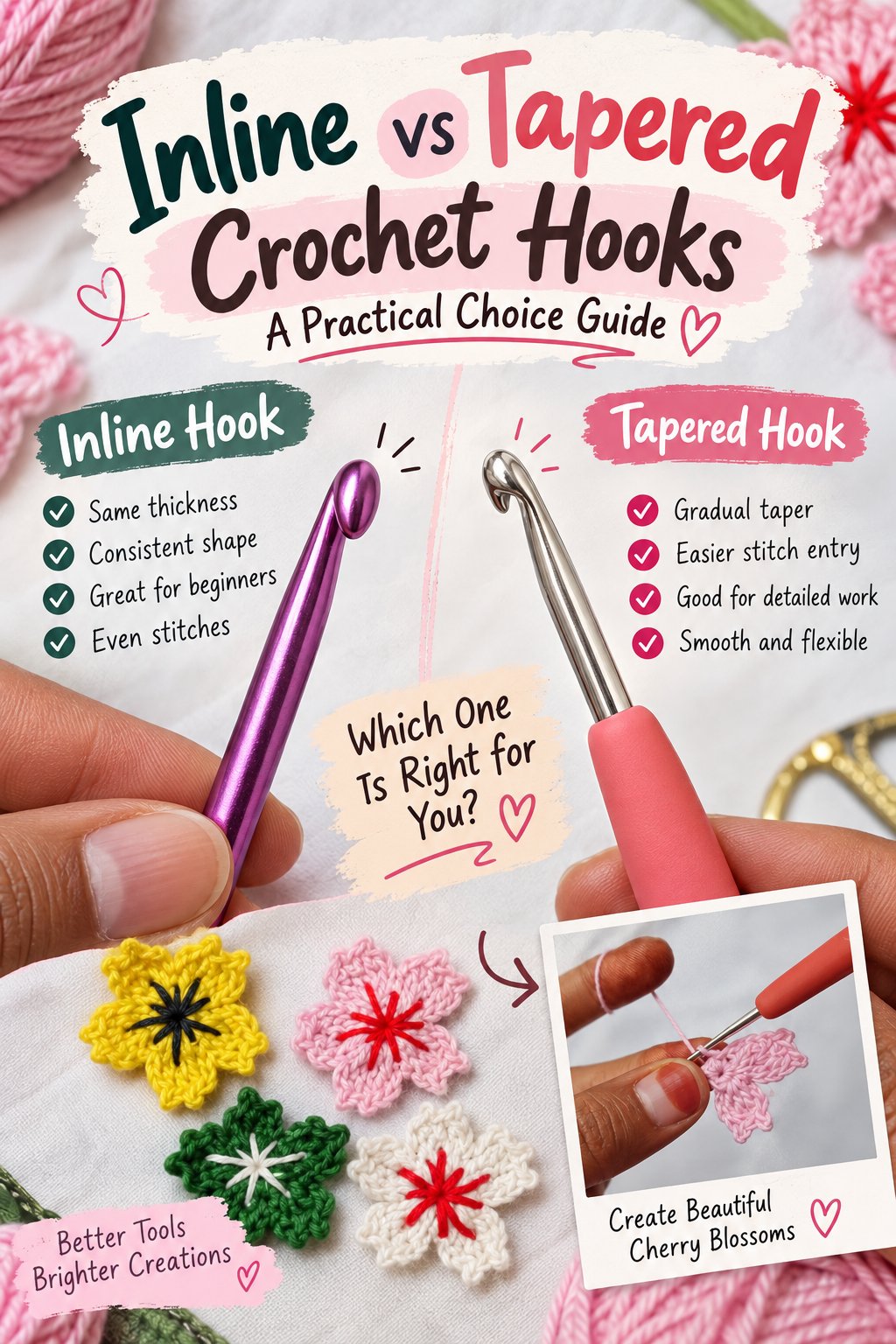
Inline vs Tapered Crochet Hooks describes two head-and-throat geometries that change how a hook enters stitches, captures yarn, and controls loop size. Inline hooks keep the head aligned with the shaft and use a deeper throat, while tapered hooks use a sloping throat and a head that extends beyond the shaft. The best choice depends on yarn, tension, grip, and project.
Key Facts
Inline hooks have a head aligned with the shaft, a deeper throat, and a more defined lip.
Tapered hooks have a rounded head, a sloping throat, and a working area that begins farther down the shaft.
The same labeled size, such as 5.0 mm or US H-8, can feel different across brands because finish, head profile, and shaft measurement vary.
Inline geometry often gives tight crocheters more loop control, while tapered geometry commonly reduces snagging during fast insertion.
A typical adaptation period is 3-5 hours of focused practice, although tension and grip can shorten or extend it.
Basic aluminum hooks commonly cost $2-$5, ergonomic models $8-$15, and premium wood, resin, or metal hooks $25-$60 or more.
What the Two Hook Geometries Mean
Inline and tapered crochet hooks differ primarily at the head, throat, neck, and transition into the shaft. An inline head sits in the same visual line as the shaft, so the hook’s lower edge forms a distinct lip and the throat is often deeper. A tapered head projects slightly beyond the shaft, with a rounded transition that guides the tool through a loop.
The terms “Bates style” and “Boye style” describe common profiles, not universal manufacturing rules. Susan Bates is strongly associated with inline aluminum hooks, and Boye is strongly associated with tapered aluminum hooks, but manufacturers use varied molds, machining methods, finishes, and hybrid profiles. A hook is best classified by its tip geometry, not by whether it was cast, machined, turned, or fitted with a comfort handle.
| Feature | Inline Profile | Tapered Profile | Practical Effect |
|---|---|---|---|
| Head alignment | Head follows shaft centerline | Head extends beyond shaft | Changes insertion angle |
| Throat depth | Deep, defined groove | Shallow, sloping groove | Changes yarn retention |
| Lip shape | More pronounced lower edge | More rounded transition | Changes snagging and splitting |
| Working diameter | More consistent near throat | Reached farther down shaft | Changes loop size control |
Head, throat, neck, and working shaft
The head is the rounded or pointed end that enters a stitch. The throat is the recessed area behind the head where yarn rests during a pull-through. The neck connects the throat to the shaft, and the working shaft is the section that determines much of the finished loop’s diameter.
Inline hooks generally make the throat easy to locate by touch. Tapered hooks require the crocheter to move the loop farther onto the shaft when consistent stitch size matters. Handle shape is separate from all four features.
How Geometry Changes Stitch Formation
Inline hooks hold yarn in a deeper throat and make the loop position more predictable, while tapered hooks guide yarn through stitches with a smoother, less abrupt transition. Neither profile automatically creates a correct gauge. Finished stitch size depends on where the loop rests, how firmly the yarn is tensioned, the hook’s actual diameter, and the crocheter’s movement.
A deep throat can help a beginner retain a loop during a yarn-over, especially when the working yarn is slippery or the hand is still learning rotation. That same lip can catch loose fibers when the hook enters at a steep angle. A rounded tapered head can pass through dense or split-prone stitches smoothly, but a shallow throat may release a loop if the hook turns away from the yarn.
| Stitch Variable | Inline Response | Tapered Response | Result to Monitor |
|---|---|---|---|
| Loop location | Easier to keep near throat | Must move onto shaft | Finished stitch width |
| Yarn retention | High during pull-through | Moderate to high by brand | Dropped-loop frequency |
| Dense insertion | Defined lip may resist | Rounded head often enters smoothly | Hand pressure |
| Loose tension | Can preserve loop shape | May allow loop migration | Uneven gauge |
Why the same size can produce different gauge
A 5.0 mm label identifies a nominal hook size, not every external contour. Two 5.0 mm hooks can have different throat depths, shaft lengths, surface friction, and head widths. The working diameter matters most after the loop leaves the throat, but the head profile affects how easily the crocheter reaches that diameter.
The Craft Yarn Council’s standard yarn labeling system pairs common yarn categories with suggested hook ranges, but those ranges are starting points rather than guarantees. A swatch remains the reliable check because an individual’s tension can move gauge several stitches over a 10 cm or 4-inch measurement.
Expert insight: The frequent mistake is blaming hook geometry for a gauge problem caused by loop placement. If a tapered hook produces oversized stitches, first move every active loop onto the full working shaft before changing size.
Inline and Tapered Brands Compared
Susan Bates aluminum hooks are the familiar inline reference, while Boye aluminum hooks are the familiar tapered reference. Clover Amour and Tulip Etimo are widely used ergonomic lines with tapered-style tips, although the exact profile and surface finish should be checked on the specific model. Prym produces profiles that many crocheters regard as intermediate or hybrid.
Furls sells multiple materials and collections, and its hooks should not be classified as one uniform geometry. Wooden, resin, and metal versions can differ in head shape, throat depth, weight, and friction. Product photos are not enough for precise classification because a comfort handle can obscure the neck and working shaft.
| Brand or Line | Typical Profile | Typical Price in USD | Best Evaluation Point |
|---|---|---|---|
| Susan Bates aluminum | Inline | $2-$5 | Deep throat and defined lip |
| Boye aluminum | Tapered | $2-$5 | Sloping throat and projecting head |
| Clover Amour | Tapered-style | $8-$15 | Smooth finish and ergonomic handle |
| Tulip Etimo | Tapered-style | $12-$20 | Rounded tip and handle balance |
| Prym Ergonomic | Hybrid to tapered | $6-$12 | Pointed tip and broad handle |
| Furls selected lines | Varies by collection | $25-$60+ | Specific head, material, and weight |
Handle ergonomics are a separate decision
An ergonomic handle changes pressure distribution, but it does not change a tapered tip into an inline tip. Susan Bates Twist and other comfort-grip products illustrate why shoppers must inspect the head rather than infer geometry from the handle.
A large handle can help a crocheter who grips with the palm, while a slim metal handle may suit a pencil grip and small repetitive movements. Weight also matters. A heavy resin hook may feel stable for ten minutes and tiring after two hours of blanket work.
Which Shape Fits Your Project?
Inline hooks suit crocheters who want strong loop retention, compact stitch control, or a clearly defined throat, while tapered hooks suit crocheters who value smooth insertion, rounded transitions, and a fluid rhythm. Yarn fiber, ply structure, stitch density, and hand mechanics matter more than a universal beginner or expert label.
For amigurumi, many crocheters prefer an inline hook because dense single crochet benefits from controlled loops and the firm throat helps prevent accidental release. A tapered hook can work equally well when its rounded head enters tight fabric without splitting cotton. For loose garments, either shape can succeed if the crocheter maintains the specified gauge.
- Choose inline geometry when dense fabric and loop retention are priorities.
- Choose tapered geometry when insertion feels abrasive or the yarn splits easily.
- Test both profiles with smooth cotton before judging them on fuzzy yarn.
- Consider a hybrid profile when a deep throat snags but a shallow throat loses loops.
- Prioritize a lighter handle when repetitive wrist fatigue appears before hand pain.
| Project or Yarn Situation | Starting Profile | Typical Starting Size | Main Reason |
|---|---|---|---|
| Amigurumi with cotton yarn | Inline | 2.25-3.5 mm | Loop control in dense fabric |
| Acrylic blanket yarn | Either | 5.0-6.5 mm | Gauge and comfort dominate |
| Split-prone bamboo blend | Tapered | 3.5-5.0 mm | Rounded entry reduces fiber catches |
| Lace-weight shawl | Smooth tapered or hybrid | 2.0-3.0 mm | Fine insertion and low abrasion |
| Plush or chenille yarn | Rounded tapered | 4.0-6.5 mm | Better visibility and fewer snags |
| Tight-handed crocheter | Inline first | Pattern size plus swatch | Limits uncontrolled loop growth |
Why yarn construction changes the result
A tightly twisted mercerized cotton usually tolerates a sharper inline lip better than loosely spun wool or roving-style acrylic. A fuzzy yarn can hide a dropped loop, so strong retention has practical value, but a rough throat can also pull fibers from the halo and make the fabric look worn.
Chenille and blanket yarn create a different problem: the crocheter often cannot see individual plies clearly. A rounded, smooth tapered head can reduce abrasion, yet a deep throat may still be useful when the plush yarn repeatedly slips from the hook. Test insertion and retention separately.
Sizes, Costs, and Compatibility
Inline and tapered hooks use the same nominal metric and US letter systems, including common sizes from about 2.0 mm through 15.0 mm or larger. The label does not guarantee identical handling because manufacturers can vary the head width, shaft tolerance, throat depth, and finish. Buy by measured performance and swatched gauge, not by letter alone.
US letter labels are not perfectly intuitive across the full range, and some brands emphasize millimeters instead. A 5.0 mm hook is commonly marked H-8, but the actual printed label should be checked because regional packaging and older size conventions can differ. Patterns usually specify millimeters when precision matters.
| Purchase Tier | Typical Price in USD | Common Construction | Expected Trade-Off |
|---|---|---|---|
| Basic single hook | $2-$5 | Aluminum or plastic | Low cost, limited grip comfort |
| Ergonomic single hook | $8-$15 | Metal tip with rubber or molded handle | Better pressure distribution |
| Premium single hook | $20-$35 | Finished wood, resin, or premium metal | Distinct weight and surface feel |
| Luxury or artisan hook | $35-$60+ | Hand-finished wood or resin | High variation between models |
Does hook size change with the profile?
The recommended size for a pattern does not change merely because a hook is inline or tapered. The crocheter may need to change size after swatching because profile and tension alter the fabric. A two-hook difference, such as moving from 4.5 mm to 5.5 mm, can materially change drape, while a one-size adjustment often makes a smaller gauge correction.
Measure the fabric, not only the hook. For a 10 cm or 4-inch swatch, count stitches across the center and rows through the center, avoiding the edge because border stitches distort the result.
How Long Does Switching Take?
Switching between inline and tapered hooks usually takes about 3-5 hours of focused practice for a crocheter with established muscle memory, but that is a typical practitioner range rather than a published universal benchmark. The first adjustment concerns loop location; the second concerns wrist rotation and how deeply the hook enters each stitch.
A crocheter who works 20 minutes per day may need several sessions to feel automatic control. A beginner may adapt faster because neither geometry has become habitual. Experienced crocheters often report slower output at first, followed by fewer snags or dropped loops once the new throat position becomes familiar.
| Practice Stage | Typical Time | What Changes | Useful Check |
|---|---|---|---|
| First handling | 10-20 minutes | Grip and rotation | No forced wrist bend |
| Basic rows | 30-60 minutes | Loop placement | Even top loops |
| Controlled swatch | 1-2 hours | Tension consistency | Comparable stitch count |
| Automatic rhythm | 3-5 total hours | Fewer corrective motions | Similar speed and errors |
A five-step same-yarn test
- Select one smooth yarn and one standard size, such as 5.0 mm, H-8.
- Crochet 20-30 stitches of single crochet with an inline hook.
- Repeat the same rows with a tapered hook, keeping yarn, posture, and stitch count constant.
- Record dropped loops, split fibers, hand pressure, and the width of each swatch.
- Wash or rest the swatches, then compare gauge, edge stability, and comfort.
Speed should be measured with error rate. A hook that produces 15 percent more stitches per minute but requires frequent unpicking may be slower across a complete project. In practice, smooth insertion often improves rhythm, while strong throat retention protects accuracy.
Expert insight: Compare hooks after one complete row, not after a few stitches. The first stitches measure novelty; a full row reveals whether the hook causes repeated wrist correction, yarn repositioning, or accidental loop release.
Quick Comparison Table
Inline hooks provide a deeper yarn seat and a more pronounced lip, while tapered hooks provide a rounded path into the stitch and a gradual transition to the shaft. Hybrid hooks occupy the middle ground, but “hybrid” is not a universal technical standard, so the individual tip remains the deciding feature.
| Decision Factor | Inline | Tapered | Hybrid |
|---|---|---|---|
| Loop retention | High | Moderate to high | Medium to high |
| Stitch entry | Direct and defined | Rounded and gradual | Balanced |
| Split-yarn risk | Higher with poor angle | Often lower | Usually moderate |
| Tight fabric | Strong control | Smooth if head is rounded | Versatile |
| Fast rhythm | Efficient after adaptation | Often fluid immediately | Depends on finish |
| Typical beginner issue | Snagging | Loop migration | Unclear feedback |
When should a beginner choose each profile?
A beginner who frequently drops yarn or produces loose, wandering loops may find an inline hook easier to read and control. A beginner whose main difficulty is pushing through tight stitches or catching yarn fibers may find a tapered hook less frustrating.
No profile guarantees better learning. A comfortable handle, correctly sized hook, smooth yarn, and visible light-colored stitches usually produce a larger improvement than changing geometry alone.
Problems, Edge Cases, and Corrections
Most hook problems come from a mismatch between tip shape and movement, not from a defective label. Inline hooks can snag when the lip meets a stitch at an oblique angle, while tapered hooks can create oversized loops when the crocheter works entirely in the narrow throat instead of advancing the loop onto the shaft.
The most useful correction is to change one variable at a time. Keep the yarn and hook size fixed while changing insertion angle, then change the hook profile, and only afterward adjust hook size. That sequence identifies the cause instead of masking it.
| Symptom | Likely Cause | First Correction | Second Correction |
|---|---|---|---|
| Yarn splits repeatedly | Inline lip or steep entry | Flatten insertion angle | Try smooth tapered tip |
| Loops become oversized | Tapered throat use | Push loop onto shaft | Reduce hook size after swatch |
| Yarn slips during pull-through | Shallow throat or loose rotation | Rotate hook inward | Try deeper-throat profile |
| Wrist aches quickly | Excess grip force or weight | Relax grip, change handle | Use lighter ergonomic hook |
| Fabric gauge varies | Loop position changes | Mark shaft working area | Practice measured swatch |
Left-handed crocheters and grip styles
Left-handed crocheters can use either profile; the hook geometry does not depend on handedness. What changes is the direction of insertion and rotation, so a hook that feels smooth in a right-handed demonstration may catch when mirrored without adjusting the wrist angle.
Knife grip users often benefit from a broad ergonomic handle, while pencil grip users may prefer a slimmer transition that permits finger rotation. Neither grip inherently favors one tip. The practical test is whether the hand can rotate the hook without pinching.
Expert insight: Wrist fatigue is not proof that a hook is the wrong shape. Fatigue can come from gripping tightly to compensate for a slippery finish, using a hook that is too heavy, or forcing the hook through a stitch smaller than the yarn and gauge require.
When is neither style the right choice?
Neither profile is ideal when the hook surface has burrs, a rough coating, or a seam that catches fibers. A premium price does not guarantee a good finish, and a basic aluminum hook can outperform an expensive model if its throat is smooth and its diameter matches the pattern.
Replace or polish a damaged hook only according to the manufacturer’s guidance. A nick at the throat can abrade yarn, alter loop release, and create repeated splitting that no change in tension will solve.
How to Choose and Buy Your First Pair
The safest purchase strategy is to compare one inexpensive inline hook and one inexpensive tapered hook in the same nominal size. A 5.0 mm Susan Bates and a 5.0 mm Boye provide a useful geometry comparison, although brand availability and exact product versions vary by country and retailer.
Check four details before buying: metric size, tip profile, handle weight, and finish. If the product listing shows only a colored handle, find a side-view photograph or inspect the hook in person. The label “ergonomic” describes comfort design, not throat geometry.
| Buying Question | Inline Answer | Tapered Answer | Verification Method |
|---|---|---|---|
| Need maximum loop retention? | Usually favorable | Depends on throat depth | Test pull-through |
| Work tight amigurumi? | Strong starting option | Use rounded head if tight | Swatch single crochet |
| Use split-prone yarn? | Adjust entry angle | Often favorable | Inspect fibers after row |
| Sensitive to weight? | Aluminum is usually light | Handle varies widely | Check product weight |
| Need a low-cost comparison? | $2-$5 | $2-$5 | Buy same size |
A hook set is not automatically better value. If a crocheter uses only 4.0 mm, 5.0 mm, and 6.0 mm, three carefully chosen hooks can cost less and provide clearer feedback than a 12-piece set containing uncomfortable profiles.
Frequently Asked Questions About Inline vs Tapered Crochet Hooks
Are inline hooks better for amigurumi?
Inline hooks are often a strong starting choice for amigurumi because their deeper throats retain loops during dense single crochet and their shaft transition makes loop placement easy to monitor. A tapered hook can also work well when its rounded head enters tight fabric without splitting cotton. Use the profile that produces the required gauge with relaxed hands.
Can I use a tapered hook for tight crochet?
Yes, but a tapered hook must be used on its working shaft rather than only at the narrow throat. If stitches remain near the throat, the loops can become smaller and harder to pull through. Swatch the fabric, then move up a size only if the measured gauge or hand comfort requires it.
Do inline hooks prevent dropped stitches?
Inline hooks can reduce accidental loop release because the deeper throat gives yarn a more defined seat, but they do not prevent every dropped stitch. Slippery yarn, an incomplete yarn-over, and excessive hook rotation can still release a loop. Tension control and consistent rotation remain necessary.
Are Clover Amour hooks inline or tapered?
Clover Amour hooks are generally recognized as tapered-style hooks, with smooth metal tips and ergonomic handles. Handle color identifies the size, not a separate tip geometry. Inspect the specific hook if a precise profile matters, because product lines and regional versions can change over time.
Which style is faster for crochet?
Tapered hooks often feel faster during insertion because a rounded head moves through loops with fewer catches, especially in split-prone yarn. Inline hooks can become equally efficient after adaptation and may reduce interruptions from dropped loops. Compare completed rows and correction time rather than counting isolated stitches per minute.
Should I buy a full set or individual hooks?
Buy individual hooks first when you are uncertain about geometry, grip, or weight. A typical two-hook comparison costs $4-$10 for basic aluminum models, while a premium set can cost $50-$150 or more. After identifying a comfortable profile, expand only through the sizes used by your patterns.
Conclusion: Making the Geometry Decision
Inline vs Tapered Crochet Hooks is a practical choice between stronger throat control and a smoother insertion path. Inline geometry is a sensible first test for dense stitches, amigurumi, and loop retention, while tapered geometry is often preferable for fluid motion, split-prone yarn, and rounded entry. Compare both at 5.0 mm with the same yarn, measure the swatches, and choose the hook that preserves gauge without forcing your hand.