
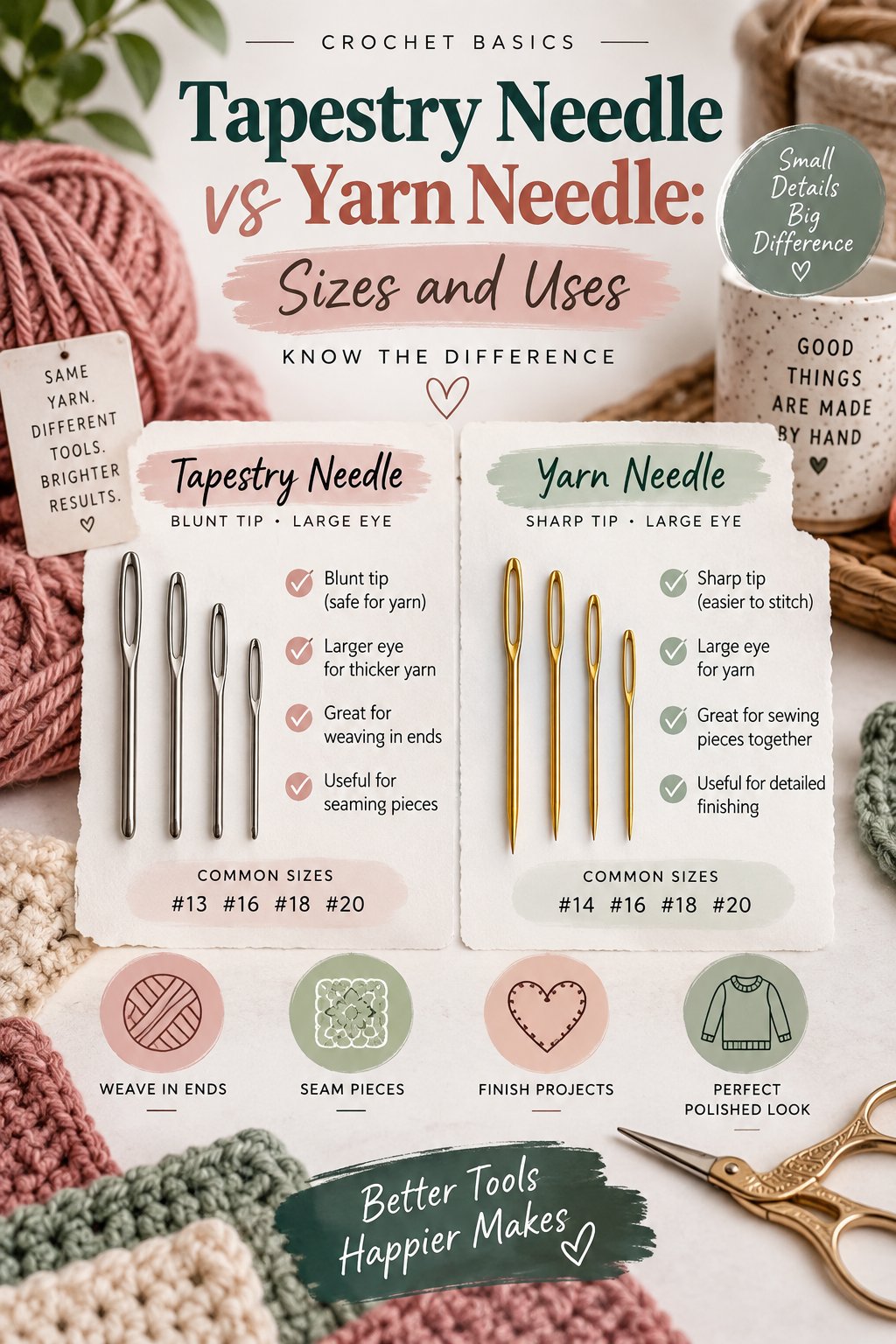
A tapestry needle is a blunt, usually metal needle with a long eye for passing yarn through knitted, crocheted, or woven stitches. A yarn needle is the broader category, including metal tapestry needles, plastic needles, bent-tip models, and flexible nylon-loop tools. In practice, a metal tapestry needle is the durable default for most finishing work.
Tapestry Needle vs Yarn Needle: The Direct Answer
Tapestry needle vs yarn needle is usually a category question rather than a comparison between completely different tools. “Yarn needle” describes the intended material, while “tapestry needle” usually describes a specific blunt needle style, most often made from steel or another rigid metal.
A size 16 metal tapestry needle and a size 16 plastic yarn needle may perform the same basic task, but they do not feel the same in use. The metal version has a smoother eye, greater stiffness, and a longer working life. The plastic version bends more easily and can be safer for children, bulky yarn, or rough craft surfaces.
The best choice depends on four variables:
- Yarn thickness and texture
- Number of plies and splitting tendency
- Stitch density and access to the fabric
- Whether the task is weaving, seaming, or decorative embroidery
For ordinary knitting and crochet, choose a blunt metal tapestry needle that passes through the stitch without forcing the fabric apart. Use a flexible loop needle when the yarn is too thick or textured for a conventional eye.
Key Facts and Quick Answer
- A tapestry needle is a blunt yarn-finishing needle; “yarn needle” is the wider category.
- Larger tapestry-needle numbers indicate thinner needles. Size 26 is finer than size 13.
- Typical working ranges are size 13-14 for bulky yarn, size 16-18 for worsted or aran, and size 20-26 for DK through fingering yarn.
- Bent-tip metal needles help with surface stitching and seaming, but a straight needle gives better control inside thick fabric.
- A quality metal needle typically costs $1.50-$5 for a pack of 2-6, while plastic packs often cost under $2.
- Needle selection should protect stitch structure. A needle that stretches the opening or catches plies is too large, too sharp, or poorly matched.
What Is a Tapestry Needle?
A tapestry needle is a blunt-tipped needle with a comparatively large eye, designed to move between existing yarn strands rather than pierce them. Traditional versions are rigid metal, commonly nickel-plated steel, and have a rounded point that follows the spaces between stitches.
The elongated eye accepts yarn that would not pass through a standard sewing needle. The blunt point reduces the chance of cutting through a yarn ply, although it cannot prevent every snag on loosely spun or brushed fibers.
Tapestry needles are used for:
- Weaving in yarn ends
- Joining knitted or crocheted pieces
- Duplicate stitch
- Surface embroidery on knit fabric
- Cross-stitch and needlepoint
- Plastic canvas
- Repairing selected knitted fabrics
A tapestry needle is not a universal replacement for a sewing needle. Its rounded end cannot pierce tightly woven cloth efficiently, and its large eye may leave a visible hole in fine fabric. For woven cotton, denim, or tightly packed linen, a sharp embroidery or sewing needle is usually more appropriate.
Why the Blunt Tip Matters
A blunt tip helps a needle travel through the legs of a stitch without cutting the yarn core. A sharp needle can enter the middle of a strand, separate its plies, and create a fuzzy or weakened section that remains visible after the tail is trimmed.
The blunt tip works best when the fabric already contains open paths. Knitted fabric, crochet loops, and plastic canvas all provide spaces that the needle can enter. The same tip becomes inefficient against compact felt, dense tapestry canvas, or tightly woven upholstery cloth.
The tip also affects speed. During mattress stitch, a blunt needle can scoop the bars between edge stitches repeatedly without stabbing the neighboring loops. A straight, smooth point is especially useful when the seam must remain flat and the yarn has a low twist.
What Does Yarn Needle Mean?
A yarn needle is a generic name for a needle intended to carry yarn through fabric, stitches, canvas, or loops. The term does not identify one material, exact point shape, or size system, so product descriptions can vary substantially between manufacturers.
A yarn needle may be:
- A rigid metal tapestry needle
- A bent-tip metal needle
- A thick molded plastic needle
- A flexible nylon-loop needle
- A hollow finishing needle
- A large-eye needle for ribbon or novelty yarn
Retail packaging often uses “yarn needle” because the phrase is easier for beginners to understand. Experienced knitters and crocheters often use “tapestry needle” when they mean the standard metal tool.
| Term | Usually describes | Typical material | Main uncertainty |
|---|---|---|---|
| Tapestry needle | Blunt, large-eye finishing needle | Steel or plated metal | Exact size and tip curve |
| Yarn needle | Any needle made for yarn | Metal, plastic, nylon | Construction varies widely |
| Darning needle | Needle for repairing fabric or yarn | Steel | May have a sharper point |
| Finishing needle | Tool for hiding or pulling tails | Plastic or hollow metal | May not suit seaming |
| Chenille needle | Sharp needle with a large eye | Hardened steel | Designed to pierce fabric |
A package labeled “yarn needle” should therefore be inspected rather than purchased by name alone. Check the point, eye, length, stiffness, and stated yarn range.
Which Needle Size Fits Each Yarn Weight?
Tapestry needle numbers run in the opposite direction from ordinary expectations: a higher number generally means a thinner needle. Size 13 is substantially thicker than size 26, although sizing is not perfectly identical across every brand.
The correct needle should carry the yarn through the stitch with light resistance. The yarn should not require force, and the eye should not create a hole wider than the surrounding stitches.
| Tapestry size | Typical yarn weight | Common yarn examples | Suitable tasks |
|---|---|---|---|
| 13-14 | Super bulky or bulky | Jumbo wool, chunky acrylic | Weaving ends, thick seams |
| 16-18 | Worsted or aran | 10-ply wool, medium acrylic | General seaming and finishing |
| 18-20 | Sport or DK | Lightweight wool, cotton DK | Garments, blankets, duplicate stitch |
| 20-22 | Sport, fine DK | Fine merino, baby yarn | Neat ends and narrow seams |
| 24-26 | Fingering or lace | Sock yarn, embroidery floss | Fine knitting, cross-stitch |
These ranges are starting points, not rigid rules. A split-prone cotton may need a slightly smaller eye than a smooth acrylic of the same nominal weight. A fuzzy mohair blend may need a larger eye because pulling it through a small opening compresses and damages the halo.
How Do You Test the Size?
Insert the threaded needle through one stitch in a low-visibility area. If the stitch opens permanently after the needle exits, select a smaller size. If the yarn catches in the eye or the needle bends under normal pressure, select a larger or stiffer model.
A useful practical clearance is approximately 1-2 millimeters between the compressed yarn and the inside width of the eye. This is a working estimate, not an industry standard, because yarn diameter changes with twist, loft, and moisture.
The needle must also fit the fabric density. A size 13 needle may carry bulky yarn comfortably but stretch a tightly knitted rib. A size 24 may protect fine stitches but prove too small for a fuzzy worsted yarn.
Metal, Plastic, or Nylon Loop?
Metal tapestry needles provide the best combination of stiffness, smoothness, and longevity for routine finishing. Plastic and nylon-loop needles solve specific problems, especially when thick yarn, children’s crafts, or limited hand strength makes a rigid metal eye difficult to use.
| Needle type | Typical price | Useful lifespan | Best application | Main limitation |
|---|---|---|---|---|
| Straight metal | $1.50-$5 per 2-6 pack | Several years to a lifetime | General knitting and crochet | Rigid with very thick yarn |
| Bent-tip metal | $2-$7 per 2-6 pack | Several years to a lifetime | Mattress stitch and surface work | Curve can catch loose fibers |
| Plastic yarn needle | Under $2 per pack | 3-12 months with heavy use | Children, bulky yarn, craft canvas | Eye can roughen or snap |
| Nylon-loop needle | $2-$8 per 2-4 pack | 6-24 months typical | Novelty, chenille, and jumbo yarn | Flexible shaft gives less control |
| Hollow finishing tool | $3-$10 per tool | 1-3 years typical | Short tails and quick weaving | Poor choice for structured seams |
Prices are typical retail ranges in the United States and vary by brand, pack size, and specialty construction. A metal needle can cost more initially, but its cost per project is usually lower when it remains smooth and straight.
When Is a Plastic Needle Better?
A plastic yarn needle is useful when a metal point could scratch a child’s hand, when the project uses very thick yarn, or when the eye must flex around a bulky strand. Plastic also works well with plastic canvas because the tool can pass through large holes without damaging the canvas.
Plastic is a poor choice for repeated seaming in dense wool garments. Friction can roughen the shaft and create burrs around the eye. Those burrs catch fibers, especially alpaca, brushed acrylic, mohair, and loosely plied roving.
When Does a Nylon Loop Needle Help?
A nylon-loop needle uses a flexible loop instead of a fixed metal eye. The loop opens widely, so chenille, blanket yarn, eyelash yarn, and other novelty fibers can pass through without compression.
The trade-off is control. A flexible shaft bends inside dense stitches, which makes accurate mattress stitch harder. The loop tool is therefore excellent for hiding a tail in a soft blanket but less suitable for aligning a sweater shoulder seam.
Why Choose a Bent Tip?
A bent-tip tapestry needle lets the user scoop stitch bars from the surface without repeatedly rotating the wrist. The curve is particularly helpful for duplicate stitch, cross-stitch on knitted fabric, and mattress stitch performed on a flat table.
A curved point is not always faster. In a narrow tube, sock toe, or crowded amigurumi opening, the bend can catch nearby loops. Keep a straight needle available for enclosed or highly structured work.
How Should You Choose a Needle by Task?
The best yarn needle is determined by the operation, not only by yarn weight. Weaving in an end requires flexible access through several stitch layers, while seaming requires a controlled path that preserves edge alignment.
| Task | Recommended needle | Typical yarn | Typical time | Reason |
|---|---|---|---|---|
| Weave in scarf ends | Straight metal size 18-20 | DK or worsted | 5-15 minutes | Smooth shaft travels through rows |
| Mattress-stitch sweater seam | Bent or straight metal size 16-18 | Aran or worsted | 30-90 minutes | Stiffness maintains alignment |
| Duplicate stitch | Bent metal size 20-24 | Sport or fingering | 10-30 minutes per motif | Curved point scoops stitch legs |
| Blanket-yarn tail | Nylon loop or plastic size 13-14 | Jumbo or super bulky | 5-10 minutes | Large opening accepts thick yarn |
| Plastic canvas | Blunt plastic or metal size 13-16 | Worsted acrylic | 15-45 minutes | Fits rigid canvas openings |
| Fine sock repair | Metal size 22-26 | Fingering wool or nylon | 10-30 minutes | Small eye avoids enlarged holes |
How to Weave in Ends Without Loosening Stitches
Weaving a yarn tail through several changes of direction secures the end through friction. A typical tail should be 15-20 centimeters long for ordinary knitting or crochet, while slippery yarn may require 25 centimeters and an extra path.
- Thread the needle without crushing the tail. Flattening a yarn end can make the eye entrance harder, not easier.
- Enter the wrong side of the fabric near the finishing point.
- Follow the direction of nearby stitches for 3-5 centimeters.
- Change direction by crossing through a second group of stitch legs.
- Repeat once, then trim close without cutting the surrounding loops.
For ribbing, weave vertically through the purl columns rather than horizontally across the stretch. For stockinette, alternate between the back of several stitches and a diagonal route through adjacent columns. The direction change prevents one loose section from releasing the whole tail.
The mistake most people make is weaving only through the nearest row. That method looks secure until washing relaxes the fabric. A longer path through at least two directions distributes movement.
How Long Should Yarn Tails Be?
A typical tail of 15-20 centimeters is sufficient for medium-weight yarn and a stable fabric. Use 25-30 centimeters for slippery rayon, cotton, silk blends, or seams that will experience repeated stretching.
A tail shorter than 5 centimeters is difficult to thread and cannot create enough friction. If the tail is already short, insert the empty needle into the fabric first, catch the tail in the eye or loop, and pull it through a short distance at a time. Do not force a threaded needle through a narrow opening.
What Happens If the Needle Is Wrong?
A needle that is too large stretches stitch openings, while a needle that is too small compresses the yarn and increases friction. A sharp needle can split plies even when its diameter appears correct.
| Mistake | Visible symptom | Likely consequence | Correction |
|---|---|---|---|
| Needle too large | Permanent hole around entry | Loose or distorted stitches | Drop 2-4 sizes |
| Needle too small | Yarn frays at eye | Broken or fuzzy tail | Increase size or use smoother metal |
| Point too sharp | Split plies and snagged loops | Weakened yarn structure | Use a rounded tapestry point |
| Eye too short | Yarn bunches at entry | Slow threading and abrasion | Choose a longer eye |
| Shaft too flexible | Seam wanders | Misaligned garment panels | Use rigid metal |
| Rough plastic edge | Halo or fuzz around tail | Visible damage after washing | Replace the needle |
Can a Sharp Needle Replace a Tapestry Needle?
A sharp needle can replace a blunt finishing needle only when the material requires penetration. Sharp needles are appropriate for woven fabric repair, felt, embroidery on cloth, and some dense canvas. They are risky for ordinary knitted or crocheted yarn because the point can pierce rather than separate fibers.
A sharp sewing needle also changes the path of a seam. Instead of entering a stitch gap, it may create a new hole beside the stitch, producing a weak point that becomes larger under tension.
What If the Needle Stretches the Fabric?
If the fabric remains visibly open after the needle exits, the tool is too large for that stitch structure. Remove the needle, smooth the fabric with your fingers, and test a smaller size in an inconspicuous section.
Blocking can disguise mild distortion, but blocking does not restore cut fibers or permanently enlarged holes. Fix the tool mismatch before continuing.
Which Alternatives Work?
A crochet hook, latch hook, loop tool, or hollow finishing needle can replace a tapestry needle for selected jobs. Each alternative changes the balance between speed, precision, yarn control, and fabric safety.
| Alternative | Typical size range | Best use | Typical time | Limitation |
|---|---|---|---|---|
| Crochet hook | 2-6 mm | Pulling short tails through crochet | 2-5 minutes | Can pull unevenly |
| Latch hook | 3-8 mm | Rug yarn and thick canvas | 10-30 minutes | Too bulky for garments |
| Yarn loop tool | 5-12 mm opening | Chenille and jumbo yarn | 3-8 minutes | Low seam precision |
| Hollow finishing needle | 2-4 mm shaft | Short tails | 2-5 minutes | Limited path control |
| Sharp embroidery needle | Size 18-26 | Woven cloth and embroidery | 10-30 minutes | Can split knitted yarn |
A crochet hook is often the fastest option for a short crochet tail because the hook can grab the strand directly. It is less precise for a long path through dense knitting and may pull a loop out of shape.
A latch hook belongs mainly to rug-making and heavy canvas work. Its latch mechanism and large shaft can damage garment stitches, even when the yarn itself is thick.
How Much Do Needles Cost and How Long Do They Last?
Typical metal tapestry needles cost $1.50-$5 for a pack of 2-6, while specialty bent-tip or loop designs commonly cost $2-$10. Plastic versions often cost under $2 per pack, but heavy use can shorten their working life to roughly 3-12 months.
| Purchase | Typical US price | Pieces | Expected replacement pattern | Value assessment |
|---|---|---|---|---|
| Basic metal set | $2-$5 | 4-6 needles | Replace when lost or bent | Best general value |
| Bent-tip set | $3-$7 | 2-6 needles | Replace when curve deforms | Useful for frequent seaming |
| Plastic set | $1-$2 | 3-8 needles | Replace after cracks or burrs | Good for children and crafts |
| Nylon-loop set | $3-$8 | 2-4 needles | Replace when loops stretch | Best for novelty yarn |
| Specialty finishing tool | $5-$10 | 1 tool | Replace when shaft wears | Fast for short tails |
Metal needles can last for decades if stored dry and protected from corrosion. Their practical lifespan is often determined by loss rather than wear. Plastic needles may bend, crack, or develop a rough eye after repeated use, particularly with dense wool.
Do not store needles loose in a project bag. A magnetic needle minder, small metal tin, or labeled pill case prevents loss and reduces accidental punctures. Check the eye before each project because a microscopic burr can damage more yarn than a visibly rough shaft.
What Is the Best First Set to Buy?
A beginner should start with a smooth metal set containing sizes 16, 18, 20, and 24, then add a size 13 or 14 for bulky yarn. This range covers most knitting, crochet, amigurumi, blanket, and small repair projects without requiring a separate tool for every yarn label.
The most useful first purchase has these characteristics:
- Rounded tip rather than a sharp point
- Eye long enough for the intended yarn
- Smooth, polished interior
- One straight needle and one bent-tip option
- Sizes clearly marked or stored separately
- Rigid shaft for garment seams
For one-needle simplicity, size 18 is the strongest general compromise for worsted and many aran projects. It is too large for delicate fingering yarn and too small for blanket yarn, so a small set is more practical than relying on one universal size.
An expert rule of thumb is to choose the smallest needle that accepts the yarn without scraping. That choice preserves the fabric opening and reduces visible finishing marks.
Frequently Asked Questions About Tapestry Needle vs Yarn Needle
Can You Use a Tapestry Needle for Embroidery?
You can use a tapestry needle for embroidery on knitted fabric, plastic canvas, and open-weave cloth. Its blunt point follows existing spaces and protects yarn. For tightly woven cotton, linen, or denim, use a sharp embroidery needle because the rounded tapestry point cannot penetrate the fabric cleanly.
Is a Darning Needle the Same as a Yarn Needle?
A darning needle overlaps with the yarn-needle category, but the terms are not identical. Darning needles often have a large eye and may have a sharper point for repairing woven fabric or socks. A blunt tapestry needle is safer for weaving ends through knitted and crocheted stitches.
Which Needle Works for Chenille Yarn?
A nylon-loop needle or large-eye size 13-14 metal needle usually works best for chenille yarn. Chenille compresses and catches easily, so avoid a narrow eye with a rough interior. Pull slowly and inspect the yarn after each pass for crushed pile or exposed core.
Can Children Use Plastic Yarn Needles?
Children can use thick plastic yarn needles for supervised work with large-hole plastic canvas or bulky yarn. Plastic reduces puncture risk, but it can still break into sharp fragments. Inspect the eye and shaft before use, and discard any needle with a crack, burr, or split.
How Do You Thread a Yarn Needle Without a Threader?
Compress the yarn end between your fingers, flatten only the final few millimeters, and push that section through the eye. If the yarn is fuzzy, twist the tip lightly and cut it cleanly. A needle threader may bend or break when used with thick yarn, so a loop needle is better for jumbo fibers.
Does Needle Material Matter for Wool?
Needle material matters more for fragile, fuzzy, or loosely spun wool than for smooth acrylic. Polished metal creates less drag and keeps its eye smooth, while rough plastic can pull the halo and increase pilling. Test the needle on a short yarn sample before weaving into a finished garment.
Final Recommendation
For most knitting and crochet, choose a blunt metal tapestry needle in a size matched to the yarn, with size 16-18 covering many worsted and aran projects. Add a smaller size 20-24 set for DK and fingering yarn, and keep a nylon-loop or plastic option for bulky and novelty fibers.
The practical answer to tapestry needle vs yarn needle is simple: tapestry needle names the standard blunt metal design, while yarn needle includes that design and several alternatives. Select by yarn diameter, stitch density, and task, then test the tool on a hidden section before finishing the visible work.