
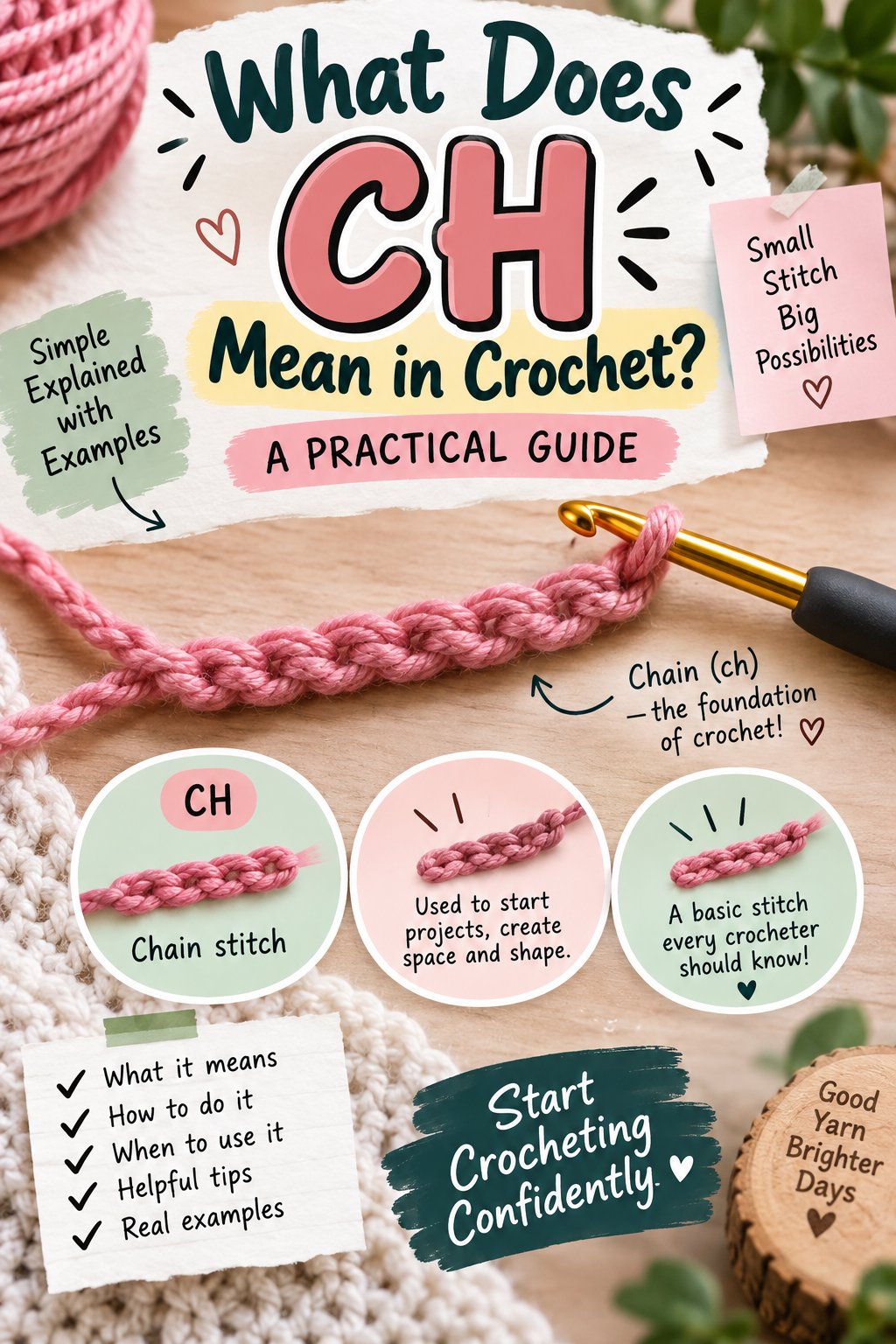
In crochet, CH means chain stitch, a loop of yarn pulled through the loop on a crochet hook. A chain creates foundation length, row height, joining points, and open spaces, but the slip knot and active loop on the hook do not count as chain stitches.
Key Facts About CH in Crochet
- CH is the standard written abbreviation for a chain stitch in most US crochet patterns.
- A completed chain is one V-shaped link. The loop currently on the hook is not a completed stitch.
- A foundation chain establishes starting width, while a turning chain raises the hook for the next row.
- A chain space, written ch-sp, is an opening formed when a pattern tells you to work around or skip chains.
- Typical beginner materials cost $3-$18, excluding shipping and pattern costs.
- Chain height varies by pattern and tension. Common starting conventions are 1 CH for single crochet, 2 CH for half double crochet, and 3 CH for double crochet.
What Does CH Mean in Crochet Patterns?
“CH” means chain stitch in crochet patterns, and the abbreviation tells you to make one or more basic chain links with the hook. A pattern may write ch 5, meaning make five chain stitches, or ch-2 space, meaning work into the opening created by two chains.
The abbreviation belongs to a larger notation system. In US terminology, SC means single crochet, HDC means half double crochet, DC means double crochet, and SL ST means slip stitch. The Craft Yarn Council’s standard crochet abbreviations use this same general vocabulary, although individual designers can define additional symbols in a pattern key.
A chain has two functions that readers often confuse. It can be a stitch that receives another stitch, or it can create distance and open fabric. The written instruction determines which role applies.
For example:
- Ch 20: make 20 chain stitches.
- Dc in 4th ch from hook: skip the first three chains and work into the fourth.
- Ch 2, skip 2 sts: create an opening over two skipped stitches.
- Work 5 dc in ch-3 space: place five double crochets around the opening, rather than into individual chain loops.
A chain is therefore both a physical stitch and a spacing tool. Its meaning depends on its position in the instruction.
How Do You Make a Chain Stitch?
A chain stitch forms when a yarn over is pulled through the active loop, leaving one completed link behind. The slip knot begins the process, but it is not a chain, and each repetition adds exactly one completed chain stitch.
Use smooth, medium-weight yarn and a hook that matches the yarn label for initial practice. Very fuzzy yarn hides the loops, while thread and bulky yarn exaggerate tension errors.
- Make a slip knot. Place the adjustable knot on the hook and tighten it enough to sit on the shaft while still sliding.
- Hold the yarn. Keep the yarn tail in one hand and the working yarn under light, steady tension.
- Yarn over. Bring the working yarn over the hook from back to front.
- Pull through. Draw the yarn through the loop already on the hook. The new V-shaped link is one chain stitch.
- Repeat. Yarn over and pull through once for every chain the pattern requests.
- Check the count. Count completed V shapes, not the slip knot, tail, or active loop.
The hook usually remains inside one active loop after each chain. That loop is necessary for continuing, but it is not an additional chain. A common beginner error is counting the loop on the hook and ending with one chain too many.
What Does a Chain Stitch Look Like?
A completed chain stitch looks like a small V when viewed from the front, and a row of chains resembles a braided cord. Each V has a front loop and a back loop; the underside also has a single ridge called the back bump or third loop.
The visible top of a foundation chain can be deceptive because its links tilt as the chain grows. Count the repeated V units from the hook toward the slip knot. If the chain is twisted, lay it flat before counting or inserting the hook.
What Are the Main Types of Chains?
Crochet chains fall into four practical categories: foundation chains, turning chains, chain spaces, and chains used to secure round work. The hand motion remains the same, but the chain’s location determines whether it affects width, height, openness, or structure.
| Chain type | Typical placement | Primary function | Common pattern example |
|---|---|---|---|
| Foundation chain | Before row 1 | Establishes starting length | Ch 31 for a 30-stitch single-crochet row |
| Turning chain | At row or round edge | Raises work to the next stitch height | Ch 1 before a single-crochet row |
| Chain space | Inside a row or round | Creates an opening | Work into a ch-2 space |
| Joining chain | Near a ring or motif | Closes or stabilizes a loop | Ch 2 before joining a small ring |
Foundation Chain
A foundation chain is a series of chains made before the first worked row. Its length often equals the number of stitches needed in the first row, plus any chains the pattern requires for turning or skipped spaces.
A pattern requesting 30 single crochets in row 1 may instruct you to chain 31, because one chain can function as the turning chain. Other designers write “ch 30, sc in second chain from hook,” which also produces 29 available insertion points unless the instruction accounts for the difference. Always follow the complete formula, not an isolated number.
Turning Chain
A turning chain lifts the working edge so the next row begins at an appropriate height. The chain may count as a stitch, or it may be a spacing chain only, depending on the designer’s instructions.
| Next stitch | Common turning chain | Often counts as a stitch? | Typical edge effect |
|---|---|---|---|
| Single crochet | 1 CH | Usually no | Firm, low edge |
| Half double crochet | 2 CH | Sometimes | Moderate edge height |
| Double crochet | 3 CH | Often, but not always | Taller edge with possible gap |
| Treble crochet | 4 CH | Often | High edge with more flexibility |
These are conventions, not universal laws. A pattern may specify ch 2, turn, then tell you to work the first double crochet into the first stitch because the turning chain does not count. If the pattern says “turning chain counts as a stitch,” skip the first stitch and work into the next one.
Chain Space
A chain space is the hole created by chains, skips, or arches. In a lace pattern, ch-3 space usually means the open area beneath three chains, not the third chain itself.
This distinction matters in granny squares and mesh fabric. Working around the space gives a flexible, open join; inserting into one chain loop can produce a tighter, less even result. Follow the wording into the chain versus into the chain space precisely.
Chain Used in Round Work
A short chain can lift the first stitch in a circular project or secure a loop before stitches are worked around it. A magic ring typically begins with an adjustable loop, then a chain that establishes height for the first stitch. The chain does not automatically become part of the ring’s stitch count.
For amigurumi, the first chain of a round often does not count as a stitch. A pattern may say ch 1, 6 sc in ring, meaning the chain raises the hook while the six single crochets establish the round count.
How Many Chains Should You Make?
The correct number of chains depends on the first row’s stitch count, turning-chain policy, skipped spaces, and the desired finished width. For a basic row, measure the foundation chain against the project gauge instead of assuming one chain equals one fixed unit of length.
A practical sizing method is:
- Make a chain approximately 10 percent longer than the intended width.
- Lay it flat without stretching.
- Measure from the first usable chain to the last required insertion point.
- Add the turning chain or pattern-specific extra chains.
- Work the first row before judging the final width.
| Project example | Typical starting instruction | Approximate usable units | Main counting risk |
|---|---|---|---|
| 10 cm practice strip | Ch 16, single crochet row | 15 SC, depending on pattern | Extra turning chain |
| 20 cm scarf sample | Ch 26-32 | 25-31 stitches | Uneven tension |
| 30 cm granny mesh | Ch 34-40 | Multiple of pattern repeat | Missing chain-space repeat |
| 50 cm blanket edge | Ch 70-90 | Pattern multiple plus turning chains | Twisted foundation |
The figures in this table are typical practice ranges, not universal gauge rules. Yarn weight, hook size, tension, and stitch pattern change the result. A designer may require a multiple of 4 plus 2, a multiple of 6, or a specific stitch count for symmetry.
What Does “Multiple of” Mean After CH?
A pattern multiple tells you which chain counts preserve the stitch repeat. “Chain a multiple of 4 plus 2” means valid counts include 6, 10, 14, 18, and 22.
The added number usually supplies edge stitches or turning space. If a lace repeat needs four chains but the border needs one chain on each side, the formula may be a multiple of 4 plus 2. Changing the count by one can shift every later shell, cluster, or eyelet.
What Materials and Costs Are Typical?
A beginner can practice chain stitches with one basic hook and a small skein of smooth yarn for approximately $3-$18 in typical US retail pricing. The price varies by fiber, brand, package size, sales tax, and whether the hook is sold individually or in a set.
| Item | Typical price | Useful beginner specification | Practice capacity |
|---|---|---|---|
| Aluminum hook | $1-$5 | 4.0-5.5 mm | Thousands of chains |
| Ergonomic hook | $5-$15 | 4.0-5.5 mm | Repeated practice with less hand pressure |
| Acrylic yarn skein | $3-$8 | Worsted weight, 80-200 g | Several practice swatches |
| Cotton yarn skein | $4-$12 | Worsted or DK weight | Clear stitch definition |
| Wool yarn skein | $8-$18 | Worsted weight, 50-100 g | Elastic, easy-to-see chains |
For first practice, worsted-weight acrylic or cotton and a 5.0 mm hook provide visible loops without consuming much yarn. Cotton shows chain structure clearly but has less bounce than wool. Acrylic is inexpensive, although some low-quality acrylic yarn splits into several plies and makes the hook harder to insert.
A hook with a pointed tip can enter tight chains more easily, while a blunt ergonomic hook may reduce accidental yarn splitting. The best choice is the one that lets the yarn slide without forcing the wrist or squeezing the hook.
What Is the Difference Between a Foundation Chain and a Chainless Foundation?
A traditional foundation chain creates the starting links first, while a chainless foundation stitch creates a chain base and a row stitch in the same repeated movement. Foundation single crochet, abbreviated FSC, and foundation double crochet, abbreviated FDC, usually provide a stretchier edge with fewer loose starting links.
| Feature | Traditional CH | FSC | FDC | Best practical use |
|---|---|---|---|---|
| Beginner difficulty | Low | Medium | Medium-high | CH for first projects |
| Typical stretch | Low-medium | Medium-high | High | FSC for cuffs |
| Counting method | Count chain V shapes | Count completed SC units | Count completed DC units | Chain for simple repeats |
| Edge correction | Unravel and remake | Add units during work | Add units during work | FSC or FDC for fitted items |
| Visual edge | Narrow braided cord | Matches SC texture | Matches DC texture | CH for lace foundations |
| Common project | Blanket or scarf | Waistband or garment | Sweater or bag base | Depends on fabric tension |
A traditional chain is easier to inspect and teach. Its weakness is structural: the chain can remain tighter than the first worked row, causing a curved or puckered edge. A chainless foundation reduces that mismatch but requires simultaneous control of the base chain and the main stitch.
When Should You Use a Chainless Foundation?
Use a chainless foundation when the starting edge needs stretch, when the first row feels tighter than later rows, or when the project is fitted around a body part. Use a traditional foundation chain when the pattern specifies a lace repeat, when you are learning, or when the starting count must be visually obvious.
Foundation stitches are not automatically better. They can look uneven until tension stabilizes, and replacing a designer’s specified chain with FSC or FDC can alter stitch height and repeat alignment.
Why Do Foundation Chains Become Too Tight?
Foundation chains become too tight when the working yarn is pulled firmly after each pull-through, when the hook is too small for the crocheter’s tension, or when the yarn has low elasticity. A tight base prevents the next row from spreading, so the fabric may curl upward or bow like a banana.
| Visible symptom | Likely cause | Specific remedy | Verification test |
|---|---|---|---|
| Hook cannot enter chain | Excess tension | Use a 0.5-1.0 mm larger hook | Hook enters without force |
| Edge curls inward | Base shorter than row | Loosen chains or use FSC | Edge lies flat after row 2 |
| Large gaps between links | Loose active loop | Reduce finger spacing | V sizes become consistent |
| Chain twists | Foundation rotated | Align back bumps before row 1 | Top V faces one direction |
| Row count changes | Missed insertion point | Mark every 10-20 chains | Groups total required count |
In practice, changing hook size is often more effective than trying to consciously “relax.” Make a sample chain with the project hook and another with a hook 0.5 mm larger. If the second chain accepts the next-row hook smoothly and the edge lies flat, keep the larger hook for the foundation only.
How Do You Fix a Wrong Chain Count?
If the mistake is found before the first row, pull out the active loop, unravel to the error, and remake the required number. If the first row is already worked, count the actual stitches and compare them with the pattern repeat before continuing.
For a missing chain at the end, adding one chain later rarely repairs the edge cleanly. A better correction is to unravel back to the error, or adjust the border only when the pattern allows an edge stitch variation. For a surplus chain, remove the extra chain before working into it.
Place a marker after every 10 or 20 chains on a long foundation. Markers do not replace counting, but they make a 100-chain error easier to locate at the 60-chain point instead of forcing a complete recount.
Which Loop of the Chain Should You Work Into?
The correct insertion point depends on the pattern and the desired edge finish. Most beginners work under the two top loops of the chain, while working into the back bump creates a ridged underside that resembles the top edge of later rows.
| Insertion location | Hook enters | Resulting edge | Typical reason |
|---|---|---|---|
| Top loops | Front V, under two strands | Familiar, flexible edge | Standard beginner method |
| Back bump | Single underside ridge | Clean chained-looking edge | Professional foundation finish |
| Front loop only | Nearest top strand | Decorative ridge | Texture or later shaping |
| Back loop only | Farthest top strand | Horizontal ridge | Ribbed effect or pattern instruction |
Working into the back bump can make the first row slower because the chain must be rotated toward you. It also reduces the loose strand often visible along a conventional foundation edge. This method is useful for scarves, cuffs, and exposed blanket borders, but it should not replace a pattern’s explicit insertion instruction.
How Do You Read CH Abbreviations Correctly?
Read CH together with the number, destination, and punctuation that follow it. The abbreviation alone only identifies the stitch; the surrounding words determine whether you make, skip, count, or work around the chains.
| Pattern wording | Required action | Count consequence | Example outcome |
|---|---|---|---|
| Ch 8 | Make eight chains | Eight completed links | Foundation or loop |
| Ch 1, turn | Make one, rotate work | Usually no counted stitch | Low row start |
| Ch 3, skip 2 | Make three, skip two stitches | Opening spans two stitches | Mesh section |
| In ch-2 sp | Work around the opening | Space, not two separate stitches | Granny-square corner |
| 2 dc in next ch | Work into one chain | Chain receives two DC | Increase at foundation |
US and UK terminology creates a separate risk. A US single crochet is equivalent to a UK double crochet, while a US double crochet is equivalent to a UK treble crochet. The abbreviation CH generally still means chain, but the stitch height assigned to a turning chain can change with the pattern’s terminology.
Check the designer’s key before applying a familiar US formula. A pattern that says ch 3 may count the turning chain as a double crochet in one design and treat it as a simple lift in another.
What Happens If You Count the Slip Knot or Active Loop?
Counting the slip knot or active loop produces an extra stitch in the foundation count. The first worked row then finishes one stitch short or long, and the error often shifts the placement of increases, decreases, shells, or lace repeats.
The slip knot is a setup knot, not a completed chain. The active loop remains on the hook and becomes part of the next chain when you pull yarn through it. Count only the finished V links between those two points.
For a pattern requiring 20 single crochets, a common instruction is ch 21, sc in second chain from hook, and sc across. The first chain from the hook is skipped because it supplies the turning height. That formula uses 21 chains to create 20 available insertion points.
CH Compared With Other Crochet Abbreviations
CH identifies a chain, whereas nearby abbreviations describe stitches that use the chain as a foundation, join, or target. Knowing the difference prevents the frequent mistake of making a chain when the pattern actually requests a slip stitch or a single crochet.
| Abbreviation | Full term | Hook action | Typical function |
|---|---|---|---|
| CH | Chain stitch | Pull yarn through one loop | Foundation, height, spacing |
| SL ST | Slip stitch | Pull yarn through work and loop | Joining or moving position |
| SC | Single crochet | Pull up loop, yarn over, pull through two | Dense fabric |
| HDC | Half double crochet | Yarn over, pull up loop, pull through three | Medium-height fabric |
| DC | Double crochet | Two pull-through stages | Taller fabric |
| FSC | Foundation single crochet | Chain base and SC together | Stretchy starting edge |
A chain is the least dense of these operations because it does not anchor into an existing stitch. It extends the working path. A slip stitch, by contrast, moves through existing fabric without adding much height.
Frequently Asked Questions About What Does CH Mean in Crochet
Does CH Mean Chain in Both US and UK Crochet?
Yes, CH normally means chain in both US and UK crochet notation. The major terminology difference affects stitch names such as SC, DC, and treble crochet, not the basic chain abbreviation. Confirm the pattern key because designers can use custom abbreviations or symbols.
Does the Loop on the Hook Count as a Chain?
No, the active loop on the hook does not count as a chain stitch. The loop is live working yarn, while a completed chain is a V-shaped link behind the hook. Count each finished link and exclude the slip knot and active loop.
Why Is My Crochet Chain Curving?
A crochet chain curves when its tension is tighter than the next row, when the yarn has limited elasticity, or when the first row is worked unevenly. Use a larger hook for the foundation, loosen the yarn hold, or use a chainless foundation for projects that need a flexible edge.
Can I Crochet Into the Back Bump of a Chain?
Yes, you can crochet into the back bump when the pattern permits it. The back-bump method leaves a cleaner edge with a row of V shapes, but it takes longer because you must rotate the chain and locate the single ridge under each link.
Is a Chain Space the Same as a Chain Stitch?
No, a chain stitch is one completed looped link, while a chain space is the opening created beneath or around one or more chains. “Work in ch-3 space” usually means insert the hook into the opening, not into the third chain’s individual loop.
How Do I Join a Foundation Chain Without Twisting It?
Lay the chain flat with all top V loops facing the same direction before joining. Insert the hook into the first chain without rotating the foundation, then make the joining stitch. For a large ring, check the entire chain’s orientation before closing because a twist cannot be removed afterward.
Conclusion
What Does CH Mean in Crochet has a simple answer: CH means chain stitch, the looped building unit used for foundations, turning height, spacing, and round-work setup. Count completed V links, follow the pattern’s turning-chain rule, and adjust tension before the first row locks the edge into shape.