
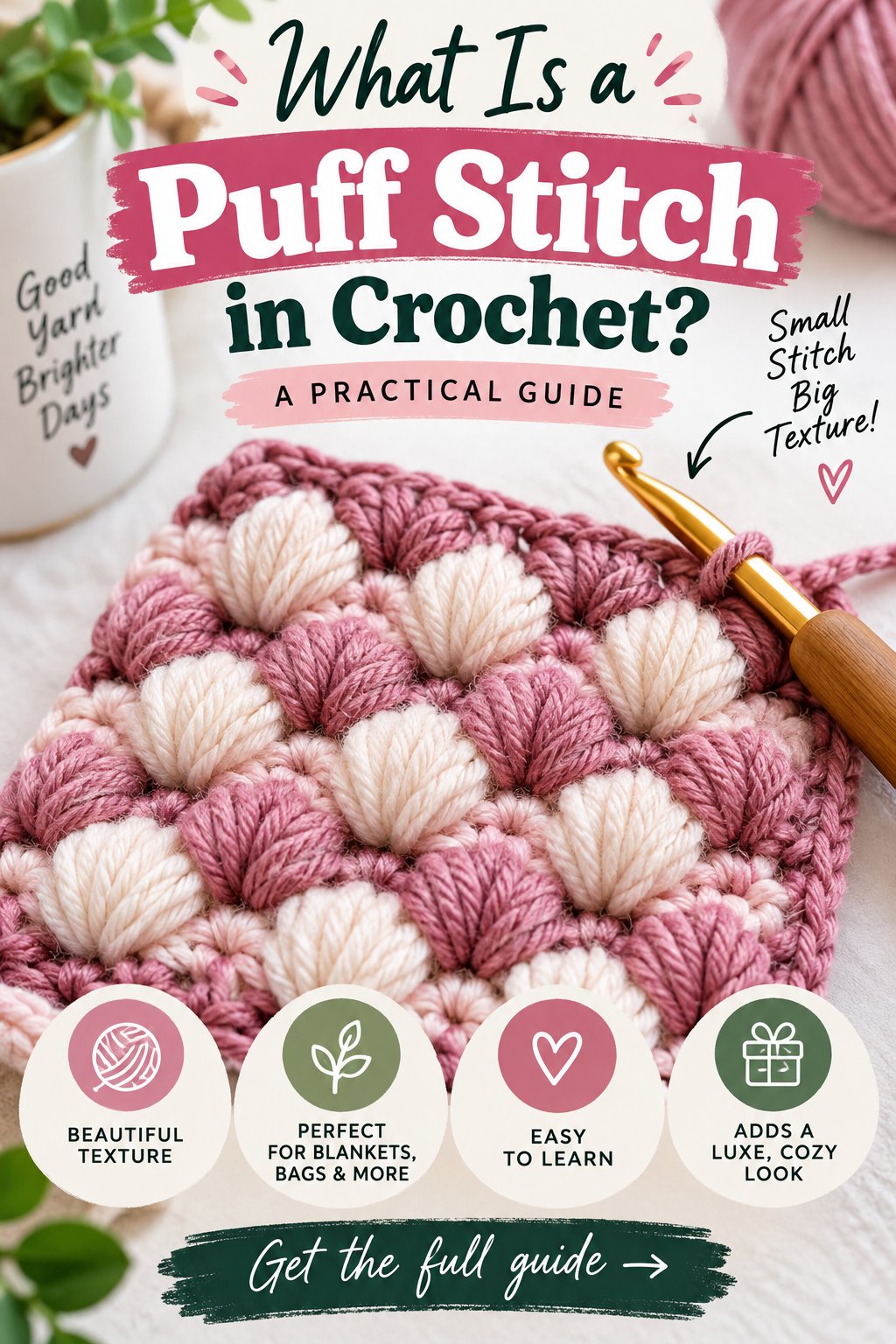
A puff stitch in crochet is a textured cluster made by drawing up several unfinished half double crochet loops in one stitch or space, then closing them together. The result is a soft, raised oval that adds warmth, thickness, and visual relief, although it uses more yarn and usually reduces fabric drape compared with a flat stitch.
Key Facts
A typical puff uses 3-5 draw-up repetitions and closes with 7, 9, or 11 loops in US crochet terminology.
Every elongated loop should reach the same height before the final pull-through.
A puff often consumes about 1.5-2.5 times the yarn of a comparable flat stitch area, depending on its size and spacing.
A closing chain is common, but the exact instruction depends on the designer and pattern.
Smooth, tightly spun yarn and a rounded, tapered hook make large loop clusters easier to close.
Puff stitches add relief and insulation, but they can make garments heavier and blankets less flexible.
What Is a Puff Stitch in Crochet?
A puff stitch is a group of incomplete half double crochet-style movements worked into the same stitch or chain space and completed as one cluster. The unfinished loops stay on the hook, creating stored yarn volume; one final yarn over pulls through the group and forms the characteristic pillowy surface.
In US crochet terms, a three-repetition puff commonly has seven loops before closure: the original loop plus two loops from each yarn-over and draw-up sequence. A four-repetition puff commonly has nine loops, while a five-repetition puff commonly has eleven. Pattern writers do not use these counts identically, so the written instructions always take priority over the label “puff.”
The stitch is defined by construction, not by one universal loop count. Some designers call a cluster made with three incomplete double crochets a puff, while others reserve that structure for a bobble or cluster. Checking the abbreviation key prevents a technically correct stitch from producing the wrong fabric.
A puff is also different from a simple increase. An increase adds completed stitches and expands the row. A puff concentrates several partial movements into one completed stitch, so the stitch count normally remains stable unless the pattern deliberately adds or skips stitches.
How Does a Puff Stitch Work?
The puff stitch works by stacking equal-height loops before closing them as a single raised unit. The vertical loops trap extra yarn and air, which gives the finished cluster more height than a single crochet, half double crochet, or double crochet.
The following method uses common US crochet terminology for a puff with three repetitions. Read “same stitch or space” literally, because inserting into different locations changes the structure and alignment.
- Yarn over and insert the hook into the indicated stitch or chain space.
- Yarn over and pull up an elongated loop to the height of the surrounding fabric.
- Repeat steps 1 and 2 two more times in the same location.
- Count the loops on the hook. A three-repetition version commonly has seven loops.
- Yarn over and pull through all loops in one controlled movement.
- Chain 1 if the pattern specifies a closing chain.
- Work the next stitch according to the pattern, usually in the next stitch or space.
The closing chain has two possible functions. It can lock the cluster and create a visible valley above the puff, or it can provide height so the next stitch begins at the correct level. Some patterns close the puff by pulling through all loops without chaining, so adding a chain automatically can alter stitch count and texture.
Puff Stitch Anatomy
| Construction | Typical US loop count | Visible result | Common use |
|---|---|---|---|
| 3 draw-up repetitions | 7 loops | Small, soft oval | Scarves, borders, light motifs |
| 4 draw-up repetitions | 9 loops | Medium raised oval | Hats, cushions, textured panels |
| 5 draw-up repetitions | 11 loops | Large, dense oval | Blankets, bags, decorative motifs |
| 6 draw-up repetitions | 13 loops | Very bulky cluster | Isolated accents, not fast fabric |
The loop count includes the loop already on the hook. That detail explains why “three-loop puff” and “three-repeat puff” can mean different things in independent patterns. Experienced crocheters count the actual loops or follow the designer’s abbreviation rather than assuming the number refers to repetitions.
The Craft Yarn Council’s standardized notation uses bracketed repeat instructions for grouped stitches. In practice, a pattern may write a puff as “(yo, insert hook, yo, pull up a loop) 3 times, yo, pull through all 7 loops,” which makes the mechanics more precise than the word “puff” alone.
Which Puff Stitch Variations Change the Fabric?
Puff variations differ mainly by insertion point, loop height, closure, and how neighboring clusters are arranged. A puff worked into a chain space usually spreads more softly, while a puff worked directly into a stitch creates a more anchored and compact surface.
| Variation | Insertion or arrangement | Typical density | Best application |
|---|---|---|---|
| Standard puff | One previous-row stitch | Medium-high | Scarves, hats, panels |
| Space puff | Chain-1 or chain-2 space | Medium | Shawls, open blankets |
| Alternating puff | Puffs offset across rows | Medium-high | Diagonal texture, faux cables |
| Braided puff | Angled or interlocking placement | High | Panels, bags, cushions |
| Jasmine-style flower | Multiple clusters joined around centers | Very high | Motifs, collars, statement accessories |
Standard and Space Puffs
A standard puff usually enters the top loops of a previous stitch. That placement produces clearer vertical columns and makes counting easier, but it can compress the row when the crocheter works with tight tension.
A space puff enters a gap rather than a stitch. The surrounding chain space gives the loops more room, often creating a softer, more open fabric. Space puffs are useful when warmth is wanted without turning the entire project into a rigid, heavy textile.
Modified and Jasmine-Style Puffs
Modified puffs use directional placement or adjacent clusters to create lines that resemble cables or braids. The visual effect depends on where the hook enters, so a chart can be easier to follow than prose instructions.
Jasmine stitch is a separate advanced family built from puff-like clusters joined horizontally, vertically, and diagonally. It produces flower or star motifs, consumes substantial yarn, and grows slowly because several loops must be controlled at once. Calling every flower-shaped cluster a standard puff obscures those construction differences.
What Yarn and Hook Make Puffs Easier?
Smooth yarn and a hook with adequate throat space make puff stitches easier to form and close. A tightly spun acrylic, mercerized cotton, smooth wool, or wool blend shows the stitch definition clearly, while fuzzy, loosely spun, or highly textured yarn hides loop height and makes repairs difficult.
| Material or tool | Typical specification | Effect on puff stitches | Practical recommendation |
|---|---|---|---|
| Smooth DK yarn | 240-300 meters per 100 grams | Clear loops, moderate bulk | Good first swatch choice |
| Worsted acrylic | 170-220 meters per 100 grams | Stable, affordable texture | Useful for blankets and practice |
| Mercerized cotton | 200-280 meters per 100 grams | Crisp definition, less elasticity | Use relaxed tension |
| Boucle or mohair blend | Variable, often 100-180 meters per 100 grams | Conceals loops and snags | Avoid for first attempts |
| Tapered hook | 4.5-5.5 millimeters for DK or worsted | Enters clusters smoothly | Strong beginner option |
| Sharp inline hook | Any size | Can split plies during closure | Use only with controlled tension |
A hook one-half to one millimeter larger than the yarn label’s recommendation can create enough clearance for the final pull-through. The trade-off is a looser surrounding fabric, so swatch before changing the entire project.
Color also affects accuracy. Light, solid colors reveal individual loops and the closing chain; black, navy, brushed, and variegated yarns make it harder to confirm whether every loop has the same height.
Expert insight: The most useful hook feature is not simply a large size. A smooth, rounded throat reduces snagging, while a head that is too blunt can struggle to enter a compact cluster. Hook geometry matters most at the final pull-through.
How Much Yarn, Time, and Money Do Puff Stitches Use?
Puff stitches usually require more yarn and time than flat stitches covering the same area, but the increase depends on puff size, spacing, yarn weight, and tension. A practical planning range is 1.5-2.5 times the yarn used by a comparable single crochet or double crochet section, not an automatic doubling of the entire project budget.
A small spaced puff may add little material to a row. Five-repeat puffs placed in every stitch can consume substantially more. Swatching is the reliable way to measure the difference because “one stitch” does not describe equal surface areas across different patterns.
| Construction | Typical yarn use versus comparable flat area | Approximate time per completed unit | Fabric consequence |
|---|---|---|---|
| 3-repeat puff, spaced | 1.5-1.8 times | 20-35 seconds | Light texture, better drape |
| 4-repeat puff, every other stitch | 1.7-2.1 times | 30-45 seconds | Noticeable relief, moderate weight |
| 5-repeat puff, every stitch | 2.0-2.5 times | 40-70 seconds | Dense, warm, slower growth |
| Jasmine-style cluster | 2.5-4.0 times | 60-120 seconds | Very dense, highly textured |
These are typical practitioner ranges for a steady crocheter using smooth DK or worsted yarn. They are planning figures, not laboratory measurements, and beginners may take twice as long while learning loop control.
For a simple budget example, a flat blanket that normally needs six USD 5 skeins, or USD 30 total, might require eight to twelve skeins when dense puffs replace much of the fabric. That produces a typical yarn budget of USD 40-60, before shipping, tax, or pattern costs. A spaced design may remain near the original budget.
| Project type | Flat-stitch estimate | Dense puff estimate | Typical yarn budget |
|---|---|---|---|
| 40 x 50 inch baby blanket | 900-1,200 meters | 1,500-2,400 meters | USD 35-75 |
| Adult scarf, 7 x 60 inches | 250-350 meters | 400-700 meters | USD 12-35 |
| Medium cushion cover | 350-500 meters | 600-1,000 meters | USD 20-50 |
| Worsted hat | 120-180 meters | 180-300 meters | USD 8-25 |
The best budget control is spacing, not simply buying cheaper yarn. Working puffs in every other stitch, using three repetitions instead of five, or limiting texture to a panel can preserve the raised effect while reducing yardage and production time.
Is a Puff Stitch Reversible?
A puff stitch is structurally reversible when the cluster is closed symmetrically, but the two fabric faces may still look different. The front often shows a clearer oval, while the back can show the closing chain, crossing strands, or a flatter ridge.
A pattern designed for a scarf or blanket may be attractive on both sides without being visually identical. A dense puff with a chain-1 closure often has a more pronounced front and a small indentation on the reverse. Alternating the direction of rows can also change which side appears raised.
| Stitch type | Front relief | Reverse appearance | Reversible for practical use? |
|---|---|---|---|
| Puff cluster | Soft oval | Ridge or shallow oval | Usually yes |
| Popcorn | Hard rounded bump | Indentation | Usually no |
| Bobble | Dense ball | Noticeable hollow or ridge | Usually no |
| Front-post cluster | Raised bar | Recessed bar | Depends on design |
For a reversible scarf, alternate puff rows with plain rows and inspect both faces after blocking. For a pillow front, garment yoke, or bag panel, orienting every puff in one direction gives a cleaner face even if the reverse will not be displayed.
Puff Stitch Versus Popcorn and Bobble
Puff, popcorn, and bobble stitches all create relief, but they do so through different construction methods. A puff keeps multiple partial stitches open until one final closure; a popcorn uses completed stitches joined at the top, while a bobble generally uses partial taller stitches closed together.
| Feature | Puff stitch | Popcorn stitch | Bobble stitch |
|---|---|---|---|
| Core construction | Partial half double crochet cluster | Completed double crochet group | Partial double crochet cluster |
| Typical loops or stitches | 7, 9, or 11 loops | 3-5 completed stitches | 5-7 partial stitches |
| Relief | Soft and oval | Firm and rounded | Dense and ball-like |
| Yarn demand | High | Very high | High |
| Typical face | Moderate front and back relief | Strong front bump | Strong front bump |
| Drape | Medium to low | Low | Low |
| Best use | Soft texture and warmth | Motifs and bold dots | Dense accents and sculpted rows |
A puff is usually the better choice when the fabric must remain comfortable against skin. Popcorn is better when a distinct raised dot matters more than softness. Bobbles work well for strong graphic texture but can add weight quickly across a large surface.
The names overlap across designers. One pattern’s “bobble” may use the same mechanics another designer calls a puff. Always compare the written stitch sequence, number of yarn overs, and closure method.
What Mistakes Distort Puff Stitches?
Uneven loop height is the most common cause of misshapen puffs. Each drawn-up loop should reach roughly the height of the surrounding stitch tops; short loops produce a compressed nub, while excessively tall loops create a loose, floppy cluster.
The most common problems are:
- The hook will not pass through the loops: Relax the hook hand, widen the loops before closing, and use a larger tapered hook.
- The puff leans sideways: Insert every repetition into the same stitch or space and avoid catching only one strand accidentally.
- The cluster disappears: Increase loop height or repetitions, then check that the yarn weight is not too fine for the pattern.
- The row becomes tight: Replace every-stitch puffs with spaced puffs or use a larger hook for the textured section.
- The yarn splits: Slow the final pull-through and rotate the hook so the head faces the loop opening.
- The stitch count changes: Confirm whether the closing chain counts as a stitch and whether the puff occupies one stitch or a chain space.
- A loop drops: Place a locking stitch marker through the loose loops immediately, then rebuild the cluster before continuing.
Expert insight: Pulling the final yarn over tightly before drawing through the cluster creates the very resistance that causes snagging. Keep the yarn-over slightly open, then tighten the completed puff afterward.
A dropped loop is not always a reason to unravel the entire row. If the cluster has not been closed, insert a spare hook or locking marker through every visible loop, undo the last movement carefully, and rebuild the missing repetition. Once neighboring stitches have been worked, repair becomes less reliable and frogging is usually cleaner.
How Should a Puff Be Blocked?
Blocking should happen after the swatch or finished piece is complete, using the fiber’s care limits. Acrylic responds mainly to controlled shaping and gentle steam, while wool and cotton respond more noticeably to wet blocking, but excessive heat can flatten the raised clusters.
Do not stretch a puff fabric aggressively. Pin the project to the intended dimensions, open the spaces between clusters, and let it dry fully. Overblocking can turn pillowy relief into a shallow textured field.
How Can Beginners Practice the Stitch?
Beginners can learn a puff stitch reliably by practicing a small swatch rather than starting with a large blanket. Use smooth worsted yarn, a 5.5 or 6 millimeter hook, and three-repeat puffs separated by one plain stitch.
Make a foundation chain of 16-20 stitches, work one plain setup row, then repeat a puff in the indicated stitch followed by a single crochet in the next stitch. Complete four to six rows before judging the fabric. The first row primarily teaches loop height; later rows reveal whether tension remains consistent.
Track three measurements:
| Practice measure | Target range | What it reveals |
|---|---|---|
| Loop height | Same as nearby stitch height | Consistent puff shape |
| Swatch width change | Within 10% between rows | Stable tension |
| Closure success | 8 of 10 puffs cleanly closed | Adequate hook clearance |
| Yarn tail increase | 50%-150% over flat swatch | Real project yardage impact |
Count loops aloud during practice. This simple habit prevents the common error of closing a four-repeat puff with only three repetitions, which creates a smaller cluster that may be difficult to notice until several rows are complete.
When Should You Use Puff Stitches?
Use puff stitches when the project benefits from soft relief, insulation, or a decorative focal area. Avoid covering an entire garment with dense puffs when low weight, stretch, and smooth layering are priorities.
Puffs work particularly well for:
- Baby blankets, provided the texture does not create unwanted snag points.
- Scarves, cowls, and hats that benefit from warmth.
- Cushion fronts, bags, and wall hangings where weight is acceptable.
- Borders and motif centers that need a raised accent.
- Small panels that would look heavy if the entire project used clusters.
Dense puffs are less suitable for fitted sweaters, socks, gloves requiring precise stretch, and frequently washed household textiles. The extra yarn increases drying time and can make fabric feel stiff when washed without sufficient ease.
The stitch also affects gauge. A row containing frequent puffs may be shorter or wider than a plain row because the loops compress differently. Measure both stitch gauge and row gauge after washing the swatch, especially when fitting clothing or matching a blanket size.
Frequently Asked Questions About What Is a Puff Stitch in Crochet
Is a puff stitch the same as a cluster?
A puff stitch is one type of cluster, but the terms are not interchangeable in every pattern. A cluster can combine partial double crochets, treble crochets, or other unfinished stitches. The written sequence determines the result, while “puff” usually signals a soft, rounded cluster with several loops closed together.
How many yarn overs are in a puff stitch?
A common three-repeat puff uses three yarn overs to begin three partial half double crochet movements, followed by one final yarn over for closure. Depending on the pattern, four or five repetitions create nine or eleven loops. Count the repetitions and loops specified by the designer rather than relying on the stitch name.
Can puff stitches be worked with cotton yarn?
Cotton yarn works well for puff stitches because its smooth surface shows the cluster clearly and resists fuzzy obstruction. Less elastic cotton can make tight puffs difficult to close, so use relaxed tension or a hook 0.5-1 millimeter larger than the label recommendation.
Why are my puff stitches flat?
Flat puffs usually result from short draw-up loops, too few repetitions, tight closing tension, or a yarn that lacks enough volume. Pull each loop to the height of the surrounding stitches, verify the loop count, and test one larger hook before changing the whole pattern.
Do puff stitches use more yarn than double crochet?
Puff stitches generally use more yarn than double crochet over the same surface area because each cluster contains several elongated loops. A typical dense design uses about 2.0-2.5 times as much yarn as a comparable flat section, while spaced three-repeat puffs may use closer to 1.5-1.8 times.
Are puff stitches suitable for blankets?
Puff stitches suit blankets when softness, warmth, and raised texture matter more than minimum weight or yardage. A full blanket of five-repeat puffs can require 1,500-2,400 meters for a baby-size project and may cost USD 35-75, so a spaced design often gives better control.
Conclusion
A puff stitch in crochet is a raised cluster formed from multiple unfinished half double crochet-style loops closed together. Choose the loop count, spacing, hook, and yarn according to the required texture, drape, cost, and time, then verify the designer’s exact instructions because puff terminology is not universal.