
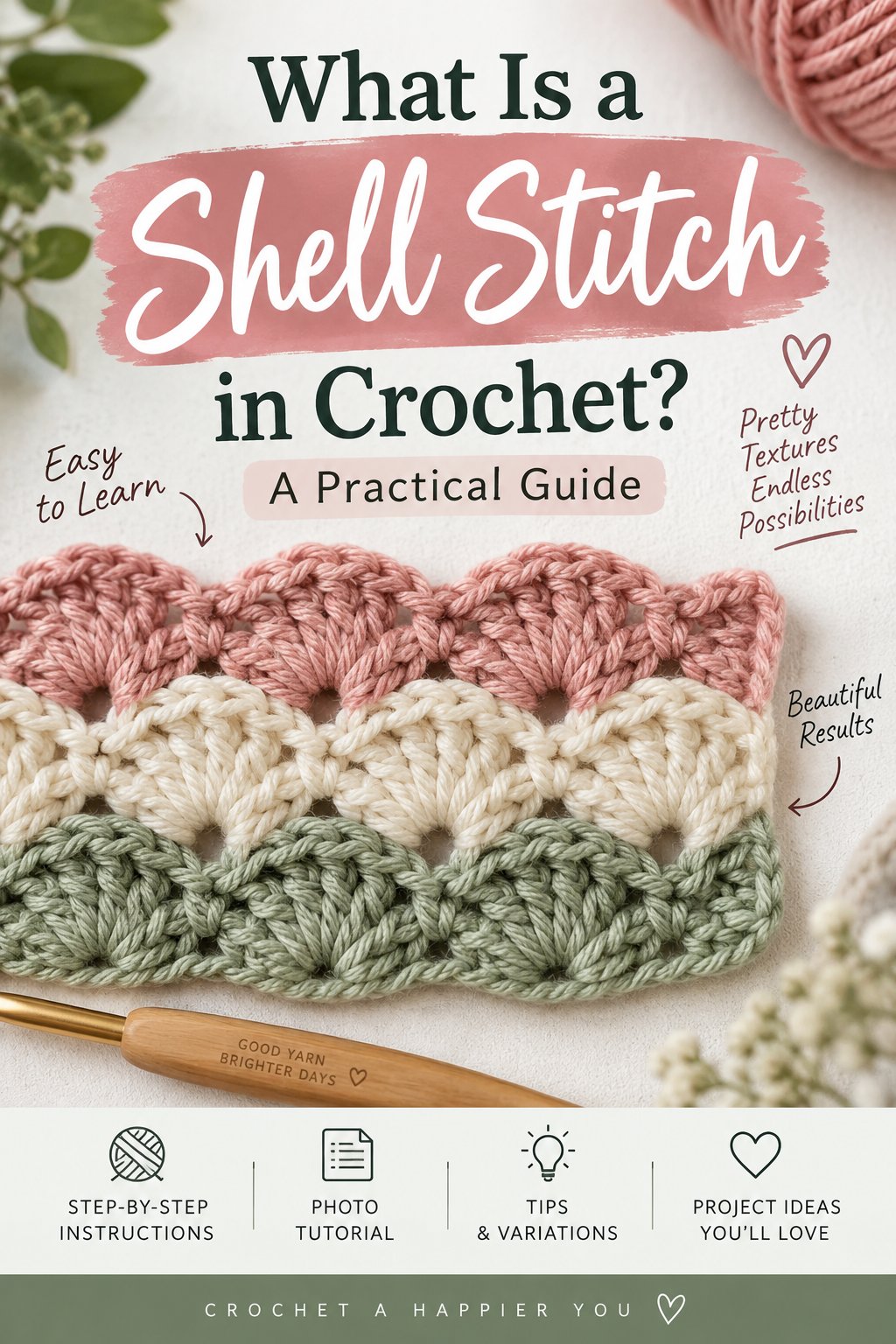
A shell stitch in crochet is a textured stitch pattern that places several stitches into one base stitch or space, creating a rounded fan. The pattern alternates expansion, usually five double crochets, with compression from skipped stitches and an anchor stitch, producing scallops, drape, and visible row texture.
Key Facts
A standard shell commonly uses 5 double crochets worked into one stitch.
A frequent repeat is 6 stitches plus 1 foundation chain.
A shell is an arrangement of stitches, not a single standalone stitch.
Single crochet anchors and skipped stitches control the fan’s width.
A 40 x 60 inch throw typically needs about 1,200-1,500 yards.
Shell fabric usually consumes more yarn than comparable flat stitch patterns.
How Does a Shell Stitch Work?
A shell stitch works through controlled expansion and compression. Multiple stitches enter one location, spreading outward into a fan, while skipped stitches reduce the fabric between fans and an anchor stitch stabilizes the next repeat.
The most recognizable example is a 5-double-crochet shell:
skip 2 stitches, 5 dc in next stitch, skip 2 stitches, sc in next stitch
The exact order depends on the pattern. Some designs place the single crochet between shells, while others use chain spaces, slip stitches, or taller anchor stitches. The important structural feature is concentration: several stitches share one base location.
A shell is therefore different from a cluster. In a shell, the component stitches usually remain visibly open at the top and spread into a fan. In a cluster, stitches are partially closed together at the top to form a compact bump.
Shell Stitch Anatomy
| Component | Typical value | Structural effect | Visible result |
|---|---|---|---|
| Shell body | 3, 5, or 7 double crochets | Expands one base location | Fan or scallop |
| Anchor | Single crochet or slip stitch | Compresses the repeat | Separates shells |
| Skipped stitches | Usually 2 on each side | Creates spacing | Curved lower edge |
| Row repeat | 4 + 1, 6 + 1, or 8 + 2 | Controls alignment | Consistent width |
The center double crochet is the visual peak of a traditional shell. When shells are stacked in succeeding rows, that center can sit over an anchor space, a center stitch, or a chain space, depending on the architecture.
What Stitch Multiples Should You Use?
The correct foundation chain depends on the shell recipe, because the shell body and the spaces between shells determine the repeat. A 5-double-crochet shell with two skipped stitches and one single-crochet anchor often uses a multiple of 6 plus 1, but patterns vary.
Use this formula:
foundation chain = repeat multiple × number of repeats + turning-chain allowance
The turning-chain allowance is separate from the repeat in many written patterns. A pattern may say “chain 25,” then use the first three chains as the turning chain, or it may count the turning chain as part of the first stitch. Read that instruction literally.
| Shell pattern | Common repeat | Example starting chain | Typical first-row layout |
|---|---|---|---|
| 3-dc simple shell | 4 + 1 | 21 chains | sc, skip 1, 3 dc, skip 1 |
| 5-dc classic shell | 6 + 1 | 25 chains | sc, skip 2, 5 dc, skip 2 |
| 7-dc large shell | 8 + 2 | 26 chains | anchor, skip 3, 7 dc, skip 3 |
| Open shell | 6 + 1 | 25 chains | 2 dc, ch 1, 2 dc in one location |
A 25-chain foundation does not always produce a finished width of 25 stitches. Turning chains, edge anchors, border stitches, and skipped positions alter the measurement. Crochet a swatch before calculating a blanket’s final chain.
How Do You Calculate the Width?
Measure the blocked width of one complete repeat rather than estimating from the chain count. If five repeats measure 10 inches, a 40-inch project needs approximately 20 repeats, then the edge and turning-chain requirements are added according to the pattern.
A practical calculation is:
desired width ÷ measured repeat width = approximate repeat count
Round to a whole repeat. For example, a 5-inch repeat cannot produce exactly 38 inches without changing tension or adding a border. Twenty repeats would produce about 40 inches before edging.
How Do You Crochet a Basic Shell Stitch?
A basic shell stitch is suitable for beginners who can make chain, single crochet, double crochet, and skip stitches. The following method creates a common 5-double-crochet shell row with single-crochet anchors.
- Make the foundation chain. Chain a multiple of 6 plus 1, such as 25 chains for four repeats, then add any turning chains required by your pattern.
- Work the first edge anchor. Insert the hook into the appropriate foundation chain and make a single crochet.
- Skip two foundation stitches. Skipping creates the space needed for the fan to spread.
- Make the shell. Work five double crochets into the next foundation stitch. Keep the loops at a consistent height.
- Create the separation. Skip two stitches, then work one single crochet into the next stitch.
- Repeat across. Continue with two skipped stitches, five double crochets in the next stitch, two skipped stitches, and one single crochet.
- Turn and begin the next row. Follow the pattern’s placement instructions, usually working the new shell into an anchor stitch or chain space.
- Check the count. Each row should contain the same number of shells and anchors unless the design intentionally increases or decreases.
The most important beginner skill is locating the correct base stitch. The five double crochets belong in one stitch or space, not one double crochet in five consecutive stitches.
Where Does the Next Row Go?
In a standard offset shell pattern, the new shell often enters the single-crochet anchor from the preceding row. The next anchor may be placed in the center double crochet of the lower shell or in a space between shell groups.
Do not assume every pattern stacks shells in the same position. A shell worked into the center of the shell below produces vertical fans, while a shell worked into an anchor usually creates offset scallops. Both structures are valid.
Which Shell Stitch Variations Are Most Useful?
Shell stitch variations differ mainly in shell size, spacing, stitch height, and the presence of chain spaces. Dense versions create warmth and opacity, while open versions reduce weight and improve airflow.
- Classic shell: Five double crochets in one stitch, separated by single-crochet anchors.
- Simple shell: Three double crochets in one location, producing smaller scallops.
- Large shell: Seven double crochets, creating a broad fan with higher yarn consumption.
- Open shell: Chain spaces break up the shell body and increase flexibility.
- Lacy shell: Tall stitches and chain spaces create a lightweight fabric.
- Solid or crazy shell: Shells are offset, tilted, or stacked for a dense ornamental surface.
- V-stitch shell: Double-crochet V-stitches combine with fan groups to form a mesh-like pattern.
- Front-loop shell: Working into front loops creates raised horizontal ridges.
- Back-loop shell: Working into back loops emphasizes ribbed texture on the reverse side.
| Variation | Typical stitch recipe | Fabric density | Suitable projects |
|---|---|---|---|
| Classic | 5 dc in one stitch | Medium to dense | Blankets, scarves, bags |
| Open | 2 dc, ch 1, 2 dc | Light and flexible | Shawls, tops, cover-ups |
| Large | 7 dc in one stitch | Medium, broad texture | Borders, statement blankets |
| V-stitch shell | V-stitches plus fan groups | Open mesh | Curtains, summer wraps |
| Solid or crazy | Offset shell groups | Dense and textured | Afghans, winter accessories |
“Crazy shell” is not a single universal standard. One designer may define it as offset 5-dc fans, while another may use crossed groups or shells separated by unusual spaces. Always check the stitch key instead of relying on the name.
What Yarn and Hook Should You Choose?
Yarn weight and fiber determine whether the fans remain distinct, flexible, and washable. Smooth worsted-weight acrylic is the easiest material for learning because its consistent twist reveals skipped stitches and tolerates repeated unraveling.
| Yarn choice | Typical hook range | Fabric behavior | Best use |
|---|---|---|---|
| Sport-weight cotton | 3.25-4.0 mm | Firm, defined, cool | Dishcloths, summer tops |
| DK acrylic or wool blend | 4.0-4.5 mm | Balanced drape | Baby blankets, scarves |
| Worsted acrylic | 5.0-6.0 mm | Warm, stable, clear | Throws, bags, blankets |
| Bulky wool blend | 6.5-8.0 mm | Fast, thick, heavy | Cowls, winter blankets |
A hook one size larger than the yarn label’s standard can improve drape in dense shell fabric, but the recommendation is not universal. A loose hook may create oversized gaps beneath each fan, especially with slick cotton or bamboo yarn.
In practice, begin with the label recommendation, then test one hook half a millimeter smaller and one half a millimeter larger. Compare the swatches after washing, because acrylic can relax and wool can change substantially during blocking.
Which Colors Show Shell Definition?
Solid and lightly heathered yarns show the shell’s curved edges most clearly. Highly variegated yarn can conceal the boundaries between fans, while long color changes can emphasize rows without breaking up each individual shell.
Place color changes at the row edge when possible. Changing color in the center of a fan interrupts the visual curve and leaves a more noticeable strand transition.
What Projects Suit the Shell Pattern?
Shell fabric works well when a project benefits from scallops, warmth, or a repeating decorative surface. The stitch is less suitable for highly elastic garments, fitted ribbing, and objects that require a completely flat surface.
| Project | Recommended shell type | Typical active time | Main design concern |
|---|---|---|---|
| 6 x 48 inch scarf | Classic 5-dc | 3-6 hours | Keep both edges straight |
| 30 x 35 inch baby blanket | Classic or open | 12-20 hours | Washability and drape |
| 40 x 60 inch throw | Classic or solid | 30-50 hours | Yarn quantity and weight |
| Shawl | Open or lacy | 8-18 hours | Blocking and triangle shaping |
| Border | 3-dc or 5-dc | 15-45 minutes | Corner increases |
| Market bag | Open shell | 4-8 hours | Stretch after use |
Shells suit baby blankets because the repeating fans provide visual interest without complicated colorwork. Choose washable acrylic or cotton blend yarn when frequent laundering is expected.
Shells can become heavy in a large blanket. Five double crochets may occupy one base stitch, but each double crochet adds yarn and fabric weight. A large wool throw may be attractive but impractical for a small child or a weak blanket rod.
When Should You Avoid Shell Stitch?
Avoid dense shell patterns for fitted cuffs, waistbands, socks, and gloves unless the pattern includes elastic edging. The fans create texture but provide less controlled stretch than ribbing made from front-post stitches or back-loop half double crochet.
Avoid an unblocked open shell for a precise garment measurement. Chain spaces can lengthen after washing, and the fabric may grow more in the vertical direction than expected.
How Much Yarn, Money, and Time Does It Require?
A shell stitch usually uses more yarn than a flat double-crochet fabric because several tall stitches are concentrated into repeated fan groups. A practical estimate is 1.2-1.3 times the yarn used by a comparable plain double-crochet project, although gauge, shell size, and open spaces change the result.
The following figures are typical planning ranges, not fixed prices. Retail prices vary by fiber, brand, sales, dye lot, and region.
| Project size | Typical yarn quantity | Budget acrylic cost | Premium natural-fiber cost |
|---|---|---|---|
| 6 x 48 inch scarf | 350-600 yards | $8-$18 | $25-$70 |
| 30 x 35 inch baby blanket | 900-1,300 yards | $15-$35 | $70-$160 |
| 40 x 60 inch throw | 1,200-1,500 yards | $15-$30 | $100-$200 or more |
| 20 x 70 inch shawl | 800-1,400 yards | $12-$35 | $60-$180 |
A 40 x 60 inch throw made from worsted acrylic may require two or three large economy skeins, but skein yardage differs widely. Buy enough yarn from one dye lot when using wool, cotton, or colored acrylic.
| Activity | Typical timeframe | Main variable | Planning rule |
|---|---|---|---|
| Practice swatch | 15-45 minutes | Experience | Make at least four rows |
| Scarf or cowl | 3-6 hours | Width and shell size | Measure after first 10 rows |
| Baby blanket | 12-20 hours | Stitch density | Reserve border yarn |
| Full throw | 30-50 hours | Hook size and breaks | Divide work into repeat targets |
The yarn-eater estimate should guide purchasing, not replace a swatch calculation. A lacy shell with chain spaces may use less yarn than a solid 3-dc pattern, while a 7-dc shell can exceed the typical 1.3 factor.
How Does Shell Stitch Compare With Other Patterns?
Shell stitch offers more texture and yarn use than granny stitch, but it usually provides less open airflow than a ripple or lace pattern. The best alternative depends on whether the project prioritizes speed, warmth, drape, elasticity, or a flat surface.
| Stitch pattern | Texture level | Relative yarn use | Typical speed | Best advantage |
|---|---|---|---|---|
| Shell stitch | High | 1.2-1.3x plain dc | Moderate | Scalloped texture |
| Ripple stitch | Medium | 1.0-1.2x plain dc | Moderate | Wavy color movement |
| Granny stitch | Medium | 0.8-1.0x plain dc | Fast | Large chain-space groups |
| Moss stitch | Low to medium | 0.9-1.1x plain dc | Moderate | Flat, stable fabric |
| Waffle stitch | Very high | 1.4-1.7x plain dc | Slow | Deep relief and warmth |
Granny stitch is faster for many crocheters because the hook enters large spaces instead of individual foundation stitches. Moss stitch is usually a better choice when a project needs a relatively flat, reversible surface with restrained texture.
Ripple stitch creates directional waves rather than individual fans. Choose ripple for stripes and chevrons, and choose shell stitch when the scallop itself is the primary visual feature.
Why Do Shell Edges Curl, Gap, or Misalign?
Shell problems usually come from incorrect repeat counts, uneven tension, or misunderstood turning chains. The visible symptom often appears several rows after the original error, because one missing anchor can shift every later shell.
| Problem | Likely cause | Diagnostic test | Correction |
|---|---|---|---|
| Wavy edge | Too many stitches or anchors | Count repeats across row | Recalculate the multiple |
| Curling edge | Tight foundation or turning chain | Compare chain with row width | Use a larger chain hook |
| Large gaps below fans | Drawn-up loops too tight | Inspect first dc of shell | Lift loops to working height |
| Shells stack incorrectly | Wrong insertion point | Mark anchors with clips | Work into specified space |
| Uneven shell peaks | Mixed stitch height | Compare dc posts | Maintain consistent draw-up height |
| Lost stitch at edge | Turning chain treated incorrectly | Count edge stitches | Follow the pattern’s turning rule |
If a 5-dc shell is separated by two skipped stitches and one single crochet, count the entire repeat, not only the shell. The shell contains five stitches, but the repeat also includes skipped base stitches and the anchor.
How Can You Keep the Foundation Straight?
A tight foundation chain is a common cause of a narrowed or curved first row. Use a hook 0.5-1.0 mm larger for the chain, or make each chain deliberately loose while keeping its height uniform.
Do not pull the first loop of every double crochet tightly against the foundation. Draw the loop up to the height of the other double crochets. Tight first loops reduce the shell’s fan width and create a puckered base.
How Do You Fix a Wrong Shell?
If the error is in the current row, unravel to the incorrect shell and replace it. If the error occurred several rows below, determine whether later rows depend on its location before deciding to leave it.
A one-stitch discrepancy may be hidden in a blanket edge but will distort a garment panel. In a wearable, correct the error early. In a decorative throw, a small asymmetry may be less disruptive than removing hours of work.
How Should You Block Shell Fabric?
Blocking opens chain spaces, evens shell peaks, and establishes the final dimensions. Wet blocking works well for wool and cotton, while steam blocking is useful for acrylic when the heat is carefully controlled.
- Measure the dry piece and record its width and length.
- Wet the fabric according to the fiber’s care limits.
- Press out excess water without twisting the shell groups.
- Pin the edges to the intended dimensions.
- Shape each scallop and shell peak with your fingers.
- Allow the piece to dry fully before removing pins.
- Compare the final measurement with the original gauge swatch.
Acrylic responds poorly to excessive heat. Steam can permanently flatten the shell relief, so hold the steamer above the surface and avoid pressing the iron onto the fabric.
Blocking cannot repair incorrect stitch counts. It can redistribute tension, but it cannot turn four shells into five or restore a missing anchor.
How Do You Finish a Shell Border?
A shell border is usually worked into the edge stitches or spaces of an existing fabric, with extra stitches added at corners to prevent buckling. The border recipe must account for the number of edge stitches available along each side.
| Border condition | Recommended adjustment | Result |
|---|---|---|
| Straight edge | Place shells at equal intervals | Even scallops |
| Dense edge | Skip fewer spaces | Prevents large gaps |
| Loose edge | Increase spacing | Reduces ruffling |
| Square corner | Add 1-3 extra shells or chains | Allows turning |
| Blanket corner | Test corner on swatch | Prevents cupping |
For a flat border, place a shell in each planned interval and inspect the first corner before completing the round. If the corner cups, add stitches. If it ruffles, reduce the corner increase.
Shell borders often look better when the final round uses a smaller 3-dc fan rather than the same large shell as the blanket body. Smaller fans create a cleaner edge and reduce excessive weight.
Expert Rules for Better Shell Fabric
Expert insight 1: Count anchors first when troubleshooting. Crocheters often count the five double crochets and miss the single crochet that determines the next repeat’s location.
Expert insight 2: A larger hook does not automatically solve stiffness. If the foundation chain remains tight, the first row can still contract even when later shell rows are loose. Change the chain hook or tension separately.
Expert insight 3: The shell center is a landmark, not always the insertion point. In offset designs, the center double crochet identifies the fan’s peak, while the next shell may belong in the anchor space below.
Expert insight 4: Shells reveal tension changes more clearly than moss stitch. If the first rows are crocheted during a rushed session and later rows are relaxed, fan widths will differ even when the stitch count is correct.
Frequently Asked Questions About What Is a Shell Stitch in Crochet
Is Shell Stitch Easy for Beginners?
Shell stitch is beginner-friendly after the crocheter can make consistent double crochets and count skipped stitches. A 3-dc shell is easier to control than a 7-dc shell. Start with a small swatch, mark each anchor, and count complete repeats before attempting a blanket.
Does Shell Stitch Use More Yarn Than Double Crochet?
Shell stitch typically uses more yarn than plain row-by-row double crochet because multiple tall stitches are concentrated into repeated fans. A practical planning factor is about 1.2-1.3 times the comparable plain fabric, although open chain spaces can lower consumption.
What Hook Size Works Best for Shell Stitch?
The best hook size is the one that produces the required gauge and fabric drape with the chosen yarn. For worsted yarn, 5.0-6.0 mm is a typical range. Test the label recommendation first, then compare a hook 0.5-1.0 mm larger if the fabric feels stiff.
Can Shell Stitch Be Worked in the Round?
Shell stitch can be worked in the round for blankets, hats, bags, and skirts. The round must distribute increases evenly, especially at corners or curved bases. Place shells into chain spaces or anchor stitches, and join rounds consistently to avoid a visible diagonal seam.
How Do You Make a Shell Stitch Less Lacy?
Use shorter spacing, fewer chain spaces, and a denser shell recipe such as five double crochets with single-crochet anchors. A smaller hook can also reduce openings, but excessive reduction makes the foundation contract and may flatten the fans.
How Do You Wash a Shell-Stitch Blanket?
Follow the yarn label first. Machine-washable acrylic can usually be washed on a gentle cycle and dried according to its care instructions, while wool generally needs cool water, minimal agitation, and flat drying to prevent felting and distortion.
Conclusion: What Is a Shell Stitch in Crochet?
A shell stitch in crochet is a fan-shaped arrangement of multiple stitches worked into one base stitch or space, then separated by skipped stitches and anchor stitches. Its defining strengths are scalloped texture, adaptable repeat math, and strong visual rhythm. Make a gauge swatch, verify the stitch multiple, choose yarn for the required drape, and plan for higher yarn use before beginning a large project.