
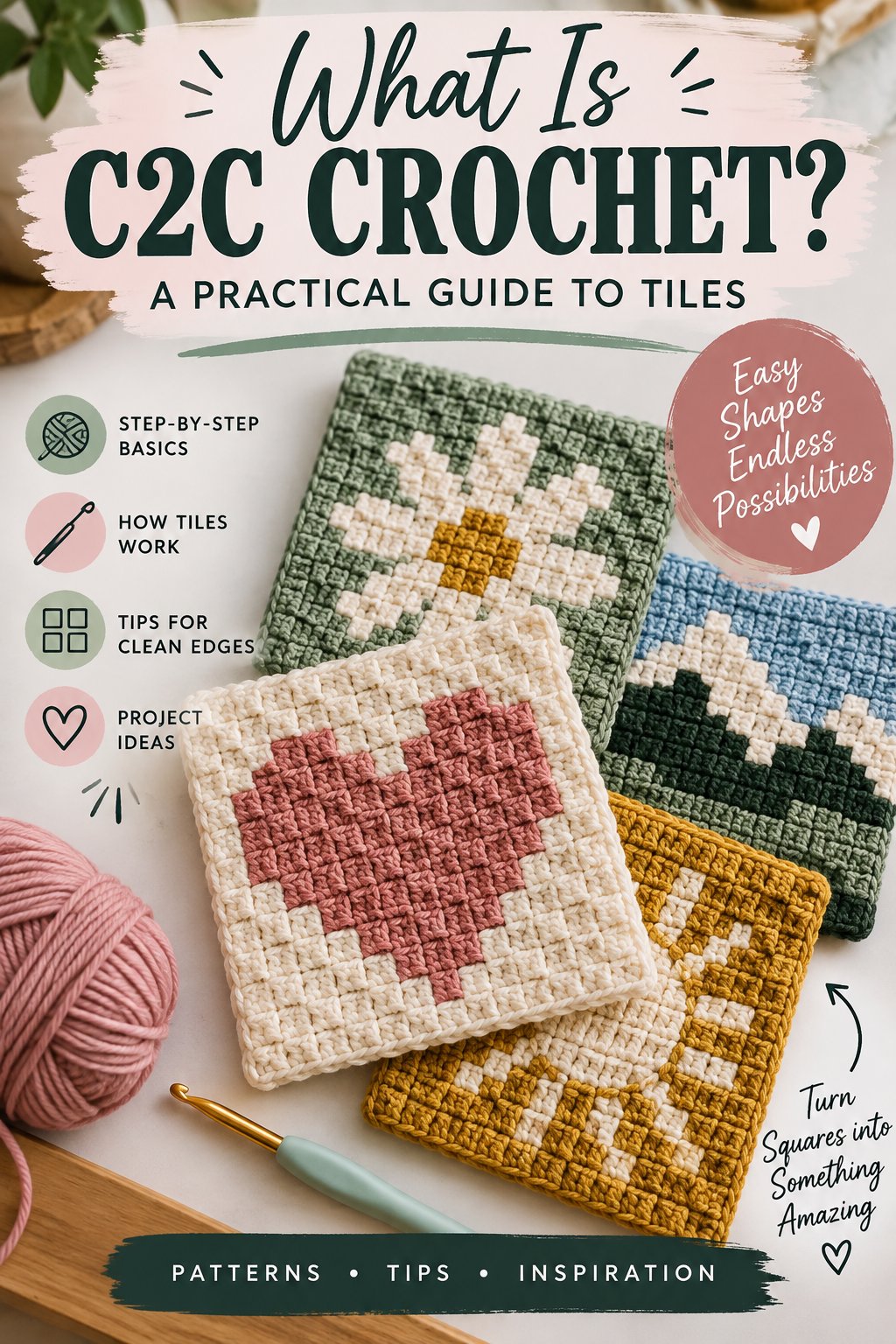
What Is C2C Crochet? Corner-to-corner crochet is a diagonal construction method that builds fabric from small square tiles, usually made with three double crochet stitches and a chain space. The work expands during increases, reaches a planned width, then contracts during decreases, making blankets, pillows, scarves, and pixel-style graphghans without a long foundation chain.
Key Facts About Corner-to-Corner Crochet
- C2C fabric grows diagonally, with each completed diagonal row containing a countable number of tiles.
- Standard C2C commonly uses three double crochet stitches and a chain-3 turning space.
- Mini C2C commonly uses three half-double crochet stitches and a chain-2 turning space.
- A square project increases to its widest diagonal, then decreases at both edges.
- A rectangular blanket uses separate increase and decrease decisions on its two sides.
- Typical yarn use depends on gauge, fiber, border size, color changes, and finished dimensions, so tile count alone cannot predict yardage precisely.
C2C is a construction technique, not a yarn type, stitch brand, or finished object. A graphghan is a picture or charted blanket that may use C2C, while C2C itself can produce a solid-color fabric with no image at all.
The method is especially useful when a design contains large blocks of color. Each tile corresponds roughly to one pixel or chart cell, although the finished image becomes softer or more abstract when the yarn is thick or the tile is large.
How Does C2C Crochet Work?
C2C crochet works by joining compact tile units along diagonal rows. A standard tile generally contains three double crochet stitches, a chain-3 space, and a slip-stitch connection to the chain space of a neighboring tile; the next row either adds tiles at an outer edge or removes them at an inner edge.
The first tile forms the starting corner. In a common right-handed construction, the crocheter turns the work after each diagonal row, chains to create height, makes a new tile, and joins that tile to the previous row with a slip stitch. Left-handed crocheters use the same geometry but may orient the chart and turning direction differently.
The Increase Phase
An increase adds one tile to a diagonal row. The familiar square sequence contains one tile in row one, two in row two, three in row three, and so forth until the chosen width is reached.
For a square with an N-by-N tile grid, the increase phase contains N rows. The complete project contains N² tiles, although each diagonal row has a different length.
The Decrease Phase
A decrease removes one tile from a diagonal row by stopping at the edge instead of creating another outward tile. The crocheter usually slip stitches across the side of the final tile, then works inward across the remaining tiles.
A 20-by-20 square has diagonal row lengths of 1, 2, 3, through 20 tiles, followed by 19, 18, 17, through 1 tile. That produces 39 diagonal rows and 400 tile positions.
Rectangle Geometry
A rectangle requires more planning than a square because one edge may keep increasing while the opposite edge begins decreasing. For a 20-by-30 grid, row lengths rise from one tile to 20, remain at 20 while the second dimension develops, then fall back to one.
| Grid size | Total tile positions | Diagonal row count | Maximum row length |
|---|---|---|---|
| 10 by 10 | 100 | 19 | 10 tiles |
| 20 by 20 | 400 | 39 | 20 tiles |
| 20 by 30 | 600 | 49 | 20 tiles |
| 30 by 40 | 1,200 | 69 | 30 tiles |
The most common rectangle error is decreasing both sides too early. The result is a parallelogram or undersized rectangle rather than a true 20-by-30 grid. Mark the transition row on the chart before beginning the decrease phase.
Which C2C Stitch Variation Should You Choose?
The best variation depends on tile size, fabric density, image resolution, and the amount of drape required. Standard double crochet is fast and familiar, while mini C2C creates smaller chart cells and a denser surface.
| Variation | Typical tile stitches | Typical chain space | Fabric behavior | Strongest use |
|---|---|---|---|---|
| Standard C2C | 3 double crochet | Chain 3 | Open, fast-growing, flexible | Blankets and large motifs |
| Mini C2C | 3 half-double crochet | Chain 2 | Denser, smaller cells | Detailed images and pillows |
| Single-crochet C2C | 3 single crochet | Chain 1 or pattern-defined | Compact, slower, firm | Small graphics and accessories |
| Block stitch | Single or double crochet groups | Repeated chain spaces | Mesh-like, textured | Openwork blankets and shawls |
Standard C2C
Standard C2C normally uses US double crochet stitches. The chain-3 space gives the next tile room to form, but the resulting fabric can show visible holes when worked loosely or with a slippery yarn.
The method is efficient for blankets because each tile covers more area than a mini tile. A trade-off follows: large tiles make low-resolution charts easier to crochet but can blur small lettering, facial features, and narrow outlines.
Mini C2C
Mini C2C usually replaces double crochet with half-double crochet and uses a shorter turning chain. The smaller tile creates more chart cells across the same finished width, which improves detail without requiring extremely thin yarn.
Mini C2C is not automatically hole-free. A loose tension, oversized hook, or chain space that exceeds the designer’s gauge can still create gaps. Test a swatch before changing the pattern’s stitch recipe, because substituting stitches changes both dimensions and yarn consumption.
Block Stitch C2C
Block stitch is related to diagonal colorwork but is not a universal synonym for corner-to-corner crochet. Many block-stitch patterns use alternating stitch groups and chain spaces to create a checkerboard or mesh effect, rather than the closed tile units found in standard C2C.
Choose block stitch when openness and surface pattern matter more than crisp pixel definition. Choose standard or mini C2C when every chart cell must correspond clearly to a color block.
What Yarn, Hook, and Gauge Suit C2C?
Medium-weight acrylic yarn with a hook near the middle of the manufacturer’s recommended range is a practical starting point for a blanket. The correct hook is the one that produces recognizable square tiles with acceptable drape, not automatically the hook printed on the yarn label.
| Yarn category | Common fiber choice | Typical hook range | Resulting C2C character |
|---|---|---|---|
| Sport weight | Acrylic or cotton | 3.25-4.00 mm | Fine detail and lighter fabric |
| Worsted weight | Acrylic or wool blend | 4.50-5.50 mm | Balanced blanket size and speed |
| Bulky weight | Acrylic or chenille | 6.00-8.00 mm | Large tiles, heavy warmth |
| Super bulky weight | Chenille or wool | 9.00-12.00 mm | Very fast coverage, low image detail |
Gauge in C2C is two-dimensional. Measure both the width and height of at least 10 completed tiles after washing or steaming the swatch. A project can have the correct width but become visibly rectangular if the tile height differs from its width.
Fiber and Washing Considerations
Acrylic is economical, washable, and stable for graphghans. Cotton produces sharper stitch definition but can create a heavier blanket and may show more tension variation. Wool offers warmth and elasticity, yet felting risk makes washing instructions important.
Chenille yarn hides individual stitches and can make tile boundaries difficult to count. It works well for a solid-color throw, but smooth worsted acrylic is usually easier for a first charted project.
How Much Yarn and Money Does a C2C Blanket Need?
A typical 30-by-30-inch C2C baby blanket uses about 800-1,200 yards, while a 50-by-60-inch throw commonly uses about 2,500-3,500 yards. Typical US yarn costs range from $20-$40 for the smaller blanket and $50-$95 for the throw, depending on fiber, brand, sales, and color count.
These are planning ranges, not guarantees. A border, frequent color changes, loose gauge, long tails, and unused bobbin sections can increase consumption by 10%-25%. The most dependable estimate comes from weighing a washed gauge sample and comparing its area with the planned blanket.
| Project | Approximate finished area | Typical yarn range | Typical US yarn budget |
|---|---|---|---|
| Baby blanket | 30 by 30 inches, 900 square inches | 800-1,200 yards | $20-$40 |
| Lap blanket | 40 by 50 inches, 2,000 square inches | 1,600-2,400 yards | $35-$70 |
| Throw blanket | 50 by 60 inches, 3,000 square inches | 2,500-3,500 yards | $50-$95 |
| Large bed blanket | 90 by 90 inches, 8,100 square inches | 6,000-8,000 yards | $120-$220 |
The tile count is not the same as the number of square inches. A 30-by-30 tile grid may finish much larger or smaller than a 30-by-30-inch blanket, depending on the tile gauge.
A Better Yardage Estimate
- Crochet and wash a sample containing at least 25 tiles.
- Weigh the sample in grams and measure its finished area.
- Calculate grams per square inch.
- Multiply that rate by the planned fabric area.
- Add 10%-20% for borders, tails, and color changes.
- Buy an extra skein when dye lots or discontinued colors create supply risk.
For charted work, buy all major colors before starting. Matching a discontinued shade halfway through a blanket is usually harder than accommodating a small amount of leftover yarn.
How Long Does C2C Crochet Take?
A typical worsted-weight lap throw takes about 20-60 active hours, depending on tile size, chart complexity, tension, and the crocheter’s experience. The often-repeated estimate of four to six minutes per 100 tiles is not a useful production measure, because 100 standard tiles generally require substantially more labor than that for hand crochet.
A practical test is more accurate: time ten complete tiles after the pattern rhythm becomes familiar, then multiply by the project’s tile count and add time for turning, yarn changes, ends, borders, and corrections.
| Project type | Tile or chart complexity | Typical active time | Main time driver |
|---|---|---|---|
| Solid baby blanket | Standard C2C | 12-25 hours | Area and repeated rows |
| Simple geometric throw | Standard C2C | 25-45 hours | Color changes and ends |
| Detailed portrait | Mini C2C | 45-100 hours | Small cells and chart checking |
| Large bed graphghan | Standard C2C | 70-150 hours | Area, bobbins, and finishing |
The beginning and ending rows feel quick because they contain few tiles. The middle rows take longer because they contain the maximum number of joins and color decisions.
Expert insight: Many crocheters time only the crocheting and underestimate finishing by 15%-30%. A graphic blanket can require dozens of minutes of daily end management even when the diagonal rows themselves feel fast.
How Does C2C Compare With Other Crochet Methods?
C2C is preferable when the project needs diagonal growth, charted color blocks, or a blanket that avoids a long foundation chain. Traditional rows offer easier shaping, tapestry crochet controls small motifs within rows, and intarsia handles separate color areas without carrying every unused strand across the back.
| Method | Color management | Typical fabric | Image suitability | Shaped garment suitability |
|---|---|---|---|---|
| C2C crochet | Tile-by-tile changes | Diagonal grid | Excellent for pixel art | Limited to moderate |
| Traditional rows | Row-based changes | Horizontal rows | Good for stripes | Excellent |
| Tapestry crochet | Unused yarn carried inside | Dense and firm | Good for small motifs | Good for structured pieces |
| Intarsia crochet | Separate yarn sections | Flexible, cleaner color fields | Good for large blocks | Moderate |
C2C avoids the long starting chain used by many row-based blankets. That advantage does not mean the fabric is structurally neutral: diagonal tile alignment can create bias, especially with soft yarn and loose tension.
C2C Versus Tapestry Crochet
Tapestry crochet usually carries one or more inactive colors through the stitches. The carried strands add thickness and can show through when the active color is light.
C2C changes color at tile boundaries, so unused yarn can remain behind the work rather than running continuously through every stitch. The back can still become tangled or bulky if long floats are carried from one distant color block to another.
C2C Versus Intarsia
Intarsia uses separate yarn sections for distinct color areas, which is efficient for large blocks and clean reversibility. C2C is easier to map onto a square chart because one tile generally represents one chart cell.
Intarsia often gives better control over broad vertical or horizontal shapes. C2C remains simpler when the design already resembles a diagonal pixel grid.
How Are Color Changes Managed?
C2C color changes are cleanest when the new color begins on the final yarn-over of the preceding stitch or at the tile join specified by the pattern. Use bobbins for isolated color blocks, carry a color only across a short gap, and cut the yarn when a long float would create a snag.
Bobbins, Carrying, and Cutting
| Color situation | Recommended action | Typical maximum span | Main risk |
|---|---|---|---|
| Same color in adjacent tiles | Continue attached yarn | 1-5 tiles | Minimal |
| Short gap in a solid field | Carry behind nearby joins | 1-3 tiles | Visible float |
| Isolated motif color | Use a bobbin | 4-20 tiles | Tangles |
| Long separation between blocks | Cut and rejoin | More than 20 tiles | Extra ends |
The chart should identify every color block before crocheting. Stitch Fiddle can convert an image into a grid, but automatic pixelation does not understand yarn contrast, tile proportions, or the visual effect of a border.
Expert insight: A color that contrasts strongly on a screen may merge in yarn. Convert the proposed image to grayscale before charting; if two colors have similar lightness, their boundary may disappear even when their hue appears different.
Keep bobbins on the working side of the blanket and rotate them in the same direction at each turn. That simple habit prevents a large portion of the twisting that occurs in multicolor C2C.
Why Does C2C Crochet Become Slanted or Holey?
A slanted C2C fabric usually results from an incorrect increase or decrease, while excessive holes usually result from loose chain spaces, a large hook, or tension that changes between turning rows. Each problem has a different correction, so replacing every chain-3 space with chain 2 is not a universal fix.
| Visible problem | Likely cause | Immediate test | Reliable correction |
|---|---|---|---|
| Parallelogram shape | One edge missed a decrease | Count both edge tiles | Mark increase and decrease sides |
| Uneven square tiles | Tension changes after turns | Measure 10 tiles | Relax chain height and repeat swatch |
| Large holes | Long chains or oversized hook | Compare chain spaces | Use a smaller hook or approved chain modification |
| Wavy edge | Too many edge increases | Count row totals | Undo to the first incorrect row |
| Tangled back | Long carried strands | Inspect floats | Cut yarn or add a dedicated bobbin |
A chain-2 modification may tighten some standard designs, but it can also compress the tile, change the finished dimensions, and cause neighboring stitches to crowd. Apply it only after a test swatch or when the pattern designer specifies it.
Why the Back Matters
The front of a graphghan can look correct while the back contains loose yarn webs. Any float longer than a few tiles deserves scrutiny because blankets are handled, washed, and used by children.
Do not carry yarn across a large blank region simply to avoid weaving an end. A separate bobbin usually costs less time than repairing a snagged blanket.
What Is C2C Crochet Best and Worst For?
C2C crochet is best for blankets, wall hangings, pillow fronts, scarves, and other projects where a diagonal grid supports the design. The method is less suitable for fitted garments that require precise armholes, curved necklines, strong vertical grain, or predictable stretch.
Good applications include:
- Pixel-art animals, letters, maps, and geometric motifs
- Baby blankets with a square or rectangular silhouette
- Pillow covers built from a fixed tile grid
- Scarves and wraps where diagonal texture is acceptable
- Sampler blankets made from color blocks
Use another construction method when the project needs tailored shaping. Traditional rows, modular motifs, or planned garment panels usually provide more direct control over width, length, and edge shaping.
C2C can make garments, but the designer must account for bias, seam placement, and the direction of stretch. A rectangular C2C panel may look square on the table and skew after wear or washing.
How Do You Block and Finish a C2C Project?
C2C projects should be measured, gently washed according to the fiber label, and blocked to the intended outline before the final border is chosen. Blocking can correct modest unevenness, but it cannot repair a missing decrease, an incorrect chart row, or severe stitch distortion.
First secure the piece to a measurement grid without stretching it beyond the yarn’s natural length. Use rust-resistant pins or blocking combs, allow the fabric to dry fully, and then inspect the edges for skipped tiles.
Border Planning
A border can hide minor edge variation, frame a graphic, and stabilize a soft blanket. It cannot make a 20-by-30 tile grid behave like a 20-by-20 square.
Choose a border width that relates to the tile scale. For standard C2C, a one- to three-round border is often visually proportionate; mini C2C may need a narrower border so the frame does not overpower the image. Measure the blocked piece before calculating border yardage.
Weave in ends over multiple directions where the fabric allows, then wash the finished piece once more if the yarn label permits. Acrylic may benefit from careful steam blocking, but direct high heat can flatten texture or damage synthetic fibers.
Is C2C Crochet Beginner-Friendly?
C2C is beginner-friendly after the first few rows, especially in one color, but chart reading and diagonal turning create a steeper start than a simple scarf. A beginner should first make a small 10-by-10 tile swatch before committing to a full picture blanket.
Learn these skills in order:
- Make and identify one tile.
- Join a new tile into the preceding chain space.
- Increase at both edges.
- Work a plain middle row without adding an unwanted tile.
- Decrease at one edge.
- Decrease at both edges.
- Change colors and manage a bobbin.
- Read the chart while tracking the written row count.
A solid-color practice square exposes geometry mistakes without the distraction of color symbols. Once the square is accurate, add a two-color stripe before attempting a portrait or lettering chart.
The most useful beginner marker is a row counter that records tile count, not only diagonal row number. When a mistake appears several rows later, tile count helps identify whether the problem began at an edge increase or at a color transition.
Frequently Asked Questions About What Is C2C Crochet
Is C2C crochet the same as a graphghan?
No. C2C crochet describes how the fabric is constructed, while a graphghan describes a charted image or pattern placed into a blanket. A graphghan can use C2C, tapestry crochet, single crochet, or another grid-based method, and a C2C blanket can be completely solid.
How many squares are in a C2C blanket?
A 20-by-20 tile blanket contains 400 tile positions, while a 30-by-40 project contains 1,200. Finished inches cannot be converted directly into tile count without gauge, because a standard tile made with bulky yarn may be more than twice the width of one made with sport-weight yarn.
Can C2C crochet use single crochet?
Yes. Single-crochet C2C patterns create smaller, firmer tile units, although the exact chain space and joining sequence vary by designer. Do not substitute single crochet into a double-crochet pattern without recalculating gauge, because the finished width, height, yarn use, and chart proportions will change.
Why does my C2C blanket look like a diamond?
A square C2C blanket naturally appears diamond-shaped while it is held from a corner, because its tile rows run diagonally. If the blocked edges are unequal or the piece forms a slanted parallelogram, check whether one side missed an increase or decrease.
Should C2C blankets have a border?
A border is optional. It can stabilize edges, conceal slight irregularities, and provide a finished frame, but it cannot correct incorrect geometry. Block the blanket first, measure each side, and then choose a border that accommodates the actual stitch count rather than forcing equal spacing.
What is the best first C2C project?
A solid-color 10-by-10 or 15-by-15 square is the best geometry exercise. A small two-color dishcloth or pillow panel is the next step, because it introduces color changes and ends without creating the hundreds of decisions found in a large portrait graphghan.
Conclusion
What Is C2C Crochet? It is a diagonal tile-building method that expands and contracts across a grid, usually with three double crochet or half-double crochet stitches per tile. Its strengths are charted colorwork, flexible blanket sizing, and freedom from a long foundation chain; its limitations include yarn management, diagonal bias, and difficult garment shaping. Test gauge, calculate the grid, mark every increase and decrease, and choose the stitch variation that matches the image detail and fabric density you need.