
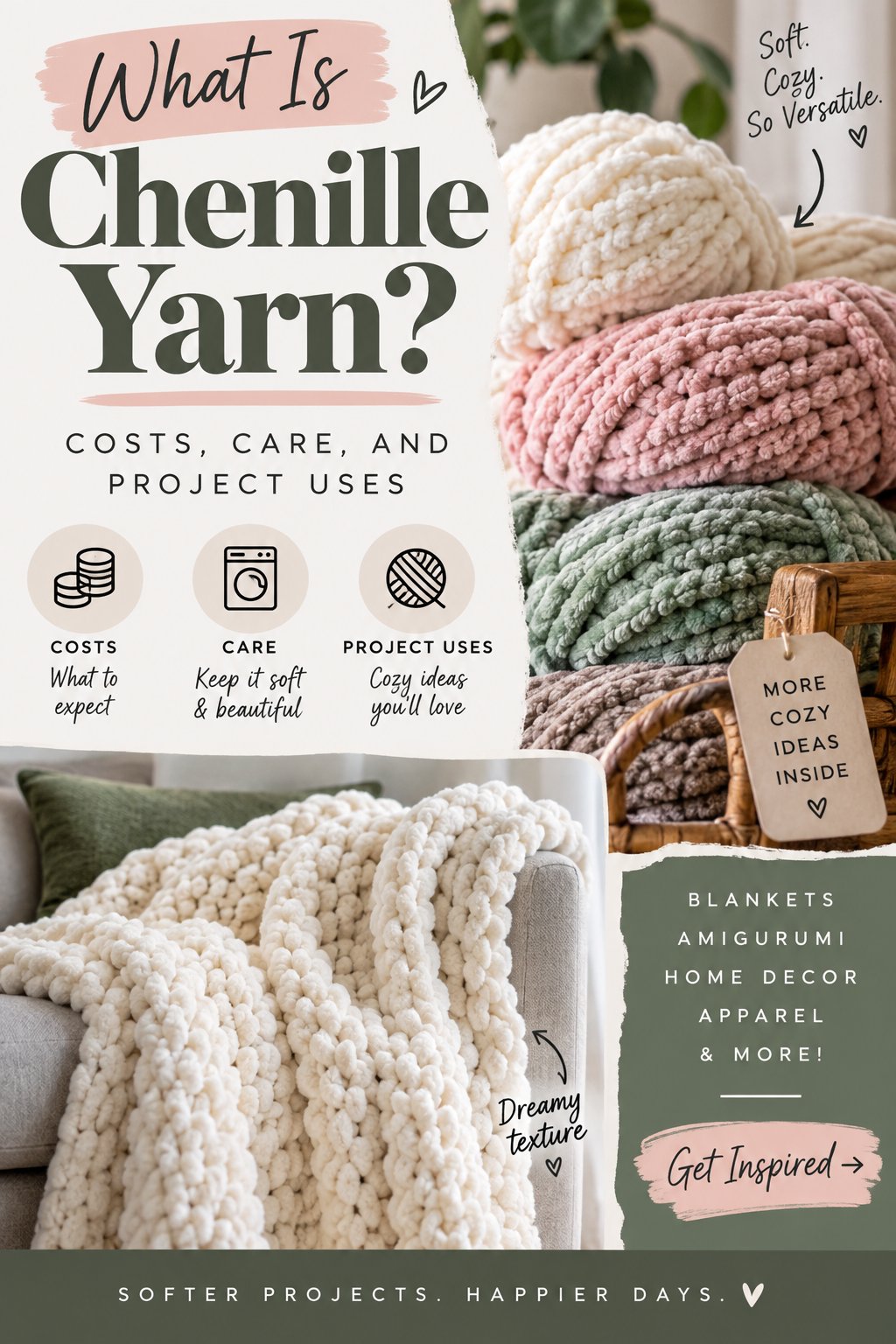
Chenille yarn is a tufted, fuzzy textile yarn made by trapping short cut fibers between two twisted core yarns. Its caterpillar-like pile creates a soft, velvety surface, but the same construction can hide stitches, shed fibers, slip at knots, and suffer damage from heat or aggressive unraveling.
Key Facts
Chenille means “caterpillar” in French and describes the yarn’s fuzzy appearance.
Two core plies hold short pile fibers that project around the yarn’s circumference.
Common retail weights range from medium weight 4 to jumbo weight 7.
Typical knitting needles and crochet hooks range from 5 mm to 15 mm.
Polyester is usually the easiest fiber to wash, while rayon and cotton need more care.
Dense stitches, long woven-in ends, and cold, gentle washing reduce common failures.
What Is Chenille Yarn?
Chenille yarn is a fancy yarn with a cut pile wrapped around a central core, rather than a conventional strand made by twisting staple fibers together. The pile gives chenille its plush hand, low stitch definition, and rounded surface; the core supplies most of the tensile strength while the exposed tufts provide softness and visual depth.
The French word chenille means caterpillar. In textile terminology, the name refers to both the yarn and fabrics made from it. ASTM International’s textile terminology describes chenille yarn as “a yarn with a pile protruding from a central core,” a concise description of the structure that separates it from ordinary spun yarn.
A chenille strand may contain polyester, cotton, acrylic, rayon, viscose, or a blend. Fiber content changes the yarn’s luster, absorbency, resilience, laundering needs, and price, so “chenille” identifies the surface construction, not one particular material.
The important practical distinction is strength location. The central plies carry tension, while the pile is comparatively vulnerable. Pulling a strand through a tight stitch can crush or dislodge the pile even when the core remains intact.
How Is Chenille Yarn Made?
Chenille yarn is made by creating a continuous row of short pile tufts and securing those tufts between twisted core yarns. A specialized chenille machine cuts or separates the pile at a controlled length, then twists the core around it before the tufts can escape.
A typical manufacturing sequence follows this order:
- An effect yarn is wound around a blade, cylinder, or forming element.
- A knife cuts the wrapped material into short, consistent fibers.
- Two core yarns travel under controlled tension beside the cut pile.
- The core yarns twist together and clamp the pile at its center.
- The finished strand is stabilized, dyed or finished when required, and wound into cones or skeins.
- Quality checks measure appearance, thickness, tensile behavior, and pile security.
The pile may be cut from a different fiber than the core. For example, a polyester pile can be held by polyester cores, while a cotton-rich chenille may combine cotton pile with a stronger synthetic support yarn.
Pile length commonly falls near 1-4 millimeters in commercial craft yarns. A longer pile feels fuller but can shed more readily and obscure more stitch detail. A shorter pile usually produces a firmer, more controlled surface.
Why Does Chenille Yarn Shed or Worm?
Chenille yarn sheds when pile fibers loosen from the twisted core or break during handling. Worming occurs when sections of the smooth core form loose loops that push out of a knitted or crocheted fabric, usually because the stitch structure, yarn tension, or finishing method does not restrain the strand.
Worming is more likely in loose knitting, open crochet, slippery synthetic yarn, and fabrics worked with large needles. The problem is not simply “bad yarn.” A highly flexible core combined with low fabric tension gives the strand room to migrate.
To test a yarn before committing to a blanket, make a 15 cm by 15 cm swatch in the intended stitch. Rub the swatch 20 times against a clean cotton cloth, stretch it in both directions, and inspect the reverse side. Loose loops, bald spots, or visible fibers on the cloth indicate elevated handling risk.
What Types of Chenille Yarn Are Available?
Chenille yarn types are mainly distinguished by fiber content, pile density, luster, and care requirements. Polyester and acrylic suit washable home projects, cotton offers a more matte and absorbent surface, and rayon or viscose creates more drape but usually tolerates less abrasion.
| Type | Typical behavior | Care profile | Suitable projects |
|---|---|---|---|
| Polyester | Resilient, plush, low absorbency | Cold machine wash if label permits; low heat | Blankets, pillows, toys |
| Cotton | Matte, breathable, absorbent | Shrinkage risk; cold wash and flat drying | Baby blankets, light garments |
| Acrylic | Lightweight, colorfast, wool-like hand | Easy care; avoid high heat | Toys, scarves, budget throws |
| Rayon or viscose | Glossy, fluid, soft drape | Hand wash; abrasion and stretching risk | Decorative shawls, cushions |
| Nylon blend | Strong core support and abrasion resistance | Follow blend label; moderate heat only | High-use accessories, upholstery accents |
| Velvet chenille | Dense, uniform, very plush pile | Gentle washing; pile can flatten | Robes, cushions, luxury blankets |
“Velvet chenille” is usually a marketing or product-style term rather than a separate universal fiber category. It generally indicates a dense, short, uniform pile that resembles velvet. Check the fiber label because two products using the same style name may have different washing and durability characteristics.
A fiber label should be read before the color name or texture description. “Soft chenille” does not tell you whether a skein contains polyester, cotton, rayon, or acrylic.
Which Fiber Is Best for a Blanket?
Polyester chenille is usually the safest general choice for a frequently washed blanket because it resists shrinking and retains a consistent pile better than cotton or rayon. Cotton works well when breathability and a matte surface matter more than easy maintenance.
For a baby blanket, select a smooth, washable polyester or acrylic product with a reliable care label and avoid loose, shedding pile. For a decorative throw that will rarely be washed, rayon or viscose can provide attractive drape, but it requires gentler handling.
| Project requirement | Recommended fiber | Reason | Main limitation |
|---|---|---|---|
| Frequent washing | Polyester | Low shrinkage and strong color retention | Can feel less breathable |
| Warm, breathable cover | Cotton blend | Absorbs moisture and feels matte | May shrink or become heavy |
| Lightweight plush toy | Acrylic | Light, colorful, and moth resistant | Can pill under friction |
| Fluid decorative fabric | Rayon or viscose | Soft drape and silk-like luster | Weakens when wet |
| High-contact cushion | Nylon or polyester blend | Better abrasion resistance | Less natural hand |
What Sizes and Tools Suit Chenille Yarn?
Chenille yarn commonly appears in medium weight 4 through jumbo weight 7, with typical needles or hooks from 5 mm to 15 mm. The correct tool depends on the manufacturer’s label, desired fabric density, and whether the project needs structure or a loose drape.
| Yarn weight | Typical tool range | Approximate fabric character | Common use |
|---|---|---|---|
| Weight 4, worsted | 5-6 mm | Moderately dense and defined | Hats, scarves, small blankets |
| Weight 5, bulky | 6-8 mm | Plush with moderate structure | Cowls, cushions, baby blankets |
| Weight 6, super bulky | 9-12 mm | Very thick and fast-working | Throws, oversized scarves |
| Weight 7, jumbo | 12-15 mm | Dense, dramatic, low definition | Arm-knit throws, decor |
Manufacturers’ gauge numbers are more useful than weight labels alone. Two skeins both marked bulky can differ substantially in diameter because pile compression, core tension, and finishing alter the apparent thickness.
For a structured fabric, begin one or two tool sizes below the upper end of the label recommendation. A smaller hook or needle reduces gaps and helps lock the pile-bearing strand into the fabric, but going too small can crush the pile and make the work unpleasant.
How Should You Check Gauge?
Make a swatch at least 15 cm wide, wash it using the intended care method, and measure after it is fully dry. Chenille can relax, compress, or expand after washing, so measuring only the unwashed sample can produce a blanket or garment with the wrong final dimensions.
A practical gauge procedure is:
- Use the exact stitch and tool planned for the project.
- Work a sample larger than the measurement area.
- Count stitches and rows across the center.
- Wash and dry according to the yarn label.
- Measure again and record the change.
- Adjust the tool size, tension, or pattern dimensions.
Chenille’s low stitch visibility makes counting difficult. Place removable markers every 10 or 20 stitches, especially in single crochet, moss stitch, or garter stitch.
How Much Does Chenille Yarn Cost?
Typical United States retail prices range from $3-$6 per 100-gram skein for polyester or acrylic, $7-$12 for cotton or blends, and $14-$25 or more for rayon, viscose, and luxury blends. Actual cost varies with brand, yardage, imported fiber, dye effects, and seasonal discounts.
| Product tier | Typical USD price per 100 g | Typical fiber content | Budget implication |
|---|---|---|---|
| Budget | $3-$6 | Polyester or acrylic | Low entry price, often shorter yardage |
| Mid-range | $7-$12 | Cotton, polyester, or blended fibers | Better hand or more consistent pile |
| Premium | $14-$25+ | Rayon, viscose, specialty blends | Higher drape or sheen, higher care cost |
| Small novelty skein | $4-$10 per 50 g | Synthetic or mixed fiber | Price per kilogram is substantially higher |
Skein weight does not equal usable length. A dense 100-gram chenille skein may contain roughly 100-180 meters, while a lighter-pile product of the same weight may contain more. Compare meters or yards per skein, not price alone.
| Project | Typical finished size | Approximate skeins | Active time |
|---|---|---|---|
| Beanie | Adult, 50-56 cm circumference | 1-2 x 100 g | 2-4 hours |
| Scarf | 18 x 150 cm | 2-4 x 100 g | 3-7 hours |
| Baby blanket | 75 x 90 cm | 5-9 x 100 g | 6-10 hours |
| Large throw | 125 x คุณ cm | 10-18 x 100 g | 12-20 hours |
The quantities above are typical planning ranges, not pattern guarantees. Stitch choice, border size, gauge, yarn length, and desired drape can change consumption by 20% or more. Buy one extra skein when dye lots matter or when matching a discontinued color would be difficult.
What Can You Make With Chenille Yarn?
Chenille yarn is best for projects that benefit from softness and surface volume rather than sharp stitch definition. Blankets, plush toys, cushions, robes, scarves, and simple hats usually suit the material better than intricate lace, cables, or fitted garments.
Good applications include:
- Baby blankets made from washable polyester or acrylic
- Amigurumi with dense single crochet
- Plush animals and stuffed cushions
- Scarves, cowls, and simple winter accessories
- Robes and loose garments with a stable, washable fiber
- Pillow covers and decorative throws
- Soft baskets that use a firm inner structure
Chenille is less suitable for socks, fitted gloves, high-friction bags, detailed colorwork, and garments that require precise shaping. The pile conceals increases, decreases, color changes, and small texture motifs, while repeated friction can flatten or remove the surface.
For amigurumi, chenille produces a soft toy quickly, but the stitches can be hard to count. Use a locking stitch marker, count every round, and photograph the work before closing difficult sections. For blankets, simple rows and a firm border reduce edge distortion.
Chenille Yarn Compared With Similar Yarns
Chenille yarn has a cut pile held by a twisted core, while velvet yarn generally has a more uniform short pile and bouclé yarn uses loops. Standard wool is spun from fibers, giving it stronger stitch definition and often better recovery during shaping.
| Feature | Chenille | Velvet yarn | Bouclé | Standard wool |
|---|---|---|---|---|
| Surface structure | Cut pile around core | Dense short pile | Loops and curls | Spun fibers |
| Typical stitch definition | Low | Low | Very low | Medium to high |
| Hand feel | Plush and rounded | Smooth and velvety | Nubby and irregular | Springy, sometimes crisp |
| Durability | Moderate | Moderate to high | Moderate to high | High, fiber dependent |
| Main risk | Worming and shedding | Flattened pile | Snagging | Felting or shrinkage |
| Best project | Blanket or plushie | Cushion or robe | Textured outerwear | Socks or shaped garments |
Chenille and velvet yarn are often confused because both feel soft. Velvet-style yarn usually has a more even surface, while chenille’s cut tufts may show direction, compression, or small irregularities.
Bouclé is a poor substitute when a smooth plush surface is required. Its loops create bumps and can make stitch placement even harder. Wool is the better alternative when warmth, elasticity, shaping, or visible texture matters more than a velvety hand.
How Do You Knit or Crochet With Chenille Yarn?
Knitting and crocheting with chenille yarn requires controlled tension, dense stitches, and secure finishing. Single crochet, half double crochet, garter stitch, and stockinette can work well, but loose fabric increases the chance of worming and makes stitch counting difficult.
Use these practical controls:
- Choose a swatch stitch that matches the final project.
- Start with a tool one size smaller than the label’s largest recommendation.
- Keep even tension without pulling the strand sharply.
- Place markers frequently because the pile hides loops.
- Inspect the reverse side every few rows for escaping core loops.
- Leave 10-15 cm tails for finishing.
- Split the core carefully when weaving ends, then bury the tail through several stitches.
- Trim loose pile only after the project is complete.
A standard overhand knot can loosen because the core is smooth and the pile prevents firm compression. A magic knot may work for some synthetic products, but test it first because a hard knot can distort the fabric. For high-stress joins, overlap the strands over 5-8 cm and weave each tail in opposite directions.
Fabric glue on a raw end can reduce unraveling, but it may stiffen the area, discolor pale yarn, or fail after washing. A long woven-in tail is the more durable primary method; adhesive is a small supplemental measure for exposed decorative ends.
Expert insight: The most reliable chenille tension is firm enough to close gaps but gentle enough to avoid compressing the pile. Excessive tension does not create a stronger fabric, because it can crush the tufts and expose the core.
How Should Chenille Yarn Be Washed and Stored?
Chenille yarn should usually be washed in cold water with mild detergent and dried flat unless the manufacturer explicitly permits machine washing and tumble drying. High heat can melt or deform synthetic pile, while agitation can loosen tufts and create bald patches.
| Care action | Safer practice | Common damage | Better replacement |
|---|---|---|---|
| Washing | Cold, gentle cycle or hand wash | Fiber shedding and matting | Mesh bag and low agitation |
| Drying | Lay flat on a towel | Stretching or heat flattening | Reshape while damp |
| Ironing | Avoid direct contact | Melted or crushed pile | Steam from a distance |
| Brushing | Use only when label permits | Pulled tufts | Smooth by hand |
| Storage | Fold loosely and keep dry | Permanent compression | Breathable drawer or box |
Do not wring a wet chenille item. Press water out between towels, then reshape it on a flat surface. Hanging a wet blanket can stretch the core and distort the borders.
Store finished pieces away from rough hook-and-loop fasteners, pet claws, and abrasive furniture edges. A pile that looks intact after one use may show flattened tracks after repeated contact.
What Problems Can Occur With Chenille Yarn?
The main chenille problems are worming, shedding, bald spots, slipping joins, poor stitch visibility, and heat damage. Each problem has a different cause, so changing the hook size will not solve every failure.
| Problem | Likely cause | Early sign | Practical response |
|---|---|---|---|
| Worming | Loose fabric or flexible core | Loops on the reverse | Tighten gauge and secure loops |
| Shedding | Weak pile hold or abrasion | Fibers on clothing | Reduce rubbing and wash gently |
| Bald spots | Aggressive frogging or pulling | Exposed core | Stop unraveling and repair locally |
| Slipping ends | Smooth core and short tails | Join loosens by hand | Rejoin with long tails |
| Hidden stitches | Dense or long pile | Lost stitch counts | Add markers and use simple patterns |
| Flattened surface | Heat or pressure | Shiny compressed patches | Avoid ironing and prolonged stacking |
Frogging, or unraveling, deserves special caution. Pulling chenille backward through several tight stitches can strip pile from the core. If a mistake is near the working edge, undo one stitch at a time; if the yarn has already become bald, cut out the damaged section and join a fresh strand.
When a finished fabric worms, crochet a narrow border in a smaller hook or needle size. The border cannot correct every structural problem, but it can restrain edge migration and improve shape.
Expert insight: A chenille swatch should be tested after washing and abrasion, not only measured for gauge. A yarn can produce attractive stitches for an hour and still fail when the pile experiences repeated movement.
Is Chenille Yarn Safe for Babies and Sensitive Skin?
Chenille yarn can suit baby items when the specific product is washable, colorfast, low-shedding, and free from loose loops. Fiber name alone does not establish safety, so inspect the label, wash the finished item, and avoid products that release visible fibers during rubbing.
For a baby blanket or toy:
- Prefer a washable polyester or acrylic blend with clear care instructions.
- Wash before use with fragrance-free detergent.
- Check seams and joins for loose tails.
- Avoid long unsecured pile if the item will contact the mouth.
- Do not use damaged or shedding yarn for infant toys.
- Follow the pattern’s recommended stuffing and eye-security instructions.
Cotton is not automatically safer because it is natural. Cotton chenille may shrink, become heavy when wet, and shed if the pile is loosely held. A well-constructed synthetic yarn can be more practical for repeated washing, provided its label and finished behavior are suitable.
Frequently Asked Questions About What Is Chenille Yarn
Is chenille yarn difficult for beginners?
Chenille yarn is manageable for beginners who use simple patterns, frequent stitch markers, and a dense fabric. Its pile hides loops and makes corrections harder than ordinary wool or acrylic, so a first project should avoid lace, cables, complex shaping, and frequent color changes.
Can chenille yarn go in the washing machine?
Some polyester and acrylic chenille yarns can go in a washing machine, but the label controls the decision. Use cold water, low agitation, and a mesh bag when permitted. Hand washing is safer for cotton, rayon, viscose, and any product with uncertain pile security.
Why can I not see my crochet stitches?
The long, dense pile covers the stitch openings and reduces contrast between adjacent loops. Use bright, directional light, feel for the top loops with the hook, mark every round, and choose single crochet or another compact stitch until the structure becomes familiar.
Does chenille yarn make warm clothing?
Chenille yarn can make warm accessories because its pile traps still air, but warmth varies with fiber, fabric density, and garment construction. Loose chenille fabric may feel soft without providing much insulation, while dense fabric can become heavy and less breathable.
Can chenille yarn be used for weaving?
Chenille yarn can be used as a weft or decorative accent in weaving, especially for cushions, wall pieces, and textured throws. It is usually a poor choice for a high-tension warp because the pile can compress, shed, or catch in the reed and heddles.
How do I choose chenille yarn for a plush toy?
Choose a dense, washable polyester or acrylic chenille with a secure pile and a weight that matches the pattern. Make a small test tube or sphere, stretch the fabric, and rub it before buying enough yarn for the toy. Reject yarn that exposes its core or sheds heavily.
Conclusion
Chenille yarn is a cut-pile strand built from short tufts trapped between twisted core yarns, which explains its softness, low stitch definition, and particular care requirements. For most blankets and plush projects, choose a washable polyester or acrylic product, swatch after washing, use dense stitches, and finish long tails securely. When deciding what is chenille yarn for your project, evaluate construction, fiber, yardage, and durability together rather than choosing by softness alone.