
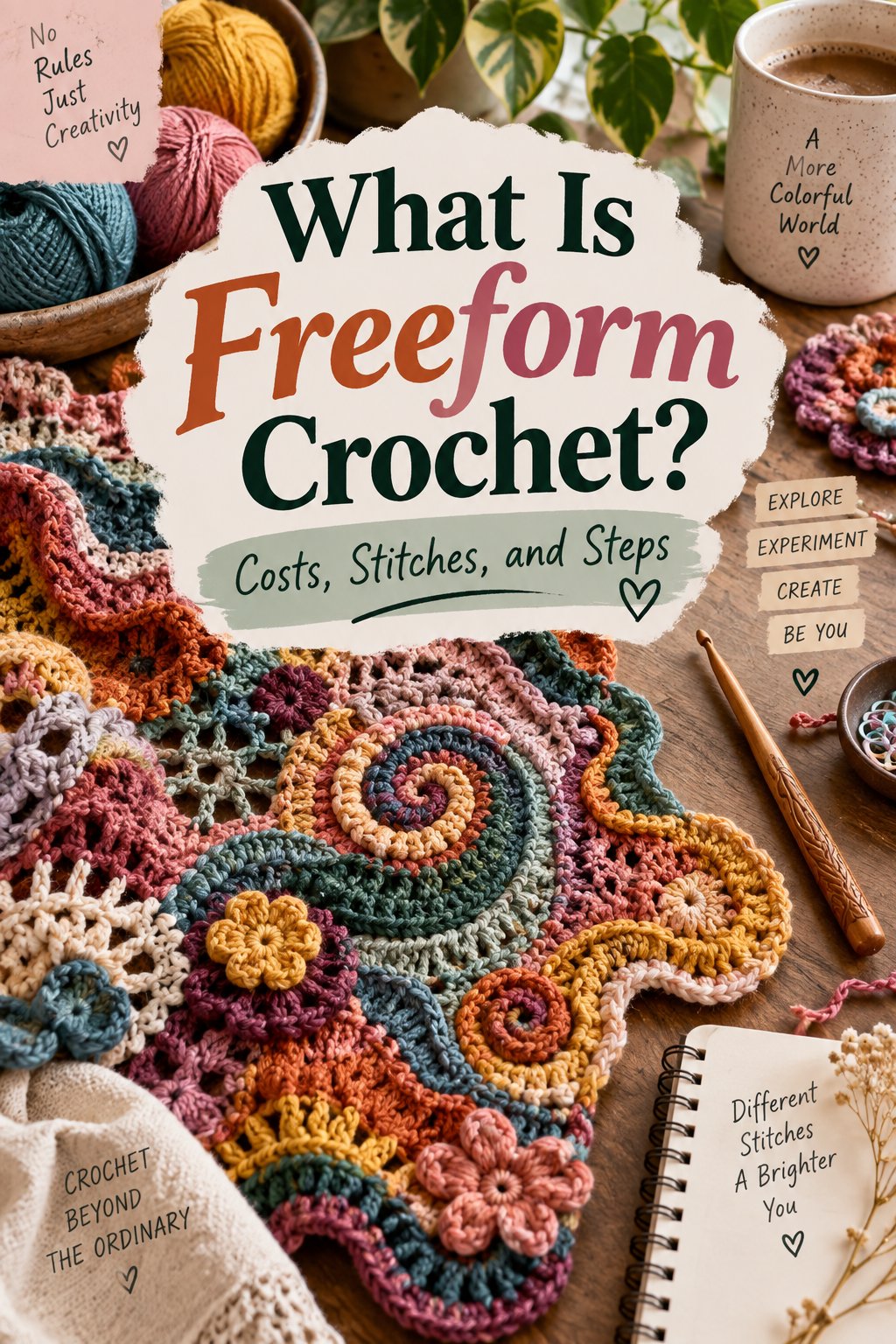
Freeform crochet is a patternless fiber-art method that builds fabric from improvised stitches, colors, motifs, and textures rather than fixed rows. The crocheter creates separate or connected sections, often called scrumbles, then joins or grows them into a functional, sculptural, or decorative object whose shape develops during construction.
Key Facts About Freeform Crochet
- Freeform crochet has no required pattern, stitch sequence, symmetry, or repeat.
- A scrumble is a small improvised crochet section that can be joined to other sections.
- Typical startup cost is $15-$40 for basic hooks and several yarns.
- A single project commonly uses 3-6 hook sizes to vary density and scale.
- Small scrumbles usually take 30 minutes to 2 hours, while a cardigan can require 40-100 or more hours.
- The method works best when the maker controls weight, drape, ends, and overall dimensions.
Freeform work is not the absence of technique. It uses ordinary crochet skills, including chain, slip stitch, single crochet, half double crochet, double crochet, increases, decreases, working into spaces, and surface attachment. The difference is that those skills are selected in response to the developing fabric instead of being dictated by a chart.
The result may be flat, dimensional, wearable, open, dense, irregular, or highly textured. A useful distinction is that freeform crochet removes the predetermined sequence, not the need for decisions. The maker still has to manage proportion, balance, joining strength, color distribution, and finishing.
How Does Freeform Crochet Work?
Freeform crochet works by growing, arranging, and connecting irregular crochet sections until they form a deliberate composition. Some artists begin with a central flower or circle and work outward; others make independent patches, arrange them on a surface, and fill the spaces between them.
The process is improvisational, but it benefits from physical checkpoints. A maker can place pieces on a paper silhouette, photograph an arrangement before joining, or measure the developing work against a shoulder, wall, bowl, or lampshade. These simple controls prevent spontaneity from becoming accidental distortion.
What Is a Scrumble?
A scrumble is an independently improvised crochet patch containing changes in stitch, color, direction, or texture. It can be a few centimeters wide or large enough to function as a complete motif, and its irregular edge allows it to connect with neighboring pieces.
A scrumble may begin as a ring, chain, leaf, spiral, shell, or cluster. The crocheter adds stitches around available edges, turning the work when a new direction is useful. Uneven stitch counts are acceptable, although uncontrolled increases can create unwanted waves.
Scrumbles are useful because they divide a large design into manageable decisions. They also make color testing and repair easier. A damaged patch can be replaced before it is permanently attached to the rest of the composition.
How Are Scrumbles Joined?
Scrumbles are joined with slip stitches, single crochet, sewing, surface crochet, or narrow bridging rows. The joining method changes the appearance and strength of the finished fabric.
| Joining method | Typical use | Visual result | Structural effect |
|---|---|---|---|
| Slip stitch | Firm patch-to-patch attachment | Low, visible ridge | Dense and stable |
| Single crochet | Uneven edges and small gaps | Raised cord-like seam | Stronger than sewing alone |
| Yarn needle sewing | Delicate or mixed-media pieces | Nearly invisible from front | Flexible, dependent on secure tails |
| Chain bridge | Open negative space | Arched or web-like opening | Light support, limited load capacity |
| Surface crochet | Decorative outlines | Raised line or contour | Reinforces selected edges |
Join only after checking the direction of the fabric. A seam that looks attractive on a table can twist when worn. For a garment, attach several sections temporarily with safety pins, then test the shoulder, side, or sleeve movement before committing.
How Are Gaps Filled?
Gaps are filled by working free-flowing rows, chain spaces, mesh, small motifs, or irregular bars between established sections. The best filler follows the shape of the opening rather than forcing every space into a rectangle.
Large holes need more than visual coverage. If the surrounding pieces pull in different directions, a narrow bridge may stretch or buckle. Add attachment points gradually, alternating between sides of the gap so tension is distributed across the composition.
Negative space can remain intentional. A transparent opening may improve drape, reduce weight, or separate a dense textured area from a visually busy neighbor.
Which Materials and Tools Are Needed?
Freeform crochet needs a hook, yarn, scissors, a yarn needle, and a surface for arranging pieces; specialized equipment is unnecessary. A mixed stash is useful, but yarns should be grouped by compatible thickness, fiber behavior, and washing requirements before they are combined.
The hook is a shaping tool as much as a stitching tool. A larger hook creates looser openings and softer bridges, while a smaller hook produces compact motifs and more defined relief.
| Material or tool | Typical quantity | Typical cost in USD | Primary function |
|---|---|---|---|
| Aluminum or ergonomic hooks | 3-6 sizes | $5-$25 | Changes stitch scale and density |
| Starter yarn assortment | 4-8 skeins | $10-$40 | Supplies color, fiber, and texture variation |
| Scrap yarn | 10-30 usable pieces | $0 | Adds small motifs and stash color |
| Yarn needle pack | 2-4 needles | $2-$8 | Joins patches and hides ends |
| Locking stitch markers | 6-20 markers | $3-$10 | Marks attachment points and temporary sections |
| Foam board or paper template | 1 silhouette | $0-$10 | Controls garment or display dimensions |
| Fabric backing or lining | 0.5-2 yards | $5-$25 | Supports loose or heavy finished work |
A first project can use one smooth worsted-weight yarn, one contrasting yarn, and hooks between 4.0 and 6.5 millimeters. Adding bouclé, eyelash yarn, ribbon yarn, or mohair increases surface interest but also makes stitch placement harder to see.
Mixed fibers require caution. Wool can shrink and bloom, cotton can stretch under weight, acrylic can resist blocking, and silk can produce a slippery seam. Combining them is possible, but the finished object should not be washed as though all fibers behave identically.
What Stitches Create the Freeform Effect?
The freeform effect comes from contrast in height, direction, density, and surface relief rather than from one mandatory stitch. Basic stitches provide structure, while popcorns, puffs, bullions, clusters, bobbles, post stitches, and looped strands create focal areas.
Bullion stitches are especially recognizable in traditional freeform crochet because several yarn wraps are drawn through one opening. They can produce a raised coil, but the wraps must remain loose enough for the hook to pass through them.
| Stitch or technique | Relief level | Typical role | Main risk |
|---|---|---|---|
| Single crochet | Low | Dense base and firm outline | Excess stiffness |
| Double crochet | Low to medium | Height and open transitions | Uneven gaps |
| Popcorn stitch | High | Rounded focal bump | Adds weight |
| Puff stitch | Medium | Soft clustered texture | Can flatten after washing |
| Bullion stitch | High | Coiled decorative relief | Difficult draw-through |
| Post stitch | Medium | Ribs and directional lines | Distorts neighboring rows |
| Surface crochet | Low | Outlines and accents | Loose strands can snag |
Use texture where the eye needs a stop. If every section contains maximum relief, the piece loses hierarchy and becomes heavy. A dense bullion cluster beside an open mesh area usually communicates more clearly than dense texture applied everywhere.
Expert insight: In practice, the most stable compositions reserve the heaviest yarn and tallest stitches for the lower or central zones. Heavy motifs placed along a garment hem can pull the entire piece downward, while heavy motifs at a shoulder can distort the neckline.
What Can You Make With This Method?
Freeform crochet can produce wearables, household objects, wall art, sculpture, accessories, and mixed-media panels. The appropriate project depends on whether the finished object must hold a precise shape, tolerate movement, support weight, or withstand repeated washing.
- Wearable art: Jackets, vests, hats, shawls, skirts, bags, and cuffs.
- Flat display work: Tapestries, framed panels, abstract landscapes, and wall hangings.
- Three-dimensional objects: Bowls, vessels, baskets, masks, creatures, flowers, and gallery forms.
- Mixed-media pieces: Crochet combined with knitting, felting, weaving, beads, leather strips, fabric, or wire.
- Small practical items: Brooches, ornaments, covers, collars, and sculptural embellishments.
Wearables need the most external control. A paper pattern, old T-shirt, dress form, or measured body outline prevents the fabric from becoming too short, too heavy, or impossible to join at the armhole.
Three-dimensional work often needs an internal support. Pipe cleaners, craft wire, plastic canvas, buckram, stuffing, cardboard, or a removable bowl can maintain form, but each support changes washing and safety requirements.
| Project type | Typical completion time | Typical material cost in USD | Main design constraint |
|---|---|---|---|
| Small scrumble set | 30 minutes-2 hours | $0-$8 | Color and edge compatibility |
| Beanie or hat | 4-8 hours | $5-$25 | Head circumference and stretch |
| Medium wall hanging | 10-25 hours | $10-$60 | Weight and hanging support |
| Shoulder bag | 12-30 hours | $15-$75 | Strap strength and lining |
| Cardigan or sweater | 40-100+ hours | $35-$150+ | Fit, drape, and seam placement |
| Sculptural vessel | 6-20 hours | $8-$80 | Internal shaping and stability |
How Much Does Freeform Crochet Cost?
Freeform crochet costs $0-$150 or more, depending on whether the maker uses existing scraps or buys specialty fibers and structural materials. The cheapest entry point uses a single hook, leftover yarn, and a small decorative object, while a large wearable may require lining, closures, many skeins, and extensive finishing.
| Budget level | Materials | Typical total in USD | Suitable first project |
|---|---|---|---|
| Stash-only | Existing yarn, available hook, needle | $0-$5 | Three small motifs |
| Basic starter | Hooks, smooth yarn, needle, markers | $15-$40 | Hat or wall panel |
| Expanded stash | Multiple weights, novelty yarns, template | $40-$90 | Bag or mixed-media panel |
| Luxury palette | Hand-dyed merino, silk, mohair | $90-$150+ | Wearable art or gallery piece |
Scrap yarn can be useful in very small quantities, including pieces around 1 meter long, but short ends create more finishing work. A “100% efficient” stash claim is misleading because unusable fragments, weak fibers, and incompatible washing behavior still create waste.
Budget by weight rather than skein count when possible. A dense bag consumes more yarn than an open shawl, and a textured stitch can use substantially more yarn than a plain double-crochet section. Keep a small reserve of each important color for joining and repairs.
How Do You Make a First Freeform Piece?
A first freeform project should begin with a small flat panel or group of motifs rather than a fitted sweater. The following sequence preserves improvisation while giving the work enough structure to remain usable.
- Choose the final function. Decide whether the piece will hang, be worn, hold objects, or remain sculptural.
- Set a size boundary. Mark a 20-by-20-centimeter panel, a hat circumference, or another measurable limit.
- Select a controlled palette. Start with two dominant colors, one accent, and no more than two contrasting textures.
- Make a base motif. Crochet a circle, flower, spiral, strip, or irregular patch using a familiar stitch.
- Grow or repeat selectively. Change stitch height, direction, or yarn when the surface needs contrast.
- Arrange before joining. Pin scrumbles to paper, cloth, or foam board and photograph the layout.
- Fill structural gaps. Add bridges or mesh where sections need support, leaving intentional openings elsewhere.
- Stabilize the perimeter. Use a controlled border, surface outline, or evenly spaced attachment points.
- Finish and test. Weave ends, block if appropriate, check snag points, and test the object under its intended use.
A boundary is not a conventional pattern. It is a design constraint that keeps improvisation connected to a purpose. Without one, makers often produce attractive motifs that cannot become a garment, panel, or stable object.
Expert insight: Stop adding texture when the fabric begins to curl, cup, or pull away from the arrangement. Many makers respond by adding more stitches, but the more reliable correction is often a larger hook, a flatter bridging section, or removal of one heavy motif.
How Does It Compare With Traditional Crochet and Freeform Knitting?
Freeform crochet differs from traditional crochet mainly through decision-making, while freeform knitting differs through tools, stretch, and fabric behavior. Traditional crochet normally follows a repeatable sequence; freeform crochet improvises the sequence; freeform knitting improvises with knitting needles and usually produces a more elastic fabric.
| Feature | Freeform crochet | Traditional crochet | Freeform knitting |
|---|---|---|---|
| Written pattern | Optional or absent | Usually present | Optional or absent |
| Main tool | One hook, often 3-6 sizes | One hook matched to gauge | Two needles or cable needles |
| Fabric elasticity | Low to moderate | Low to moderate | Moderate to high |
| Shape control | Motifs, joins, borders | Rows, rounds, increases | Rows, decreases, grafting |
| Error recovery | Patch can become design feature | Repeat may need correction | Dropped stitches can run |
| Best use | Sculptural texture and collage | Repeatable garments and objects | Draping, stretch, and soft fabric |
| Fit documentation | Template or measurements | Gauge and pattern sizing | Gauge and pattern sizing |
Traditional crochet is usually better for matching pairs, precise sizing, blankets with repeat motifs, and projects that need reliable replication. Freeform crochet is better for one-off composition, irregular surfaces, and using an unpredictable stash.
Freeform knitting may produce softer drape, but it requires more attention to live stitches and edge stability. Crochet offers a single active loop, which makes patch construction and local repair simpler for many beginners.
What Problems Occur and How Can You Fix Them?
Most freeform problems come from incompatible weight, uncontrolled density, weak joins, or insufficient finishing rather than from imperfect improvisation. A visible irregularity can remain, but a stretched seam, unsafe protrusion, or distorted garment needs correction.
| Problem | Likely cause | Diagnostic sign | Practical correction |
|---|---|---|---|
| Bullion will not pull through | Wraps are too tight | Hook catches every loop | Loosen wraps or use a larger hook |
| Panel cups inward | Too many decreases or dense motifs | Edges rise from the table | Add open bridges or block gently |
| Panel ripples outward | Excess increases | Perimeter forms waves | Remove a section or absorb fullness |
| Garment sags | Heavy yarn beside light yarn | Hem drops after hanging | Reinforce seams and reduce weight |
| Scrambles look disconnected | No repeated color or contour | Eye cannot travel across pieces | Repeat an accent or add surface lines |
| Hundreds of loose ends appear | Yarn cut after every change | Back of fabric is crowded | Carry short tails and plan joins |
| Edge stretches | Few attachment points | Border becomes longer than body | Add spaced anchoring stitches |
| Mixed fibers wash unevenly | Different shrinkage or finish | Sections change size after washing | Test swatches and clean conservatively |
Do not carry every tail indefinitely. Carrying a tail for several stitches can secure it, but a long float can show through open fabric or create a snag. Short tails should be woven through multiple directions, then trimmed only after the join has been stressed gently.
Expert insight: Photograph the layout before sewing. Freeform compositions are difficult to reconstruct from memory, and a photograph reveals whether one color, texture, or heavy area has become visually dominant.
Wearable pieces should be checked on the intended body or a comparable form before the final border. A flat table hides armhole restriction, neckline torque, and the downward pull produced by a bag strap or dense hem.
What Are the Limitations of Freeform Crochet?
Freeform crochet is a poor choice when exact replication, standardized sizing, reversible symmetry, or rapid production matters. The method also makes yarn estimation difficult because stitch selection, motif size, and joining decisions change during construction.
Pattern-free does not mean measurement-free. A garment still needs circumference, length, ease, seam placement, and an opening large enough for movement. A sculptural object still needs a stable base and a plan for how it will stand or hang.
Cleaning can limit mixed-media work. Mohair, wool, metallic fibers, beads, leather, wire, and felt may require different care, so a finished object containing all of them may be unsuitable for machine washing. Label the fiber content and recommend the gentlest compatible cleaning method.
Freeform pieces also have a higher documentation burden. If a maker wants to reproduce a successful design, photographs, yarn notes, hook sizes, dimensions, and joining diagrams should be recorded while the work develops.
Frequently Asked Questions About What Is Freeform Crochet
Is freeform crochet suitable for beginners?
Freeform crochet is suitable for beginners who know chain, slip stitch, single crochet, and double crochet, especially when the first project is a small flat panel. Beginners should postpone fitted garments and complex bullions because shape, tension, and finishing create several simultaneous problems.
Do you need to know advanced crochet stitches?
You do not need advanced stitches to begin. Basic stitches can create strong freeform work when they vary in height, direction, spacing, and color. Add puffs, popcorns, post stitches, or bullions after the base fabric behaves predictably.
Can freeform crochet be made from scrap yarn?
Scrap yarn works well when the fibers and thicknesses are reasonably compatible. Sort scraps by weight and washing behavior, reserve the longest pieces for joining, and use very short lengths for surface accents rather than structural seams.
How do you wash a freeform crochet project?
Wash according to the least washable major fiber or component. A wool, mohair, bead, and leather composition generally needs gentle hand cleaning and flat drying, while a single-fiber acrylic panel may tolerate a less restrictive routine.
Can freeform crochet be replicated?
Freeform crochet can be replicated approximately, but exact duplication is difficult without records. Photograph each stage, note hook sizes and yarn changes, measure major sections, and save a small sample of unusual yarns used in the original piece.
Is freeform crochet the same as crochet without a pattern?
Freeform crochet is broader than simply ignoring a pattern. It is a deliberate design approach in which motifs, stitches, colors, textures, joins, and dimensions are chosen during construction, usually with some boundary or intended function guiding the improvisation.
Conclusion
Freeform crochet is a structured form of improvisational fiber art: the maker replaces a fixed pattern with decisions about scrumbles, texture, color, joining, proportion, and use. Start with a bounded panel, a compatible yarn group, and familiar stitches, then add relief and irregularity where they improve the composition. The method is inexpensive to sample, but successful wearables still require measurements, templates, and disciplined finishing. Understanding what is freeform crochet means recognizing both sides of the practice: freedom in construction and responsibility for the fabric that results.