
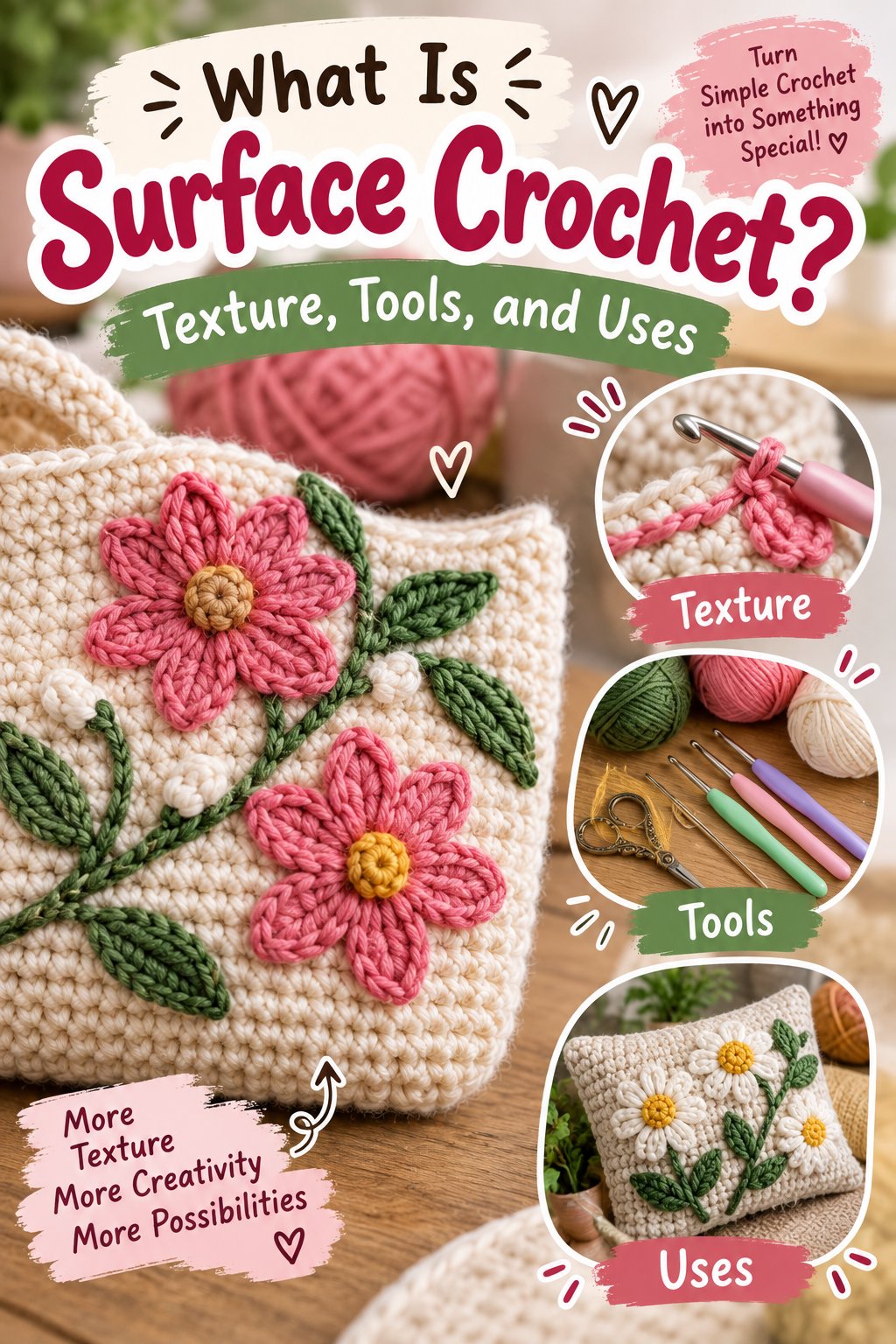
Surface crochet is a decorative technique that adds stitches over the face of completed crochet or knitted fabric, usually with slip stitches worked through the fabric from front to back. The added yarn forms visible lines, lettering, outlines, ridges, or motifs without rebuilding the base fabric, so it functions like crochet embroidery.
Key Facts About Surface Crochet
- Surface crochet decorates an existing fabric rather than creating a separate row or round.
- The most common stitch is a slip stitch worked along the fabric’s surface.
- A smaller hook and moderate tension usually produce cleaner lines than a large hook.
- Surface crochet can be added to blankets, garments, bags, amigurumi, hats, knitting, and Tunisian crochet.
- The technique is usually less dense than overlay crochet because it adds selected lines instead of covering many previous rows.
- A coaster-sized design typically takes 15-40 minutes and uses approximately 3-10 yards of contrast yarn.
What Is Surface Crochet?
Surface crochet is a method for drawing with yarn on top of a completed textile. The crocheter inserts a hook through selected spaces or stitches in the base fabric, pulls a new yarn strand through, and completes a chain or slip-stitch path that remains visible on the front.
The base fabric supplies the structure. The decorative yarn supplies the line.
Unlike ordinary crochet, surface crochet does not usually advance by working into the top loops of the newest row. Unlike embroidery, it uses a crochet hook and often creates a slightly raised chain on the fabric face. The result can be subtle with matching yarn or highly graphic with a contrasting color.
The term covers several related methods, but the standard approach uses surface slip stitches. A hook travels along a planned path, entering the fabric at regular points and pulling the working yarn through each point. The reverse side generally shows small connecting bars or dots rather than a fully duplicated design.
A useful practitioner rule is to treat the base fabric as graph paper. Each insertion point controls the angle, spacing, and smoothness of the finished line.
How Does Surface Crochet Work?
Surface crochet works by anchoring a new yarn strand at intervals through an existing fabric. Each insertion creates one visible chain segment on the front, while the working yarn travels behind the base between insertion points.
Before starting, identify the fabric’s front side, choose the route, and mark difficult turns with removable stitch markers. Thread the contrast yarn onto a yarn needle or hold it from the wrong side, then bring the hook from the front through the first insertion point. Pull up a loop and continue with slip stitches along the planned route.
The hook does not need to enter every stitch. For a straight horizontal line, entering every other stitch or every row space may create a cleaner proportion than entering every location. Curves usually require more frequent anchors because a long span between insertion points produces angular turns.
Surface crochet differs from ordinary slip-stitch edging in one important way: the new stitches sit on a finished surface instead of forming the active edge of the fabric. That difference allows decoration after blocking, colorwork mistakes, or garment assembly.
The Basic Construction
| Element | Typical choice | Visible result | Main risk |
|---|---|---|---|
| Base fabric | Single crochet, half double crochet, stockinette knitting | Stable foundation | Uneven insertion spacing |
| Decorative stitch | Surface slip stitch | Narrow raised chain | Puckering from tight tension |
| Contrast yarn | Same weight or one size lighter | Clear graphic line | Excessive thickness |
| Hook | 0.5-1.5 mm smaller than base hook | Controlled loops | Difficulty entering dense fabric |
| Path | Horizontal, vertical, diagonal, or curved | Motif or outline | Jagged corners |
The chain should rest on the face without pulling the underlying stitches together. If the line sinks into the fabric, use a slightly larger hook or a thicker contrast yarn. If the fabric gathers beneath the line, loosen the pull-up loop immediately.
Which Fabrics Work Best?
Surface crochet works best on fabrics with visible, repeatable openings. Single crochet, half double crochet, double crochet, garter stitch, stockinette, and Tunisian simple stitch all provide usable anchor points, although each produces a different line quality.
Open lace and highly textured fabric require more planning because the hook may pass through large gaps rather than a consistent stitch structure. Very dense slip-stitch fabric can also be difficult because the hook must separate tightly packed strands without splitting them.
| Base material | Suitability | Recommended placement | Expected appearance |
|---|---|---|---|
| Single-crochet fabric | Excellent | Between stitch posts or through stitch tops | Precise, narrow line |
| Double-crochet fabric | Very good | Row spaces or stitch posts | Slightly open, flexible line |
| Garter-stitch knitting | Very good | Between ridges | Rounded, textured line |
| Stockinette knitting | Good | Through selected columns | Clean vertical motifs |
| Lace crochet | Variable | Stable chain spaces | Delicate, irregular line |
| Fuzzy or brushed yarn | Poor | Only on broad motifs | Low stitch definition |
Surface crochet on knitting is especially useful for adding duplicate-style outlines, color accents, or simple lettering after finishing. A blunt hook can catch neighboring strands, so a tapered hook head usually enters knitted columns with less disturbance.
Tools, Yarn, and Tension
Surface crochet needs a crochet hook, decorative yarn, scissors, a tapestry needle, and optional removable markers. The hook size controls both insertion difficulty and the height of the visible chain.
Smooth yarn gives the most reliable results. Cotton, mercerized cotton, tightly spun wool, and anti-pilling acrylic show the chain clearly; chenille, boucle, mohair, and loosely plied yarn can obscure the route or split during repeated insertions.
| Project | Base yarn | Surface yarn | Typical hook | Decorative yarn needed |
|---|---|---|---|---|
| Coaster, 10-12 cm | Cotton DK | Cotton fingering or DK | 2.5-4 mm | 3-10 yards |
| Cushion panel, 35-45 cm | Acrylic or cotton worsted | DK or worsted | 4-5.5 mm | 20-60 yards |
| Blanket motif, 20-30 cm | Acrylic worsted | DK or worsted | 4.5-6 mm | 30-100 yards |
| Sweater detail | Wool, cotton, or blend | Matching fingering or sport | 2.5-4 mm | 10-40 yards |
| Amigurumi face | Cotton sport or DK | Cotton fingering | 2-3.5 mm | 2-8 yards |
Color contrast matters more than yarn quantity. A medium-value blue line on a dark navy base may disappear, while a cream line on navy remains legible at a smaller stitch size. For lettering, choose a contrast ratio that preserves visibility after washing and normal viewing distance.
The hook should pull a loop to the fabric’s surface without stretching the base. In practice, a hook 0.5-1.5 millimeters smaller than the hook used for the base often gives better control, but dense fabrics may require the same size or a pointed steel hook.
Expert insight: The most common tension mistake is pulling each loop snug before moving forward. Surface chains need a small amount of slack because later anchors distribute the line across the fabric. Tightening every stitch individually creates puckered rows and distorted curves.
How to Add a Surface-Crochet Line
A straight line is the best first exercise because it reveals tension problems before a complex motif makes them difficult to diagnose.
- Finish and inspect the base. Weave in structural ends, block the fabric if needed, and let it dry fully.
- Plan the route. Mark the beginning, end, corners, and major curves with removable markers.
- Choose the insertion path. Use consistent stitch columns, row spaces, or gaps between crochet posts.
- Bring up the yarn. Insert the hook from the front at the starting point and pull the contrast yarn through.
- Make the first surface slip stitch. Insert the hook at the next point, catch the yarn behind the fabric, and pull it through the fabric and the loop on the hook.
- Repeat with even spacing. Keep the decorative chain resting on the surface rather than sinking below it.
- Check the reverse side. Short, regular bars are normal; long floats indicate anchors spaced too far apart.
- Secure the ends. Leave 10-15 cm of yarn, weave the tails through nearby stitches, and split the path if the design will receive heavy wear.
- Block again if necessary. Steam or wet-block according to the base fiber’s care requirements.
At corners, place an anchor immediately before and after the turn. A sharp 90-degree angle made with only one insertion point often creates a loop or a flattened corner. For a gentle curve, shorten the distance between anchors rather than forcing the chain to bend sharply.
For a diagonal line across double crochet, test a five-centimeter section first. The gaps may be wider than expected, and the line can appear stair-stepped unless the anchor points alternate between stitch posts and row spaces.
What Designs Can You Make?
Surface crochet can create narrow decoration or a substantial raised motif, depending on stitch size, yarn contrast, and anchor density. Common applications include:
- Blanket borders and corner ornaments
- Names, initials, numbers, and short words
- Floral stems, leaves, waves, spirals, and geometric outlines
- Facial features on amigurumi
- Cuffs, necklines, pockets, and sleeve details
- Bag logos and decorative straps
- Color accents on knitted hats and scarves
- Grid lines for later embroidery or bead placement
Lettering requires a simple shape. Block capitals with strokes at least 5-8 mm apart remain more legible than script on most worsted-weight crochet. A word on a 40-centimeter cushion commonly needs 6-10 centimeters of letter height to remain readable from across a room.
Surface crochet may be worked freehand, from a chart, or over a paper template. Do not pin paper permanently to the textile because the insertion path can shift as the fabric stretches. A washable marker or removable thread tracing gives better control.
Surface Crochet Techniques
The term surface crochet describes a family of decorative approaches rather than one mandatory stitch. The following methods differ in height, flexibility, and reverse-side behavior.
| Technique | Stitch action | Texture level | Best use |
|---|---|---|---|
| Surface slip stitch | Pull yarn through fabric and loop | Low to medium | Outlines and lettering |
| Surface chain stitch | Form linked chain over fabric | Medium | Bold motifs and borders |
| Surface single crochet | Work compact stitches around anchors | Medium to high | Raised lines and stems |
| Back-loop surface work | Catch selected strands behind fabric | Low | Subtle tonal decoration |
| Freeform surface work | Change route and spacing organically | Variable | Abstract motifs and art pieces |
Surface slip stitches are the easiest to control because they use little yarn and create a narrow path. Surface single crochet produces more height but can become bulky on garments or flexible blankets.
A chain-backed method can be worked separately and stitched onto the base, but that construction is appliqué rather than true surface crochet. The distinction matters when washing, because a separate chain can shift more easily than a line anchored through the fabric.
Surface Crochet vs. Overlay Crochet
Surface crochet and overlay crochet are different construction methods. Surface crochet adds selected decorative lines to a finished fabric, while overlay crochet builds dense layers by working tall stitches into deliberately preserved loops or other specified locations in earlier rows.
The supplied AI Overview describes overlay crochet, not the ordinary meaning of surface crochet. Its references to back-loop-only foundation rows, saved front loops, post stitches, mandalas, row-by-row color changes, and embossed layers belong primarily to overlay crochet or related layered colorwork.
| Feature | Surface crochet | Overlay crochet | Mosaic crochet | Tapestry crochet |
|---|---|---|---|---|
| Base construction | Finished fabric | Planned layered rows | Planned rows or rounds | Simultaneous colorwork |
| Main stitch action | Surface slip stitch | Tall stitches into earlier loops | Front-loop or drop stitches | Carrying or changing colors |
| Texture | Narrow raised lines | Heavy embossed relief | Medium geometric relief | Usually low relief |
| Reverse side | Small anchor bars | Dense ridges and tails | Bars or floats, pattern-dependent | Floats or carried yarn |
| Yarn use | Low, often 5-60 yards | High, commonly 1.5-2 times a simple fabric | Moderate to high | Moderate |
| Best application | Details after construction | Mandalas and dense motifs | Blankets and geometric panels | Bags and pictorial fabric |
Overlay crochet can use surface-like decorative stitches, which explains occasional terminology overlap between designers. However, a crocheter does not need to reserve front loops several rows below to make a standard surface-crochet outline.
Cost, Time, and Material Planning
Surface crochet is inexpensive compared with constructing a second layer because the decorative yarn is usually a small fraction of the base material. Typical costs range from USD 0.50-3 for a small accent to USD 5-20 for a large blanket containing multiple colors.
These are practical planning ranges, not fixed retail prices. Local yarn stores, fiber type, skein size, and imported brands can change the total substantially.
| Project | Surface-crochet time | Decorative yarn | Typical added cost |
|---|---|---|---|
| Coaster motif | 15-40 minutes | 3-10 yards | USD 0.50-2 |
| Hat or small garment detail | 20-60 minutes | 10-30 yards | USD 1-5 |
| Cushion front | 1-3 hours | 20-60 yards | USD 2-8 |
| Blanket border and motifs | 3-10 hours | 60-250 yards | USD 5-20 |
| Large lettering panel | 2-6 hours | 30-120 yards | USD 3-12 |
The base item still determines most of the project’s total price. Surface crochet increases labor more than material consumption, especially when the design contains many color changes or short yarn tails.
A ten-centimeter line may take less than five minutes once the path is familiar. A detailed floral border can take several hours because every branch, corner, and color transition requires separate placement decisions.
Common Problems and Fixes
Surface crochet problems usually come from inconsistent anchor spacing, unsuitable yarn, or tension that does not match the base fabric.
| Problem | Likely cause | Observable symptom | Practical fix |
|---|---|---|---|
| Puckering | Loops pulled too tightly | Base gathers under the line | Loosen each pull-up loop |
| Broken-looking line | Anchors too far apart | Gaps between chain segments | Add intermediate insertions |
| Jagged curve | Uniform spacing on a tight bend | Polygon-shaped outline | Shorten spacing around curves |
| Sinking stitches | Hook too small or yarn too thin | Chain disappears into fabric | Increase hook or yarn size |
| Split yarn | Blunt hook or loose ply | Frayed decorative strand | Use a sharper hook and slower insertion |
| Loose ends unravel | Short tails or weak securing | Line opens after washing | Leave 10-15 cm tails and weave twice |
The mistake most people make is judging the front before checking the reverse side. A decorative line can look smooth while the yarn forms long, loose floats behind the fabric. Those floats catch fingers, snag jewelry, and loosen during laundering.
Surface crochet on a stretchy garment needs a flexible path. A rigid, tightly tensioned outline can restrict the fabric and create a visible ridge after the garment is worn. Use lighter yarn, fewer anchors, or a deliberately open chain on ribbing and fitted knitwear.
What Happens If the Base Fabric Is Uneven?
An uneven base transfers its irregularity to the decorative line. Surface crochet cannot fully straighten a fabric whose rows vary substantially in height, although careful route selection can hide small inconsistencies.
On highly textured crochet, anchor through comparable structural points rather than following every visible bump. For example, a line across bobble stitches may look straighter when it passes between bobble columns instead of over their centers.
Is Surface Crochet Reversible?
Surface crochet is usually not fully reversible. The front displays the decorative chain, while the back shows anchor bars, small floats, or occasional color dots.
For reversible blankets, use a closely matching base color and secure every tail carefully. A contrasting line intended for a wall hanging can tolerate a less decorative reverse side, but a baby blanket needs shorter, well-buried ends and a washable fiber.
Can It Be Washed?
Surface crochet can be washed when the base yarn and decorative yarn tolerate the same care method. Acrylic, cotton, and washable wool are common choices, but different fibers can shrink at different rates and distort the line.
Test a five-centimeter sample first. Wash and dry it using the intended method, then inspect whether the chain remains flat, the colors bleed, or the base contracts around the anchors.
Is Surface Crochet Suitable for Beginners?
Surface crochet is beginner-friendly for straight lines and simple borders because the base fabric is already complete. Curved motifs, lettering, and work on dense or stretchy fabric require intermediate control of tension and stitch placement.
A useful progression is a horizontal stripe, then a square outline, then a leaf or spiral. Beginners should practice on a 10-15-centimeter swatch instead of a finished sweater, where misplaced holes are harder to disguise.
Surface crochet is a poor choice when the finished item must remain completely flat, reversible, or highly elastic. Printed colorwork, woven-in tapestry crochet, or embroidery may create a cleaner result for those requirements.
Frequently Asked Questions About What Is Surface Crochet
Can You Surface Crochet Without Turning the Work?
Yes. Surface crochet is commonly worked from the front of a completed project without turning it. The hook repeatedly enters from the front, while the yarn is held behind the fabric. Working from one face keeps the decorative chain consistent, although left-handed crocheters may prefer a mirrored route.
Can You Add Surface Crochet After Blocking?
Yes. Blocking first is often preferable because the fabric reaches its final dimensions before the decorative path is placed. If the line is added before blocking, stretching or shrinking can change its curve, spacing, and tension.
How Do You Surface Crochet Letters?
Plan letters as block shapes with clear spacing, mark the major strokes, and use surface slip stitches along each path. Letter strokes 5-8 mm apart remain more readable than tightly packed lines, particularly when the base fabric has strong texture.
Does Surface Crochet Use More Yarn Than Regular Crochet?
Surface crochet usually uses far less yarn than overlay crochet because it adds selected lines rather than a second dense layer. A small motif may use 3-10 yards, while a blanket border and several motifs may use 60-250 yards.
Can You Remove Surface Crochet?
Usually, yes. Carefully cut the decorative yarn on the reverse side and pull the line out from the front with a blunt needle or hook. Work slowly around the anchor points, because aggressive pulling can enlarge holes in delicate crochet or knitting.
What Is the Best First Surface-Crochet Project?
A coaster, swatch, or cushion panel with one contrasting stripe is the best first project. It is large enough to reveal tension and spacing problems but small enough to redo in under an hour. Avoid starting with lettering on a stretchy garment.
Conclusion
Surface crochet is a way to add raised yarn lines, outlines, lettering, and motifs to completed crochet or knitting. Its defining action is working a new chain or slip-stitch path through the existing fabric, not building dense layered relief from reserved loops.
Choose smooth yarn, plan the route, anchor curves more frequently, and keep the loops relaxed. For simple decoration, surface crochet is faster and lighter than overlay crochet; for heavy embossed mandalas, overlay crochet is the more accurate technique.