
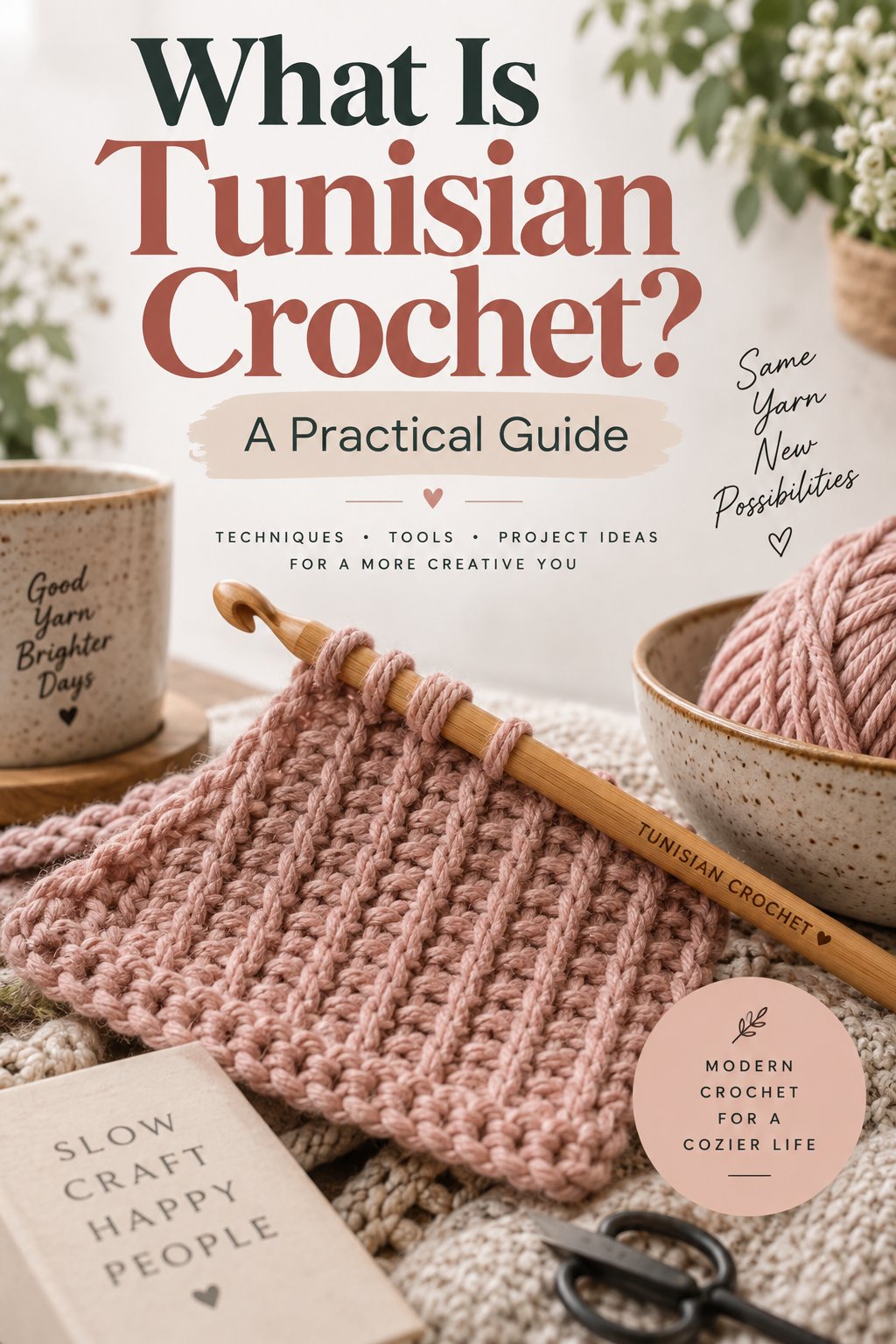
Tunisian crochet is a needlecraft method that combines a crochet hook with knitting-like loop management. A long or corded hook holds several live loops during a forward pass, then works them off during a return pass, producing a dense fabric with distinctive vertical bars, low vertical stretch, and often more structure than ordinary crochet.
Key Facts About Tunisian Crochet
- Tunisian crochet uses two passes for each standard row and normally does not require turning the work.
- The forward pass gathers loops from right to left; the return pass works them off from left to right.
- A long Tunisian hook suits narrow projects, while a cable-connected hook supports blankets, shawls, and garments.
- Tunisian simple stitch creates a firm grid, while Tunisian knit stitch resembles knitted stockinette on the front.
- Typical beginners spend 1-3 hours learning the basic passes and edge handling.
- A 5.5-6.5 mm hook and smooth worsted-weight yarn provide a practical starting point.
How Does Tunisian Crochet Work?
Tunisian crochet creates one row through a forward pass and a return pass. The forward pass builds a row of loops on the hook, while the return pass reduces those loops until one working loop remains, so the fabric develops without the crocheter turning the piece.
The foundation row begins with a chain, much like standard crochet. The hook then draws up loops through the chain, placing one loop on the shaft for each stitch. On later rows, the crocheter usually inserts the hook under a vertical bar and pulls up a new loop.
During the return pass, the yarn travels over the hook and through two loops at a time. The first movement generally draws through one loop to establish the edge, followed by repeated yarn overs through two loops. Terminology varies by designer, so patterns may label the opening movement as chain 1, chain 1 return, or a simple pull-through.
The work remains facing the same direction in the standard method. That differs from many crochet patterns, where the maker turns at the end of every row. The stable viewing direction makes stitch placement easier to inspect, but the fabric has a visible front and back.
The Standard Two-Pass Row
- Make the foundation chain and draw up loops across it.
- Keep the loops on the hook without twisting the row.
- Work the return pass through the first loop, then through two loops repeatedly.
- Begin the next forward pass by identifying the correct vertical bars.
- Work the final edge stitch through the complete edge structure.
- Repeat until the fabric reaches the planned length.
A practical distinction matters here: a Tunisian row can look finished after the return pass, but the next forward pass determines whether the side edges remain straight. Missing the final edge stitch gradually narrows scarves and blankets.
| Row stage | Hook direction | Loop result | Common error |
|---|---|---|---|
| Foundation chain | Right to left | One loop drawn from each chain | Skipping chain spaces |
| Forward pass | Right to left | Multiple loops held on hook | Pulling loops too tightly |
| Opening return | Left to right | First edge loop worked | Misreading chain 1 instructions |
| Repeating return | Left to right | Two loops become one | Working through one loop only |
| Final edge stitch | Right to left | Outer border stays stable | Missing the rear edge bar |
Which Tunisian Stitches Should You Learn First?
The best beginner sequence is Tunisian simple stitch, Tunisian knit stitch, Tunisian purl stitch, and Tunisian full stitch. These stitches teach the main insertion points and create enough visual contrast to explain why the technique produces different fabrics.
- Tunisian simple stitch, or TSS: Insert under the front vertical bar. The result is a compact fabric with a regular woven grid.
- Tunisian knit stitch, or TKS: Insert through the fabric between the front and back vertical bars. The front resembles knitted stockinette.
- Tunisian purl stitch, or TPS: Bring the yarn to the front before inserting under the bar. The stitch forms a horizontal ridge.
- Tunisian full stitch, or TFS: Insert into the gap between neighboring vertical bars. The result is thick, open-textured, and relatively firm.
- Tunisian reverse stitch, or TRS: Work from the back-facing side of the fabric. This adds texture and can create a raised surface.
- Tunisian honeycomb: Alternate simple and purl stitches. The pattern produces small textured cells and usually lies flatter than plain simple stitch.
| Stitch | Insertion location | Typical front appearance | Suitable first use |
|---|---|---|---|
| TSS | Front vertical bar | Grid-like woven columns | Dishcloth or practice swatch |
| TKS | Between front and back bars | Stockinette-like columns | Scarf or hat panel |
| TPS | Front bar with yarn held forward | Horizontal purl ridges | Textured cowl |
| TFS | Space between vertical bars | Thick interlocking texture | Potholder or cushion |
| TRS | Rear-facing vertical structure | Raised reverse texture | Decorative panel |
| Honeycomb | Alternating TSS and TPS | Small cellular pattern | Scarf with reduced curl |
Tunisian knit stitch does not behave exactly like machine-knitted stockinette. The front can look similar, but the reverse side, edge formation, row gauge, and elasticity differ. That distinction becomes important when substituting a Tunisian pattern for a knitting pattern.
What Tools and Yarn Does Tunisian Crochet Need?
Tunisian crochet needs a suitable hook, yarn, scissors, a measuring tool, and a method for checking gauge. A smooth medium-weight yarn and a 5.5-6.5 mm hook make loop placement visible, while a cable-connected hook becomes necessary when the live loops exceed the shaft length.
A standard short crochet hook is generally unsuitable because the shaft cannot hold a full row. Some small swatches can use a long rigid hook, but projects wider than the hook require a flexible cable or interchangeable system.
The Craft Yarn Council classifies yarn by weight categories rather than prescribing one universal Tunisian hook size. Yarn labels provide a starting point, not a final answer, because dense stitches and personal tension can make the labeled crochet hook too small.
In practice, begin 1-2 mm above the yarn label’s suggested crochet size, then make a swatch. A larger hook creates more room for the return pass and improves drape, although excessive hook size can leave gaps between vertical bars.
| Starter item | Typical specification | Typical USD cost | Practical note |
|---|---|---|---|
| Aluminum straight hook | 6.0-6.5 mm, 25-35 cm shaft | $5-$10 | Suits narrow samples |
| Interchangeable hook set | 4.0-12.0 mm hooks with cables | $40-$120 | Supports blankets and garments |
| Worsted yarn | 100 g skein, approximately 170-220 yd | $4-$12 | Smooth wool or acrylic is easy to read |
| Measuring tape | 150 cm flexible tape | $2-$8 | Measures width and blocked growth |
| Locking stitch markers | 10-20 markers | $3-$10 | Marks repeats and edge locations |
| Blocking surface | Foam mats, approximately 60 x 60 cm | $15-$35 | Useful for straightening dense fabric |
Tunisian fabric often uses approximately 20-30% more yarn than a similarly sized single-crochet fabric, but the difference depends on stitch, gauge, fiber, and finishing. Treat that percentage as a planning estimate rather than a guaranteed conversion.
How Much Does a Starter Setup Cost?
A realistic beginner setup costs about $11-$30 when using one hook and one skein of yarn. A larger setup for blankets or garments commonly costs $55-$140 before pattern fees, extra yarn, or blocking equipment.
| Setup | Hook cost | Yarn cost | Estimated total |
|---|---|---|---|
| Practice swatch | $5-$8 | $4-$8 | $9-$16 |
| Scarf starter kit | $6-$10 | $8-$24 | $14-$34 |
| Cowl and texture kit | $8-$15 | $10-$24 | $18-$39 |
| Blanket cable system | $40-$120 | $40-$120 | $80-$240 |
Prices vary by material, brand, local taxes, and sales. The largest budget mistake is buying a full interchangeable set before confirming that the maker enjoys the two-pass rhythm.
How Long Do Tunisian Crochet Projects Take?
Tunisian crochet typically takes 1-3 hours to learn at a basic level, 1.5-3 hours for a small dishcloth, 8-15 hours for a scarf or cowl, and 40-80 or more hours for a throw. Actual time depends on width, stitch pattern, yarn weight, interruptions, and correction frequency.
The method can feel slow initially because the crocheter performs two distinct movements per row. Once the return pass becomes automatic, the forward pass often becomes steady, but dense fabric still requires more yarn and hand movement than an open crochet pattern.
A 20 x 20 cm swatch is a better productivity test than a generic hourly estimate. Record the time, number of rows, and yarn consumed, then multiply those values by the finished project dimensions.
| Project | Typical dimensions | Typical time | Yarn planning range |
|---|---|---|---|
| Dishcloth | 20 x 20 cm | 1.5-3 hours | 35-60 g |
| Potholder | 18 x 18 cm | 1.5-3 hours | 40-70 g |
| Cowl | 25 x 60 cm | 5-10 hours | 150-250 g |
| Scarf | 20 x 160 cm | 8-15 hours | 250-450 g |
| Baby blanket | 75 x 90 cm | 25-50 hours | 700-1,000 g |
| Throw blanket | 120 x 150 cm | 40-80+ hours | 1,200-2,000 g |
These are typical practitioner ranges for medium tension. A full-stitch blanket made with bulky yarn may consume more material but finish sooner than a fine-yarn knit-look scarf.
How Does Tunisian Crochet Compare With Crochet and Knitting?
Tunisian crochet sits between traditional crochet and hand-knitting in construction. It uses one hooked tool but holds a row of live loops like knitting, creating fabric that is usually denser and less elastic than knitted fabric.
Traditional crochet excels at sculptural shapes, rapid increases, and strong three-dimensional texture. Hand-knitting generally provides better stretch and drape, especially with ribbing and fine yarn. Tunisian crochet is useful when a maker wants a flatter fabric with visible vertical columns and crochet-style construction.
| Feature | Tunisian crochet | Traditional crochet | Hand-knitting |
|---|---|---|---|
| Main tool | Long hook or cable hook | Short hook | Two needles |
| Live loops held | Most of one row | Usually 1-2 active loops | Most of one row |
| Standard row action | Forward and return passes | One primary pass | Knit or purl pass |
| Typical elasticity | Low vertical, moderate horizontal | Moderate, stitch-dependent | High, stitch-dependent |
| Fabric character | Dense, structured, woven | Textured, sculptural | Supple, often drapey |
| Edge behavior | Can curl and narrow | Often stable | Can curl in stockinette |
| Best advantage | Knit-like surfaces with one hook | Shaping and texture | Stretch and fluid drape |
Tunisian fabric is not automatically warmer or superior. Its density can make a scarf heavy, and its low vertical stretch can make fitted sleeves uncomfortable unless the pattern includes ease, ribbed borders, or another elastic stitch.
When Is Tunisian Crochet the Better Choice?
Choose Tunisian crochet for structured scarves, blankets, cushion covers, bags, and panels where surface regularity matters more than maximum elasticity. Choose ordinary crochet for amigurumi, complex three-dimensional shaping, and projects that need frequent increases or decreases.
Choose knitting for socks, close-fitting cuffs, and garments requiring substantial recovery. A Tunisian approach can work for clothing, but it usually needs larger hooks, careful blocking, and a pattern designed for its distinctive gauge.
Why Does Tunisian Crochet Curl?
Tunisian crochet curls because the forward-pass loops and return-pass chains create unequal tension between the front and back of the fabric. Simple stitch emphasizes the problem, especially in the first rows, because the front vertical bars pull toward the fabric face.
Curling is normal, but severe curling usually indicates tight tension, a hook that is too small, or a stitch pattern with insufficient counterbalance. Blocking can relax moderate curl, but it cannot reliably correct fabric that is structurally too tight.
The most effective prevention is to increase hook size, loosen the return pass, and alternate stitches that pull in different directions. A foundation chain made with a larger hook also reduces the tight lower edge that often acts as a curling hinge.
| Symptom | Likely cause | First correction | If the problem remains |
|---|---|---|---|
| Bottom edge rolls forward | Small hook or tight TSS | Increase hook by 1-2 mm | Add a counteracting border |
| Side edges narrow | Missed final stitch | Mark the last edge bar | Unravel to the first decrease |
| Fabric feels rigid | Dense gauge and low hook size | Swatch with larger hook | Change to wool or acrylic blend |
| Return pass resists | Loops pulled too tightly | Keep loops shaft-height | Use a longer cable hook |
| Curl returns after blocking | Structural tension imbalance | Change stitch pattern | Redesign the opening rows |
How Should Tunisian Crochet Be Blocked?
Wet blocking works well for wool and some animal fibers, while steam or spray blocking is safer for many acrylic projects. Soak wool gently, press out water without wringing, pin the piece to measured dimensions, and let it dry completely before removing pins.
Blocking opens the vertical bars and can improve drape, but it does not change a fundamentally unsuitable gauge. Acrylic may respond permanently to controlled steam, so keep the heat source above the fabric and avoid flattening the surface accidentally.
What Are the Main Advanced Techniques?
Advanced Tunisian crochet includes colorwork, entrelac, lace, cables, shaping, and several methods of edge finishing. These techniques use the same two-pass foundation but change loop placement, color management, or the order in which loops are worked.
Tunisian entrelac builds small blocks in different directions rather than working one uninterrupted row. Mosaic and stranded colorwork create graphic bands, while Tunisian lace uses yarn overs and larger hook sizes to reduce density.
The reverse side deserves attention before starting a garment or reversible accessory. Some stitches produce a tidy front and a noticeably different back, so a scarf intended to twist or fold should use a reversible pattern or include a deliberate lining.
- Tunisian entrelac: Good for geometric blankets and color changes, but it creates more ends to weave.
- Tunisian cables: Adds relief and thickness, so the finished gauge becomes narrower.
- Tunisian lace: Requires loose tension and blocking because open spaces can close during the return pass.
- Tunisian colorwork: Uses separate yarn strands or color changes at the forward and return passes.
- Tunisian shaping: Uses decreases and increases at selected edges, with row gauge checked separately from width.
- Decorative borders: Simple crochet, slip stitch, or reverse single crochet can stabilize exposed edges.
What Mistakes Should Beginners Avoid?
Beginners most often create problems by using a standard crochet hook size, tightening the return pass, misreading the final edge stitch, or assuming every vertical bar is worked the same way. Each mistake changes width, loop access, or the final fabric density.
A common misconception is that a larger hook always solves curling. It helps only when tight tension causes the curl; a stitch pattern with strong directional bias may still require a border or a different opening sequence.
Another counterintuitive rule is that the foundation chain can determine the entire lower edge. If the chain is too tight, increasing the hook later cannot fully repair the compressed base.
A Practical Troubleshooting Sequence
- Measure the swatch before blocking and record its width, height, and row count.
- Check whether the first and last stitches are present on every row.
- Compare loop height with the hook shaft, rather than pulling each loop snug.
- Test a hook 1 mm larger and repeat at least ten rows.
- Block the test piece using the fiber-appropriate method.
- Compare drape, width, curl, and yarn use before selecting the final gauge.
Expert insight: the return pass controls more than speed. When its loops are uniform and relaxed, the next forward pass becomes easier, the fabric becomes more even, and the side edges need fewer corrective stitches.
Is Tunisian Crochet Suitable for Every Project?
Tunisian crochet is suitable for dense accessories, home textiles, and selected garments, but it is a poor choice when the design depends on high elasticity, very light weight, or rapid three-dimensional shaping. Project success depends on matching the fabric’s behavior to the object’s function.
Dishcloths and potholders benefit from the technique’s structure, although synthetic fibers should be checked for heat resistance before use near hot cookware. Scarves and blankets show stitch definition well, but their yarn requirements can exceed an equivalent open crochet design.
For clothing, measure the blocked swatch and compare it with the pattern’s finished dimensions. A fabric that feels comfortable in a 20 cm sample may become heavy and restrictive across a sweater body.
| Project type | Suitability | Preferred stitch or feature | Main limitation |
|---|---|---|---|
| Dishcloth | High | TSS, TFS, honeycomb | Slow compared with open crochet |
| Potholder | High | TFS or dense TSS | Acrylic can soften near heat |
| Scarf | High | TKS, honeycomb, lace | Heavy if hook is too small |
| Blanket | High | TSS, entrelac, colorwork | Large loop capacity required |
| Sweater | Moderate | TKS with shaped borders | Low vertical stretch |
| Socks | Low to moderate | Elastic ribbed combinations | Fit and recovery are difficult |
| Amigurumi | Low | Standard crochet preferred | Tunisian fabric is less sculptural |
How Should Tunisian Crochet Be Washed and Maintained?
Tunisian crochet should be washed according to the yarn fiber, then dried flat when the fabric is dense or heavy. Wool can felt with heat and agitation, cotton can grow when wet, and acrylic can lose surface texture under excessive steam.
Read the yarn label before washing a finished piece. Measure the item after blocking and after the first wash, because a blanket or garment may lengthen under its own weight while wet.
Store long projects on a cable hook or transfer the loops to a holder when pausing. A project bag prevents the hook from catching neighboring fibers, while a row counter reduces errors in patterns with alternating forward-pass stitches.
Frequently Asked Questions About What Is Tunisian Crochet?
Can someone who only knows knitting learn Tunisian crochet?
Yes. Knitters already understand live-loop control, tension, and reading vertical columns, which transfer well to Tunisian crochet. The main adjustment is learning to use one hooked tool and to complete a return pass after gathering loops. A crocheter may find hook handling easier but need more practice recognizing insertion bars.
Does Tunisian crochet use more yarn than knitting?
Usually, yes, especially in dense stitches such as simple stitch and full stitch. A typical Tunisian swatch may use about 20-30% more yarn than a comparable single-crochet swatch, while knitting often creates lighter fabric with greater drape. The exact difference depends on yarn, stitch, hook size, and finished dimensions.
Can a regular crochet hook be used for Tunisian crochet?
A regular crochet hook can work for a very narrow sample if its shaft is long enough to hold the loops. Most full-width projects need a Tunisian hook with a long shaft or flexible cable. A standard short hook becomes crowded, which compresses loops and makes the return pass harder to control.
Is Tunisian crochet reversible?
Some Tunisian stitches are reversible, but many have a defined front and back. Simple stitch and knit stitch usually show different surfaces on opposite sides, while select honeycomb, ribbed, and colorwork patterns can provide a more balanced appearance. Check both sides of a swatch before choosing a scarf or blanket design.
What yarn is easiest for a first project?
Smooth worsted-weight wool, wool blend, or acrylic yarn is easiest because its plies separate less and its vertical bars remain visible. Very fuzzy yarn hides insertion points, while split cotton can make the return pass frustrating. A medium color also makes it easier to inspect the foundation and edge stitches.
Does blocking remove all Tunisian crochet curling?
No. Blocking can relax moderate curling and improve drape, but it cannot fully correct a hook that is too small, extremely tight tension, or a strongly biased stitch pattern. Test the fabric after blocking before committing to a large project. If the curl returns, change the gauge or add a stabilizing border.
Tunisian crochet is a two-pass hooked technique that combines crochet construction with knitting-like loop storage. It offers structured fabric, recognizable vertical columns, and useful stitch variety, but the method demands attention to hook capacity, return-pass tension, edge stitches, yarn quantity, and curling. For a reliable first project, use smooth worsted yarn, a 6.0-6.5 mm cable hook, and a measured swatch before choosing Tunisian crochet for a larger design.