
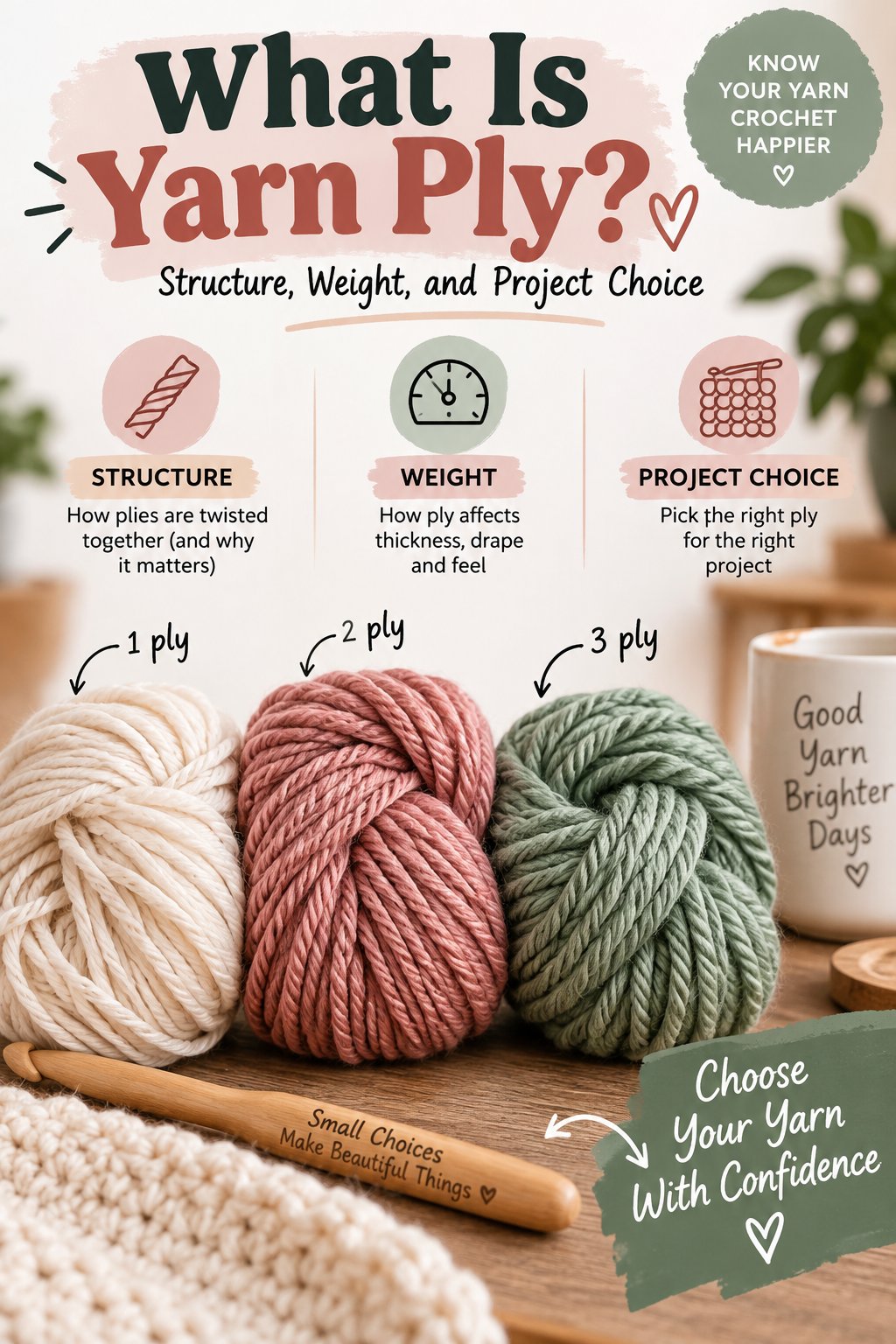
Yarn ply is the number of individual spun strands twisted together to form one working yarn. Ply affects roundness, strength, split resistance, drape, stitch definition, and abrasion behavior, but it does not reliably identify thickness because fiber size and spinning methods vary.
Key Facts About Yarn Ply
- A singles yarn contains one spun strand; a 3-ply yarn contains three strands twisted together.
- Plying usually adds stability by balancing the twist in the individual singles.
- Ply count is a construction detail, not a dependable yarn-weight measurement.
- The Craft Yarn Council uses weight categories 0 through 7, while gauge and meterage help confirm substitutions.
- Round, firm multi-ply yarns usually produce sharper cables and resist abrasion better than loosely spun singles.
- Fiber type, twist level, finishing, and laundering can matter more than ply count when predicting pilling or durability.
Yarn labels often create confusion because “4-ply” can describe construction in one market and a thickness category in another. A fine 4-ply merino and a bulky 4-ply wool may contain the same number of component strands but produce completely different fabrics.
The practical rule is simple: use ply to understand structure, then use gauge, yarn weight, meterage, fiber content, and a swatch to choose a replacement. Ply helps explain how a yarn behaves. It cannot replace a gauge measurement.
What Is Yarn Ply and How Is It Made?
Yarn ply is the count of singles yarns combined during a plying stage. A spinner first drafts and twists loose fibers into a continuous singles strand, then combines two or more singles and twists them together, commonly in the opposite direction.
The first twist holds fibers inside each singles strand. The second twist binds the strands into a more stable composite yarn. When the forces are balanced, the finished yarn lies relatively straight instead of coiling aggressively on the ball.
Singles Yarn Versus Plied Yarn
A singles yarn has one component strand and no second plying operation. It can feel soft and lofty because fewer twist interactions compress the fibers, but its exposed fibers and relatively flat structure may wear faster in high-friction areas.
Plied yarn combines multiple singles. The resulting cross-section may be round, oval, or somewhat flat, depending on the number of strands, the twist angle, the tension used during plying, and whether the yarn is steamed or otherwise finished.
The following table describes common constructions. The ranges are typical craft-yarn observations, not universal manufacturing limits.
| Construction | Component strands | Typical cross-section | Common behavior |
|---|---|---|---|
| Singles | 1 | Flat to softly rounded | High loft, visible halo, greater bias risk |
| 2-ply | 2 | Oval to moderately round | Soft drape, clear diagonal twist, moderate stability |
| 3-ply | 3 | Round | Balanced stitch definition and abrasion resistance |
| 4-ply | 4 | Round to compact | Firm structure, crisp texture, dependable wear |
| Cable yarn | 4 or more after re-plying | Dense and rope-like | High resilience, low stretch, strong texture |
How Do S-Twist and Z-Twist Work?
S-twist and Z-twist describe the visible slant of the fibers or strands. If the diagonal follows the middle stroke of an uppercase S, the yarn has S-twist; if it follows the middle stroke of Z, it has Z-twist.
Spinning and plying often use opposite directions. For example, a singles yarn may receive Z-twist and then be plied with S-twist. The opposing forces reduce torque and help the finished yarn remain stable.
Most commercial knitting yarns use combinations of these directions, but there is no universal rule that every commercial yarn uses Z-twist singles or one particular final direction. Hand spinners and specialty mills deliberately vary twist to create texture, elasticity, or a particular bias.
How Does Ply Change Yarn Performance?
Ply changes performance by altering the yarn’s cross-section, surface exposure, torque, and resistance to abrasion. A round 3-ply or 4-ply usually gives compact stitches and wears more evenly, while a loose singles yarn often gives softness and halo at the cost of stability.
The effect is not controlled by ply count alone. A tightly spun 2-ply linen can outwear a loosely spun 6-ply alpaca, and a superwash wool may pill sooner than a rustic non-superwash wool because finishing changes fiber scales and surface friction.
| Attribute | Singles | 2-ply | 3-ply | Firm 4-ply or cable |
|---|---|---|---|---|
| Typical stitch edge | Soft, sometimes fuzzy | Gentle definition | Clear definition | Sharp definition |
| Surface abrasion tolerance | Low to moderate | Moderate | Moderate to high | High |
| Lace drape | High | High | Moderate | Low to moderate |
| Cable relief | Low | Moderate | High | Very high |
| Split risk | Low strand count, fiber can separate | Moderate | Moderate | Variable, depending on twist |
| Blocking stability | Moderate | Moderate | High | High |
Why Does Ply Affect Stitch Definition?
A round yarn fills the base of a knitted or crocheted stitch more evenly, so raised stitches cast stronger shadows. This is why cables, bobbles, seed stitch, and moss stitch often look more architectural in a firm multi-ply yarn.
Singles yarn can flatten under tension. That behavior softens color transitions and gives stockinette a painterly surface, but it may cause cables to look less raised than the pattern photograph.
A loose 2-ply can be excellent for lace because its softer profile opens during blocking. The same softness can make ribbing appear less elastic and make textured motifs lose their edges after repeated washing.
Does More Ply Always Mean More Strength?
More ply does not automatically mean more strength. Strength depends on fiber tensile strength, staple length, twist per inch, ply balance, strand diameter, finishing, and the quality of the joins between fibers.
A high-ply yarn can still break if each component strand is extremely fine or loosely spun. Conversely, a thick, tightly twisted singles yarn may have substantial tensile strength but can wear unevenly because the working strand has no neighboring plies to share abrasion.
Expert insight: for socks, the most useful question is often “How compact and abrasion-resistant is the yarn?” rather than “How many plies does it have?” A firm 3-ply wool with 15-25% nylon is a common practical choice, but a dense wool-only yarn may perform better than a soft, loosely spun wool-nylon blend.
Is Ply the Same as Yarn Weight?
Ply is not the same as yarn weight. Ply counts the component strands, whereas yarn weight categories describe approximate thickness and recommended gauge. A 4-ply yarn can be laceweight, fingering, worsted, or bulky, depending on the diameter of each singles strand.
The Craft Yarn Council’s Standard Yarn Weight System classifies yarn from 0, Lace, through 7, Jumbo. Its guidance separates yarn weight from construction, and the organization states that weight categories “are not an indication of the thickness of the yarn” in the absolute sense because yarn characteristics vary.
| Craft Yarn Council category | Common label | Typical knitting gauge per 4 inches | Typical needle range |
|---|---|---|---|
| 0 | Lace | 33-40 stitches | US 000-1 |
| 1 | Super Fine | 27-32 stitches | US 1-3 |
| 2 | Fine | 23-26 stitches | US 3-5 |
| 3 | Light | 21-24 stitches | US 5-7 |
| 4 | Medium | 16-20 stitches | US 7-9 |
| 5 | Bulky | 12-15 stitches | US 9-11 |
| 6 | Super Bulky | 7-11 stitches | US 11-17 |
| 7 | Jumbo | 1-6 stitches | US 17 and larger |
Gauge figures are typical CYC ranges, not promises. A crocheter, a loose knitter, and a machine knitter can obtain different results from the same ball.
What Should Replace Ply When Matching Yarn?
Match a substitute using gauge first, then compare meterage, fiber behavior, construction, care instructions, and finished fabric. The label’s category is a starting point, not proof that two yarns are interchangeable.
Use this order:
- Identify the pattern’s blocked gauge over at least 10 centimeters or 4 inches.
- Compare the original yarn’s meters or yards per 50 or 100 grams.
- Compare fiber content, especially wool, cotton, silk, acrylic, nylon, and alpaca.
- Examine the number of plies, twist firmness, halo, and elasticity.
- Knit or crochet a swatch, wash it according to the finished item’s care plan, and measure again.
- Adjust needle or hook size until the blocked gauge and fabric hand are acceptable.
- Calculate quantity by total meterage, not by the number of balls alone.
Wraps per inch, or WPI, can help when a label gives no category. Wrap the yarn snugly without compressing it around a ruler, count the wraps in one inch, and treat the result as an estimate because loft and halo distort the reading.
| Yarn example | Ply count | Weight category | Typical meterage per 100 g | Substitution implication |
|---|---|---|---|---|
| Fine merino sock yarn | 4 | 1, Super Fine | 350-420 m | Compare gauge and nylon content |
| DK wool | 8 | 3, Light | 210-250 m | Ply count cannot match fingering yarn |
| Worsted acrylic | 4 | 4, Medium | 170-200 m | Fiber stretch differs from wool |
| Bulky alpaca | 4 | 5, Bulky | 80-120 m | Four plies do not indicate fine weight |
Which Ply Is Best for Different Projects?
The best construction depends on friction, drape, stitch pattern, elasticity, and laundering. A compact 3-ply or 4-ply often suits socks and cables, while a soft 2-ply or singles yarn can better suit lace, shawls, and fabrics where halo matters more than abrasion resistance.
| Project requirement | Preferred construction | Typical fiber choice | Main reason |
|---|---|---|---|
| Adult socks | Firm 3-ply or 4-ply | Wool with 15-25% nylon | Resists foot and shoe abrasion |
| Cable sweater | Round 3-ply or 4-ply | Wool or wool blend | Preserves relief and shadow |
| Lace shawl | Soft 2-ply or singles | Merino, silk, or cashmere blend | Opens during blocking |
| Baby cardigan | Smooth 3-ply or 4-ply | Machine-washable merino or acrylic | Limits snagging and simplifies care |
| Fair Isle colorwork | Grippy 2-ply wool | Rustic wool | Fibers help neighboring colors hold |
| Rug or basket | Ribbon or multiple-cord yarn | Cotton or recycled textile | Handles structural compression |
When Should You Choose a Singles Yarn?
Choose singles yarn when softness, loft, color depth, or a lightly felted surface matters more than maximum abrasion resistance. Singles are effective in airy cowls, haloed shawls, art yarns, and projects that will receive gentle use.
Singles yarn can also be a good choice for color-dyed gradients because a broad, less compact surface displays transitions smoothly. It is a poor choice for the heels of socks, bag handles, mitten palms, or garments worn under backpack straps unless the yarn has unusually strong fiber and twist.
A common mistake is judging singles yarn only by how strong it feels during knitting. The long-term weakness often appears at fold lines and friction zones after washing, not while the project is on the needles.
When Is a Multi-Ply Yarn Better for Cables?
Use a round, balanced multi-ply yarn when cables or raised texture must remain distinct. Three or more compact strands create a fuller cross-section, which fills the stitch and gives cable crossings cleaner edges.
A very firm cable yarn has limits. Its low stretch can make a dense sweater feel stiff, and its rope-like surface may exaggerate uneven tension. A moderately firm 3-ply often gives a better balance than an extremely hard-twisted cable yarn.
Is Two-Ply Yarn Better for Lace?
Two-ply yarn is often effective for lace because its oval profile and softer drape allow eyelets to open during blocking. The result depends on fiber and twist, so a firm 2-ply linen will behave differently from a lofty 2-ply merino.
Lace designers sometimes choose singles for maximum openness and halo, especially in shawls. The trade-off is lower resistance to snagging and a greater chance that repeated handling will roughen the fabric.
How Do Alternatives Compare With Plied Yarn?
Alternatives such as chainette, blown yarn, ribbon yarn, and tube yarn use different structures from conventional plied yarn. They can reduce weight or create unusual texture, but each alternative changes how the fabric stretches, unravels, wears, and accepts repairs.
| Yarn structure | Typical weight range | Best project use | Main benefit | Main limitation |
|---|---|---|---|---|
| Chainette | Light to Super Bulky | Sweaters and cardigans | Low weight with warm air pockets | Snags and difficult unraveling |
| Blown yarn | Fine to Bulky | Lightweight winter garments | High loft at low grams | Weak against sharp jewelry |
| Ribbon yarn | Fine to Super Bulky | Bags, trim, summer tops | Flat graphic surface | Limited elasticity |
| T-shirt yarn | Super Bulky to Jumbo | Rugs and baskets | Fast fabric growth | Heavy and tiring to handle |
| Tube yarn | Medium to Super Bulky | Cushions and home decor | Smooth, tubular appearance | Can collapse under pressure |
Chainette yarn consists of a small knitted or braided tube, while blown yarn generally uses a mesh tube filled with loose fibers. Neither should be evaluated by counting visible strands as if they were conventional plies.
Ribbon and T-shirt yarn are especially unsuitable for projects requiring springy ribbing. Their flat structures can twist in the fabric, and their low elasticity may stretch cuffs beyond recovery.
What Causes Splitting, Pilling, and Bias?
Splitting occurs when a needle or hook enters between component strands instead of passing through the complete yarn. Pilling occurs when loose fibers and broken surface fibers form small balls under friction. Bias occurs when residual twist causes the fabric to lean or the yarn to coil.
| Problem | Frequent structural cause | Where it appears | Practical correction |
|---|---|---|---|
| Splitting | Loose ply twist or open fibers | Crochet hooks, lace needles | Use a sharper or smaller tool and enter the full strand |
| Pilling | Short fibers plus friction | Underarms, cuffs, sock heels | Choose longer-staple fiber or firmer twist |
| Bias | Unbalanced singles torque | Stockinette and long chains | Alternate yarn direction or wet-block a swatch |
| Limp cables | Flat or low-volume yarn | Aran motifs | Use round 3-ply or 4-ply construction |
| Felted surface | Scale-bearing wool plus heat | Washed garments | Use cool water and minimal agitation |
| Snagging | Open halo or chainette tube | Jewelry and bag straps | Select a compact yarn for high-contact areas |
How Can You Test a Yarn Before Starting?
Test the actual yarn in the actual stitch pattern. A stockinette swatch may hide problems that appear immediately in cables, colorwork, crochet, or lace.
Use this practical test:
- Make a swatch at least 15 by 15 centimeters.
- Include the project’s main texture, not only plain stockinette.
- Measure gauge before washing.
- Wash and dry the swatch exactly as planned.
- Measure gauge again after 24 hours of rest.
- Rub one section 100 times against a similar fabric and inspect fuzz.
- Pull a 20-centimeter sample steadily to observe stretch and recovery.
- Unravel a short section to see whether the yarn separates or sheds fibers.
Expert insight: a yarn that pills in a controlled rub test is not automatically unusable. Pilling matters most where friction is repeated, so a shawl and a sock can tolerate completely different surface behavior.
Why Does Yarn Twist Matter During Crochet?
Crochet tends to expose twist problems because the hook repeatedly rotates the working strand. A yarn with strong residual torque may kink, untwist, or form uneven loops, especially when worked into dense single crochet.
Allow the ball to rotate freely, pause to let excess twist escape, and avoid pulling tightly against a yarn bowl that prevents rotation. For split-prone yarn, a blunt-tipped hook can sometimes reduce accidental entry between plies, although hook size and personal tension remain decisive.
What Do Ply Labels Mean in Different Countries?
Ply labels do not have a consistent international thickness meaning. In the United Kingdom, Australia, and New Zealand, terms such as 4-ply and 8-ply have historically been used as practical thickness descriptions, while North American labels more often use names such as fingering, sport, DK, worsted, and bulky.
The same numerical label can therefore describe different specifications across brands and regions. A buyer should compare the pattern gauge, meters per 100 grams, recommended needle size, and finished swatch rather than importing the number directly.
| Label context | Common term | Possible approximate category | What to verify |
|---|---|---|---|
| North America | Fingering | CYC 1, Super Fine | 27-32 stitches per 4 inches |
| United Kingdom | 4-ply | Often fingering to light fingering | Meters per 100 grams and gauge |
| Australia or New Zealand | 8-ply | Often DK or light worsted | 21-24 stitches per 4 inches |
| North America | Worsted | CYC 4, Medium | 16-20 stitches per 4 inches |
| Hand-spun listing | 3-ply | Any thickness | WPI, grams, meters, and swatch |
“Ply” on a vintage pattern may be a period yarn-size instruction rather than a modern construction description. Vintage substitutions require extra care because historic wool, needle sizes, and washing practices can differ from contemporary commercial yarn.
What Does Yarn Ply Cost?
Ply count alone does not set a yarn’s price. Typical retail costs range from about $4-$10 USD for 100 grams of acrylic or basic wool, $10-$24 USD for premium merino or cotton, and $25-$45 USD or more for cashmere, silk blends, hand-dyed yarn, or specialty construction.
Additional plying can increase processing time, but raw fiber value, dyeing, labor, branding, and batch size usually have greater effects on the final price. A 2-ply cashmere yarn can cost far more than an 8-ply acrylic yarn.
| Yarn type | Typical retail price per 100 g in USD | Typical production factor | Budget implication |
|---|---|---|---|
| Basic acrylic | $4-$8 | Large-scale spinning | Lowest material cost |
| Standard wool | $7-$16 | Scouring, spinning, dyeing | Moderate garment budget |
| Premium merino | $12-$24 | Fine fiber and tighter quality control | Higher cost per meter |
| Wool-nylon sock yarn | $10-$22 | Blending and durable finishing | Cost justified by wear |
| Cashmere blend | $22-$45 | High-value fiber and limited yield | Highest fiber-driven cost |
| Hand-dyed 4-ply | $25-$40 | Small-batch labor and dyeing | Labor often exceeds plying premium |
Typical industrial production may run a singles strand through one spinning stage and a plied yarn through additional plying and winding stages. Exact time depends on mill equipment, lot size, yarn diameter, and fiber preparation, so a universal “twice as long” estimate would be misleading.
How Long Does Plied Yarn Last?
Plied yarn does not have a fixed lifespan. A well-spun 3-ply wool sock can last several seasons, while a loose singles sweater may show pilling after a few wears, but laundering, friction, fiber length, and garment design determine the actual outcome.
In practice, abrasion zones predict failure better than calendar age. Sock heels, cuffs, underarms, backpack contact points, and mitten palms need compact fibers and stable twist. A decorative shawl stored carefully may last decades even when made from delicate singles.
| Use condition | Typical wear exposure | Better construction | Maintenance interval |
|---|---|---|---|
| Daily socks | 5-7 days per week | Firm 3-ply with nylon | Inspect after 10-20 wears |
| Weekly sweater | 1-2 wears per week | 3-ply or 4-ply wool | Depill after 5-10 wears |
| Baby garment | Frequent washing | Smooth washable 3-ply | Check after each wash |
| Shawl | Occasional gentle use | 2-ply or singles | Inspect before seasonal storage |
| Tote handles | Repeated load friction | Dense cotton cord or tape | Check every 1-3 months |
Wash according to the fiber label. Heat and agitation can felt wool, while repeated tumble drying can weaken many fibers and distort the finished fabric.
Frequently Asked Questions About What Is Yarn Ply
Does a higher ply number make yarn thicker?
A higher ply number does not necessarily make yarn thicker. Thickness depends on the diameter of each singles strand, the amount of twist, and the finishing process. A 4-ply lace yarn can be much thinner than a 2-ply bulky yarn, so compare gauge, WPI, and meterage rather than the number alone.
Can I use 4-ply yarn for a pattern calling for worsted?
You can use a 4-ply yarn for a worsted pattern only if its measured gauge and fabric density match the pattern requirements. The label may describe four component strands rather than a medium weight. Make a washed swatch, adjust needle size, and recalculate meterage before substituting.
Why does my yarn keep untwisting while I work?
Yarn can untwist when the tool repeatedly rotates the working strand or when the ball cannot rotate freely. Crochet often reveals this problem quickly. Let the ball turn, pause to release accumulated torque, and test a different tool size or yarn orientation.
Is singles yarn suitable for crochet?
Singles yarn is suitable for crochet when the project has low abrasion and benefits from loft or color depth. It is less reliable for bags, cuffs, socks, and dense accessories because repeated hook contact can separate fibers and increase pilling.
How can I tell whether yarn is plied?
Look at the yarn end under bright light or with a 5x-10x magnifier. Gently untwist the strand and count the smaller spun components. A label may provide the answer, but a visual check is useful for hand-spun, chainette, blown, and novelty yarns.
Should I choose wool or acrylic based on ply?
Choose fiber based on warmth, care, elasticity, moisture handling, and allergies, then use ply to refine structure and wear expectations. Wool usually provides better elastic recovery, while acrylic offers easier care and often lower cost. Neither fiber becomes automatically durable because it has more plies.
Conclusion: What Is Yarn Ply Used For?
Yarn ply identifies how many spun strands are twisted together, allowing you to predict broad differences in roundness, stability, drape, stitch definition, and abrasion behavior. The number is useful, but yarn weight, twist firmness, fiber, gauge, and washing conditions determine whether a particular yarn suits the project.
For a reliable choice, match the pattern gauge first, inspect the yarn construction second, and test the washed fabric before buying the full quantity. Choose firm 3-ply or 4-ply yarn for socks and crisp cables, softer 2-ply or singles for airy lace, and alternatives such as chainette or ribbon only when their structural trade-offs fit the project.